The Philosopher Who Refused a Crown
The year was 715 BCE. Romulus, the founder of Rome, had vanished during a sudden storm. Some whispered assassination. Others claimed he had ascended to the gods. What everyone agreed on: Rome had no king, and the city was tearing itself apart.
For an entire year, the Senate scrambled to maintain order. Roman patricians wanted a Roman on the throne. Sabines demanded one of their own. The interregnum dragged on for twelve months, with senators rotating power every five days in an increasingly desperate attempt to prevent civil war. Fists flew in the Forum. Swords left sheaths.
Then someone proposed a solution so absurd it might actually work: a Sabine philosopher who lived in the hills, a man who had spent his life studying divine law rather than wielding a sword. His name was Numa Pompilius. And when the Roman delegation arrived at his quiet home in the Sabine town of Cures, roughly twenty-six miles northeast of Rome, he did something no one expected.
He said no.

A Sabine Outsider
Numa Pompilius was born around 753 BCE in Cures, the principal town of the Sabines, an Italic people who inhabited the hills northeast of Rome. His father, Pompo, was a respected citizen, though not of royal blood. According to Plutarch, Numa received an education that set him apart from his contemporaries. While other young men trained for war, Numa immersed himself in philosophy, theology, and sacred law.
By the time the Roman delegation arrived at his door, Numa was about forty years old. He had been married to a woman named Tatia, the daughter of Titus Tatius, the Sabine king who had briefly co-ruled Rome with Romulus after the famous rape of the Sabine women. Tatia had died after thirteen years of marriage, and Numa was, by all accounts, content to live out his days in scholarly solitude.
The Roman sources paint a portrait of a man genuinely uninterested in power. When the Senate's ambassadors pleaded with him to save Rome from itself, Numa's response cut to the heart of his philosophy. Why would he want to rule a city of warriors? He had spent his life learning the will of the gods. Romans solved their problems with swords.
That was exactly the point, the senators argued. Romulus had given Rome walls and armies. Now Rome needed someone to teach its people that not every problem required bloodshed.

Jupiter Must Approve
Numa's refusal was not false modesty. He pointed to the cautionary tale of Romulus himself, who had killed his own twin brother Remus in a dispute over the new city's boundaries. Power corrupted. Rome's throne was built on fratricide. Why would any wise man want such a crown?
His own father, Pompo, urged him to accept. This was an honor, he argued. No Sabine had ruled Rome since Tatius died. Even the respected philosopher Marcius, Numa's childhood teacher, traveled to Cures to tell his former student that the gods themselves desired this outcome.
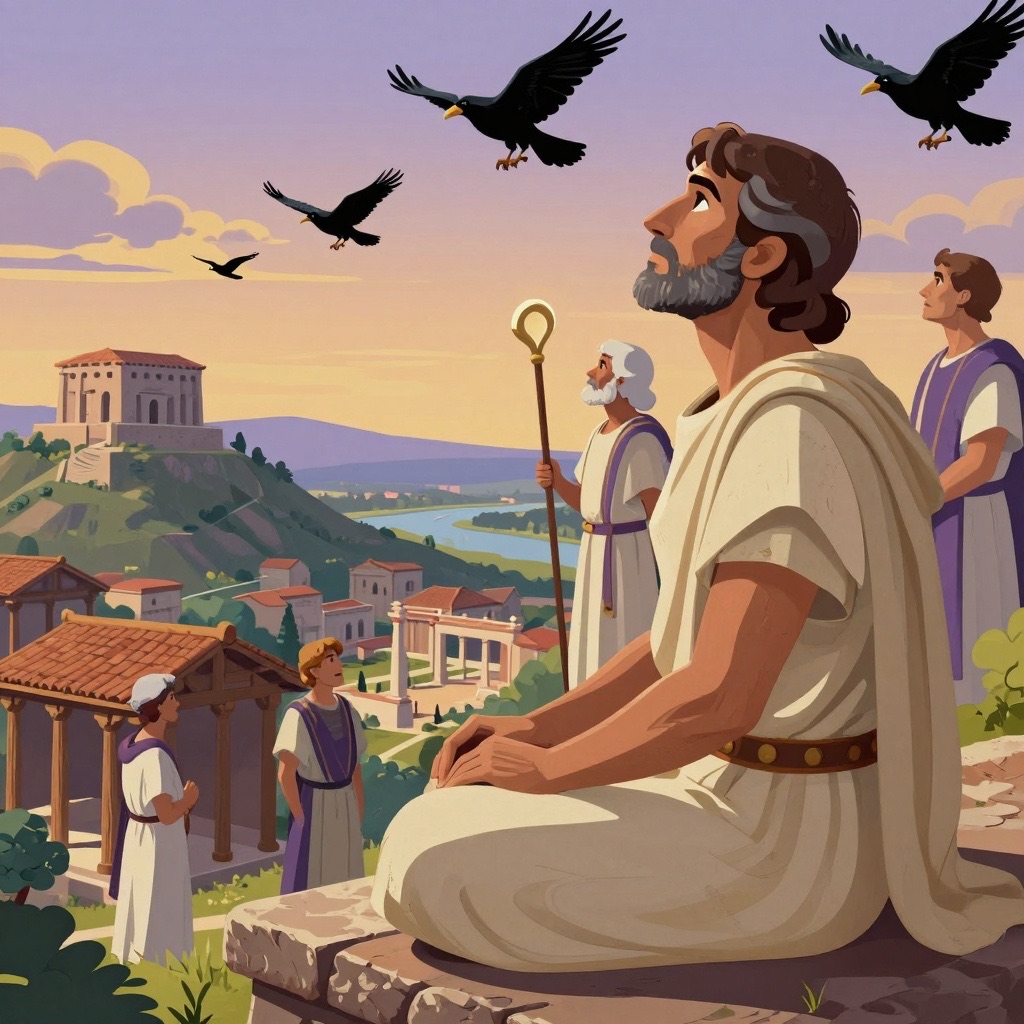
Numa finally agreed to consider the offer, but only on one condition: the gods themselves would have to approve. He demanded that the augurs, Rome's sacred priests who interpreted divine will through the flight of birds, conduct an official ceremony. If Jupiter remained silent, Numa would return to his scrolls and his solitude.
The delegation brought Numa to Rome's citadel at dawn. He sat on a stone seat while the augurs scanned the heavens, searching for omens in the movements of birds. The ceremony was called the inauguration, from which our modern word derives. Romans took such matters seriously. A king without divine approval was no king at all.
The birds flew from left to right, the auspicious direction. Jupiter, apparently, approved.
Forty-Three Years Without War
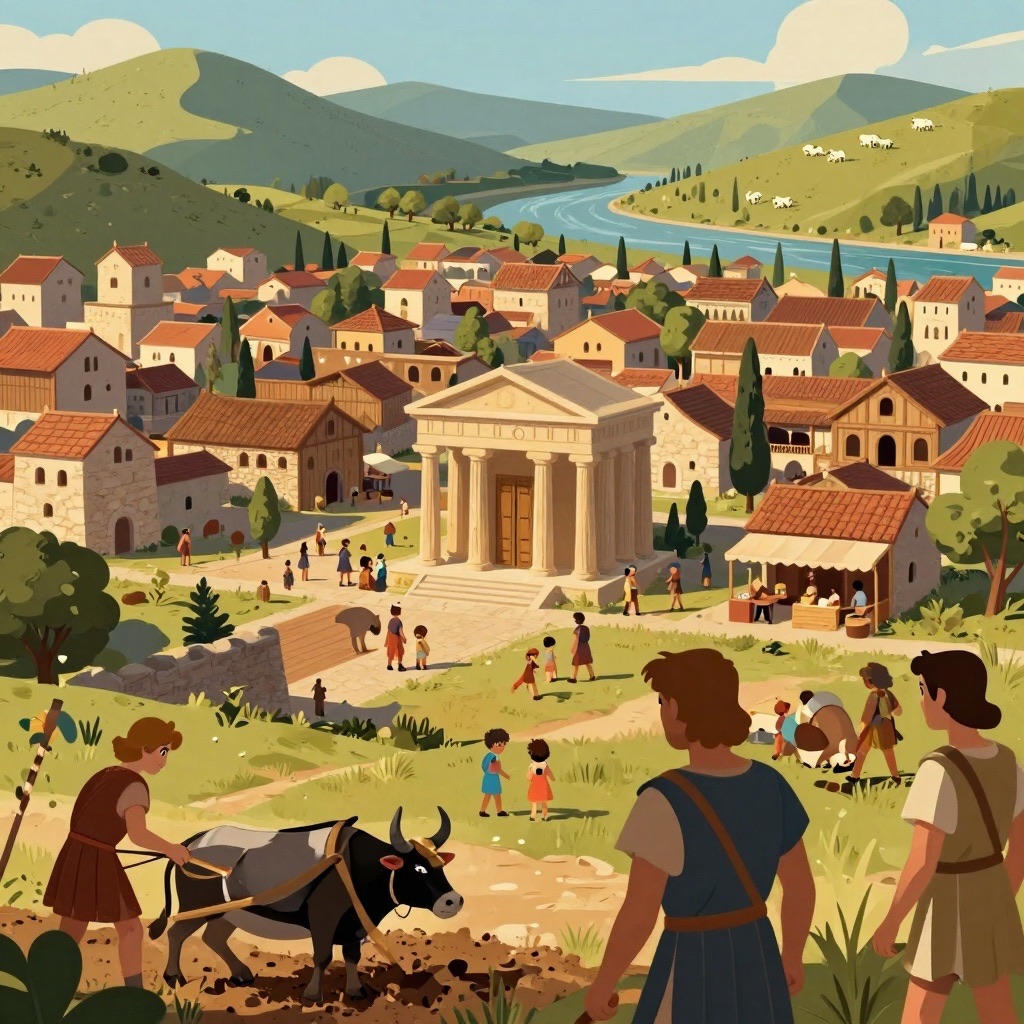
What followed was unlike anything Rome had experienced before or would experience for centuries afterward. Numa Pompilius ruled for roughly forty-three years, from 715 to 672 BCE, and in all that time, Rome did not fight a single war. The gates of the Temple of Janus, which Numa constructed to symbolize peace or war, remained closed for his entire reign.
This was not passive peacemaking. Numa actively transformed Rome from a rough settlement of warriors into something resembling a civilized state. He understood that the Romans who had flocked to Romulus's new city were, by and large, outcasts, refugees, and fugitives. They respected only strength. To change their behavior, Numa would have to change their minds.
His solution was religion. Not hollow rituals, but an intricate system of sacred laws, festivals, and priesthoods that bound every aspect of Roman life to divine authority. Break these rules, and you were not merely violating a law. You were breaking a covenant with the gods themselves.
The genius of Numa's approach: it gave Romans reasons beyond the sword to trust one another. Contracts were sacred. Oaths carried divine weight. The calendar itself became a tool of social cohesion, with designated days for business and days reserved for the gods, festivals that brought the community together in shared observance.
Building Rome's Religious Infrastructure
Numa's religious reforms shaped Roman civilization for over a thousand years. He organized the priesthoods into structured colleges, each with specific duties and domains. The flamines were priests dedicated to particular gods: the Flamen Dialis to Jupiter, the Flamen Martialis to Mars, the Flamen Quirinalis to Quirinus (the deified Romulus). These priests lived by strict taboos and regulations that set them apart from ordinary Romans.
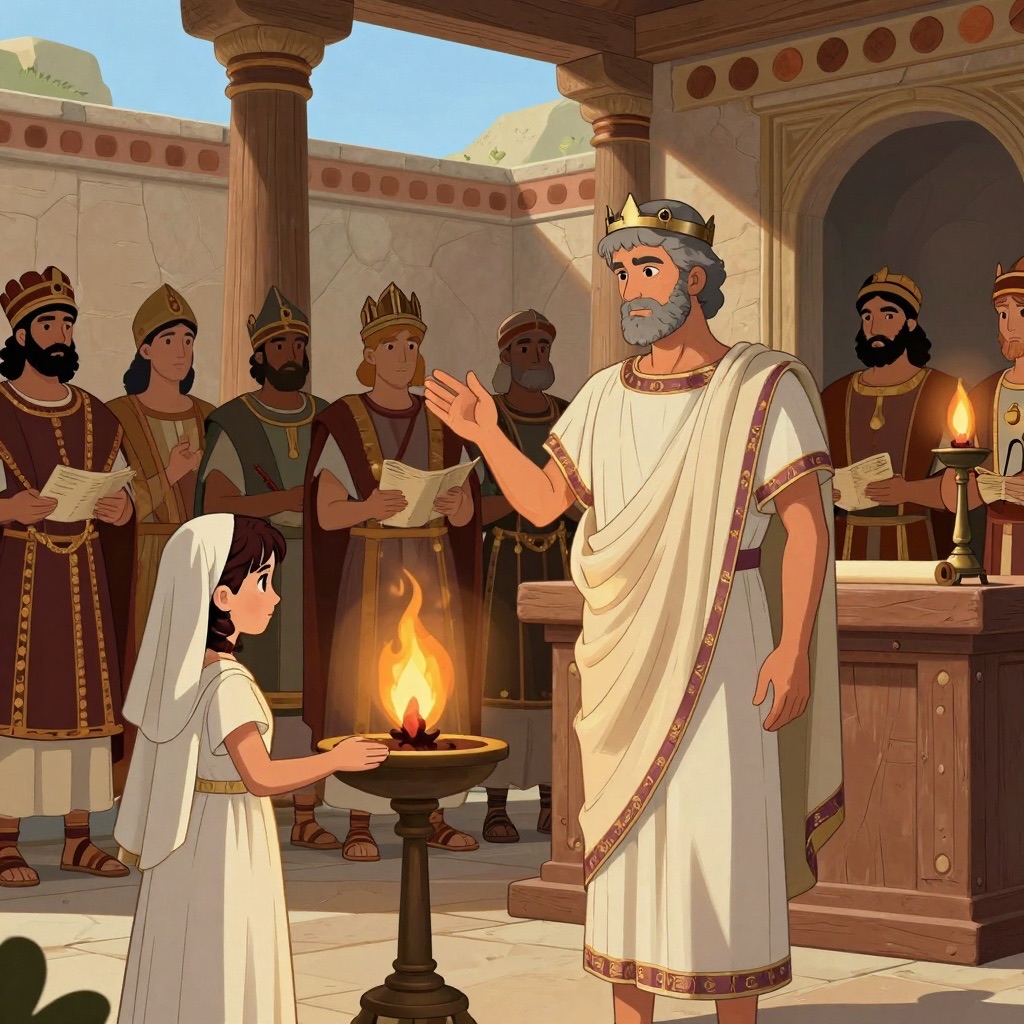
Most significantly, Numa established the Vestal Virgins in Rome. While the cult of Vesta may have had earlier origins in Alba Longa, where Romulus and Remus's mother Rhea Silvia had served as a Vestal, Numa formalized the institution in Rome. He built the first Temple of Vesta in the Forum and appointed the first pair of Vestals, later increasing their number to four. Later kings would eventually expand the college to six.
The Vestals tended the sacred flame that symbolized Rome's eternal life. They were chosen before puberty, served for thirty years, and enjoyed privileges granted to no other Roman women. In exchange, they maintained absolute chastity. A Vestal who broke her vow faced one of the most horrifying punishments in Roman law: burial alive, since spilling a Vestal's blood was forbidden.
Numa also established the pontiffs, a college of priests responsible for maintaining the sacred calendar, recording religious law, and advising on proper ritual. The head of this college, the pontifex maximus, would eventually become one of the most powerful religious offices in Rome. Centuries later, Julius Caesar would hold the title. It survives today in the Pope's designation as Supreme Pontiff.
Reforming Time Itself
Beyond religion, Numa reformed the Roman calendar. The original calendar attributed to Romulus had only ten months, beginning with March and leaving roughly sixty days of winter essentially uncounted. This agricultural calendar made a certain practical sense but left Rome's timekeeping hopelessly out of sync with the lunar and solar cycles.
Numa added two new months: Januarius (January) at the beginning of the year and Februarius (February) at the end. January was named after Janus, the two-faced god of beginnings and endings, doorways and transitions. February took its name from Februa, a Sabine purification festival. The choice was deliberate: Numa wanted the year to begin with peaceful Janus rather than warlike Mars.
The reformed calendar had 355 days, still slightly out of alignment with the solar year. To compensate, Numa instituted an intercalary month called Mercedonius, added every other year after February. This system would remain in use until Julius Caesar's more famous calendar reform in 46 BCE.
Numa also designated days as fasti (suitable for business and legal proceedings) or nefasti (forbidden for such activities). Religious festivals were interwoven throughout the year, creating a rhythm of work and worship that bound the community together. Romans who had been taught to trust only their swords now had a shared calendar, shared rituals, and shared obligations to the gods.
The Nymph in the Grove
Every night, according to Roman tradition, Numa walked alone into a sacred grove outside the city walls. He claimed to meet a divine being there: a nymph named Egeria, who served as his consort and counselor, whispering the laws of the gods into his ear.
Egeria was described variously as a water nymph or mountain nymph. Her sacred sites included a grove near the Porta Capena in Rome and another near Aricia in the Alban Hills, an area already associated with the worship of Diana. Whether Numa truly believed he communed with a divine being or whether Egeria was a political fiction designed to give his reforms the weight of divine authority, no one can say.
The Romans certainly believed the story, or at least found it useful to believe. Ovid's Metamorphoses describes Egeria dissolving into tears after Numa's death, transforming into the spring that still flowed near her sacred grove centuries later. The image of the philosopher-king receiving divine guidance in moonlit solitude became central to Numa's legend.
Modern scholars tend toward skepticism. The relationship between Numa and Egeria may have been a Roman invention to explain how a mortal man could have created such a comprehensive religious system. Or perhaps Numa himself invented Egeria, understanding that his people would more readily accept laws from the gods than from a fellow mortal. Either way, the story speaks to something essential about Numa's reign: he governed through persuasion and mystery rather than force.

A Death Without Violence
Numa Pompilius died around 672 BCE at roughly eighty years of age. The manner of his death set him apart from virtually every other figure in early Roman history: he died peacefully, in his bed, surrounded by mourners. No assassination. No coup. No suspicious circumstances.
The entire city mourned him. Plutarch records that his funeral was attended by Romans and Sabines alike, along with representatives from neighboring peoples who had come to respect Rome's peaceful king. His body was placed in one coffin, his sacred writings in another. According to later tradition, these writings were discovered in 181 BCE buried near his tomb, though scholars recognized them even then as probable forgeries.
His legacy was immediate. Numa had taken a rough settlement of warriors and given it the religious and cultural foundations that would carry it through centuries of expansion. The priesthoods he established, the festivals he created, and the calendar he reformed would outlast the Roman Kingdom, the Roman Republic, and even much of the Roman Empire. The Vestal Virgins he instituted would serve Rome for over a thousand years, until the Christian emperor Theodosius I extinguished their sacred flame in 394 CE.
The Peace That Could Not Last
But peace only lasts as long as the peacemaker. Numa's successor was a man named Tullus Hostilius, and even his name meant "hostile." Where Numa had been a philosopher, Tullus was a warrior. Where Numa had kept the Temple of Janus closed for forty-three years, Tullus threw open its doors almost immediately, plunging Rome into war with the neighboring city of Alba Longa.
The contrast was deliberate. Tullus reportedly criticized his predecessor's peaceful policies, arguing that they had made Rome soft. The Romans needed war to stay strong. Within a short time of taking the throne, Tullus had undone Numa's life's work.
The pattern would repeat throughout Roman history. After each period of devastating war, Romans would look back nostalgically to Numa's reign as a golden age of peace and piety. Augustus, after ending the civil wars that had torn the Republic apart, pointedly closed the Temple of Janus three times during his reign, a feat recorded on coins and monuments. He was consciously evoking Numa, the peaceful king who had turned Rome from a city of swords into something approaching civilization.
Yet the temple doors always opened again. Rome would become the greatest military power the ancient world had ever seen, conquering the Mediterranean and beyond. Numa's legacy was not that he ended Roman militarism, but that he gave it a moral framework, a set of religious and legal principles that Romans could invoke even as they conquered their neighbors. Treaties were sacred because Numa had made them so. Oaths bound because Numa had taught that the gods were watching.
The Historical Numa
Modern historians approach the traditional accounts of Numa with appropriate skepticism. The seven kings of Rome are, at best, legendary figures whose historical existence cannot be confirmed. The religious institutions attributed to Numa certainly did not spring fully formed from a single ruler's mind. They evolved over centuries, shaped by contact with Etruscans, Greeks, and other Mediterranean peoples.
The story that Numa studied with Pythagoras, for instance, was recognized as chronologically impossible even in antiquity. Pythagoras lived roughly two centuries after Numa's supposed reign. Similarly, the fourteen books of religious and philosophical law supposedly discovered in 181 BCE were clearly later fabrications.
Yet the figure of Numa served an important function in Roman historical memory. He represented the ideal of the philosopher-king, the ruler who governed through wisdom rather than violence. His legend reminded Romans that their civilization rested not merely on military might but on law, religion, and shared values. Whether or not a historical Numa actually lived, the Roman belief in his legacy shaped their understanding of what a good ruler should be.
The Temple of Janus stood in the Forum for centuries, its doors a constant reminder of Numa's impossible achievement. In all of Roman history, those doors were closed only a handful of times: once under Numa, once after the First Punic War in 241 BCE (and then only briefly before war with the Gauls reopened them), and three times under Augustus. Each closure was momentous enough to be recorded on coins and in the histories. Each reopening confirmed what Romans already knew: peace was precious, fragile, and rare. Numa had given them forty-three years of it. They would spend the next thousand years trying to recapture what he had built.
Frequently Asked Questions
1How long did Numa Pompilius reign as king of Rome?
According to Roman tradition, Numa ruled for roughly 43 years, from 715 to 672 BCE. His was the longest reign of any of the seven legendary kings of Rome, and it was marked by complete peace with no wars.
2What religious institutions did Numa Pompilius establish?
Numa established the Vestal Virgins in Rome, created the colleges of flamines (priests dedicated to specific gods) and pontiffs (keepers of sacred law), built the Temple of Janus, and organized the Roman religious calendar with its festivals and sacred days.
3Who was Egeria in Roman mythology?
Egeria was a water nymph who, according to legend, served as Numa's divine consort and counselor. Numa claimed to meet her nightly in a sacred grove outside Rome, where she whispered the laws of the gods to him. After his death, she supposedly dissolved into tears and became a spring.
4What did the Temple of Janus symbolize?
The Temple of Janus had doors that served as a physical representation of whether Rome was at peace or war. Closed doors meant peace; open doors meant Rome was engaged in military conflict. Under Numa, the doors remained closed for his entire 43-year reign.
5Why did Numa initially refuse to become king?
Numa was a philosopher who preferred studying divine law to ruling warriors. He pointed to the example of Romulus, who had killed his own brother, as proof that power corrupted. He only agreed to accept the kingship after the augurs confirmed that Jupiter approved through the flight of birds.
6How did Numa reform the Roman calendar?
Numa added two months, January and February, to the original ten-month Roman calendar. January was named after Janus, the god of beginnings, and February after a Sabine purification festival called Februa. He also designated days as suitable or unsuitable for business and established religious festivals throughout the year.
Experience Numa's Story
Hear the tale of Rome's peaceful king narrated by Lumo, the immortal wolf who watched Numa walk into that sacred grove night after night.


Listen to Related Stories
The King Who Said No
4 minAfter Romulus vanished, Rome went a whole year without a king...

Key Figures
Listen to the Full Story
Experience history through immersive audio lessons narrated by Lumo, your immortal wolf guide.