A Boy Inherits a War
The mummy of Seqenenre Tao tells a brutal story. Modern CT scans reveal five distinct wounds to the skull: two axe blows above the right eye, a spear thrust behind the left ear, a mace strike that shattered his cheekbone, and a final blow that cracked the base of his skull. His arms show no defensive wounds. They were probably bound or pinned when he died. This was either a battlefield execution or an assassination. Either way, Seqenenre Tao died violently around 1558 BCE, and his war died with him.
His son Kamose picked up the fight. For three furious years, Kamose threw himself against the Hyksos occupiers, pushing north from Thebes toward the enemy capital. The campaign was aggressive but ultimately failed. Kamose died around 1550 BCE. The records don't say how. Perhaps battle wounds caught up with him. Perhaps something else.
That left the youngest son: Ahmose. He was about ten years old when his brother died. His mother, Queen Ahhotep I, served as regent while he grew up. The war paused, but it didn't end.
The Strategic Pause
Here is what distinguished Ahmose from his father and brother: patience. Seqenenre Tao had charged into battle against enemies with superior military technology and died for it. Kamose followed the same pattern, attacking relentlessly until death stopped him. The family trait was courage. What it lacked was calculation.
Ahmose spent years rebuilding. The Hyksos had brought new military technology to Egypt: the horse-drawn chariot and the composite bow. These weapons gave the invaders a decisive tactical advantage in open battle. Egyptian infantry armed with bronze axes and simple bows couldn't match the speed and range of chariot-mounted archers firing composite bows.
Rather than charging against these advantages, Ahmose studied them. He built an Egyptian chariot corps. He trained archers in composite bow technique. He took the weapons that had killed his family and turned them into instruments of liberation. The Hyksos had taught Egypt how to fight a new kind of war. Ahmose was a fast learner.
The years of preparation also let his power base solidify. His mother Ahhotep I was no passive regent. Her burial included three golden flies, military decorations awarded for valor in combat. An inscription praises her for rallying troops and suppressing a rebellion in Upper Egypt. She was buried with military honors. The Theban royal family was fighting on multiple fronts, holding their territory together while preparing the army that would eventually march north.

Who Were the Hyksos?
The enemy Ahmose faced had ruled northern Egypt for over a century. The term Hyksos comes from the Egyptian phrase "heqa khasut," meaning "rulers of foreign lands." They were Semitic peoples, likely from the Levant, who had migrated into the Nile Delta region during the declining years of the Middle Kingdom.
The Hyksos takeover was gradual. For generations, foreign settlers had lived in the Delta as traders, mercenaries, and laborers. When Egypt's central government weakened during the Second Intermediate Period (roughly 1650-1550 BCE), these communities consolidated power. By the time the Theban pharaohs recognized the threat, the Hyksos controlled all of Lower Egypt from their fortress capital at Avaris.
The Hyksos adopted Egyptian royal titles and customs while keeping their distinct identity. They worshipped Set, the Egyptian god of chaos and foreigners, and built temples in a blend of Egyptian and Near Eastern styles. Archaeological digs at Avaris (modern Tell el-Dab'a) show a cosmopolitan city with Minoan frescoes, Canaanite pottery, and Egyptian administrative practices.
They weren't primitive raiders. They were a sophisticated foreign elite who had integrated into Egyptian systems while remaining culturally distinct. This made them harder to dislodge than simple invaders would have been. They had administrative infrastructure, economic networks, and a century of established rule.
The Fall of Avaris
The campaign against Avaris wasn't a single glorious battle. It was a grinding, multi-year siege with major assaults scattered across three years.
Ahmose's forces first had to secure Middle Egypt, dealing with local allies of the Hyksos and establishing supply lines for the northern campaign. The famous Rhind Mathematical Papyrus contains a daybook entry noting that Ahmose captured Tjaru, a border fortress, before advancing on Avaris itself. This methodical approach was characteristic of his campaign: secure the rear before pressing forward.
The siege of Avaris involved both naval and land operations. Egyptian forces attacked from the water, sailing up Nile channels to assault the fortress city. They also surrounded the city and cut it off from reinforcement. The assault required at least four major attempts over approximately three years before the walls finally fell around 1550 BCE.
Our main source for the campaign is the tomb autobiography of Ahmose, son of Ebana, a naval officer who fought under the pharaoh. His inscriptions describe fighting at Avaris, hand-to-hand combat in the canals around the city, and the taking of prisoners. He doesn't describe a quick victory. He describes sustained, difficult fighting that required repeated attempts.
When Avaris finally fell, Ahmose I had accomplished what two generations of his family had died attempting. The Hyksos capital was Egyptian again. But the pharaoh wasn't satisfied.
The Pursuit to Sharuhen
Most conquerors would have stopped at Avaris. The stated goal was achieved. Egypt was liberated. The foreign rulers were expelled. Time to go home and build victory monuments.
Ahmose I thought differently. The Hyksos retreating from Avaris fled northeast into Canaan, regrouping at the fortress city of Sharuhen (possibly modern Tell el-Ajjul in Gaza). A surviving Hyksos stronghold just beyond Egypt's borders was a threat waiting to return. Ahmose decided to eliminate it.
The siege of Sharuhen lasted three years. Three years outside a single city in foreign territory, maintaining supply lines back to Egypt, keeping an army fed and fighting far from home. This wasn't the impulsive charge of his father. This was strategic patience pushed to its extreme.
The logic was defensive: make sure the Hyksos could never come back. Egypt had learned a painful lesson about allowing foreign power centers to develop near its borders. By destroying Sharuhen, Ahmose was creating a buffer zone and sending a message to any neighboring power that might consider Egypt vulnerable.
When Sharuhen finally fell around 1547 BCE, the Hyksos threat was eliminated. A century of occupation was truly over. Egypt was reunified, and the pharaoh who accomplished this was still a young man with decades of rule ahead of him.
Securing the Southern Border
The Hyksos weren't Egypt's only concern. During the century of divided rule, Nubia to the south had developed its own power structures. The Nubian rulers had been Hyksos allies. They threatened Thebes from the south while the foreign dynasty controlled the north.
Ahmose conducted at least three campaigns in Nubia, pushing Egypt's effective border south and securing access to the gold mines that would fund the New Kingdom's building projects. He established a new administrative center at Buhen, a massive fortification complex that had existed since the Middle Kingdom but now became Egypt's headquarters for Nubian control.
The Nubian campaigns served multiple purposes: eliminating a potential threat, securing gold, and showing that the new unified Egypt could project power in all directions. Any neighbor who thought the century of division had permanently weakened Egypt was proven wrong.
Founding the 18th Dynasty
Ahmose I is traditionally counted as the founder of the 18th Dynasty, though technically he was continuing the Theban royal line of his father and brother. The distinction matters because the 18th Dynasty would become one of the most famous ruling families in human history.
The dynasty Ahmose founded would rule Egypt for about 250 years. Its roster of pharaohs reads like a greatest hits of ancient history: Hatshepsut, the female pharaoh who built Deir el-Bahri; Thutmose III, the "Napoleon of Egypt" who expanded the empire to its greatest extent; Akhenaten, the religious revolutionary who tried to impose monotheism; and Tutankhamun, the boy king whose intact tomb would captivate the modern world.
The New Kingdom that began with Ahmose's victory would be Egypt's most powerful and wealthy period. The great temples at Karnak and Luxor, the royal tombs of the Valley of the Kings, the artistic and literary achievements that define popular images of ancient Egypt today: all of this followed from the foundation Ahmose laid.
Administrative and Cultural Revival
Military victory was only the beginning. Ahmose I spent the rest of his reign rebuilding institutions that had decayed during the century of division.
He reorganized Egypt's administration, reestablishing central control over the nomes (provinces) that had operated semi-independently during the Hyksos period. Tax collection resumed under unified authority. Trade routes that had been disrupted by the division were reopened. Quarries and mines that had fallen idle were put back to work.
Major construction projects began. Ahmose commissioned work at the temple complex of Karnak, beginning what would become centuries of expansion by successive pharaohs. He built a cenotaph (memorial structure) at Abydos, the sacred site associated with Osiris. According to some sources, he constructed the last pyramid built by a native Egyptian ruler, though only the base of the structure survives today.
The artistic and cultural achievements of the early New Kingdom show a society eager to reclaim its identity after foreign occupation. Craftsmen who had worked under Hyksos patronage now produced work celebrating Egyptian themes. New royal inscriptions proclaimed the restoration of Ma'at, cosmic order.
Glass-making may have developed during Ahmose's reign. The oldest intentionally crafted glass objects appear in early 18th Dynasty contexts.
The Role of Royal Women
The liberation war wasn't a male-only achievement. The royal women of Ahmose's family played major roles in both the fighting and the transition to peace.
Queen Ahhotep I, Ahmose's mother, received extraordinary honors for her service during the wars. Her burial included three golden flies, military decorations awarded for valor in combat. An inscription praises her for rallying troops, suppressing rebellion, and caring for Egypt during the conflict. This wasn't honorary language: she probably commanded forces or exercised significant military authority during her regency.
Ahmose-Nefertari, who was both Ahmose's sister and his Great Royal Wife (royal incest was common in Egyptian dynasties to preserve bloodline purity), wielded substantial power during and after his reign. She held the title "God's Wife of Amun," a position that would become one of the most powerful in Egypt. After her death, she was deified and worshipped as a goddess.
The prominence of royal women in the early 18th Dynasty set a pattern that would eventually produce Hatshepsut, who ruled as pharaoh in her own right a few generations later.
Death and Mummy Discovery
Ahmose I died around 1525 BCE after a reign of about 25 years. The cause of death is unknown. He was probably in his mid-thirties.
His mummy wasn't found in his original tomb. Like most New Kingdom royal mummies, it was moved in antiquity by priests trying to protect the remains from tomb robbers. In 1881, the mummy was discovered in the Deir el-Bahri cache, a hidden tomb in the cliffs above the mortuary temple that Hatshepsut would build a century later. The cache contained dozens of royal mummies, gathered together for protection during a period of systematic tomb robbery.
Modern analysis of the mummy shows a man who died in his thirties. He was about five feet six inches tall, average for Egyptian men of his era. His teeth show the wear common to ancient Egyptians who ate bread contaminated with sand from the grinding stones.
What Ahmose Taught Egypt
The century of Hyksos occupation changed Egyptian foreign policy. Before the Second Intermediate Period, Egypt had been relatively isolationist. It exploited Nubian resources and traded with neighbors but wasn't particularly interested in territorial expansion beyond its natural borders.
After Ahmose, Egypt became an empire. The lesson of the Hyksos was clear: passive borders invite encroachment. Foreign settlements become foreign power centers. Neighbors who seem harmless today might dominate you tomorrow.
The New Kingdom pharaohs responded with aggressive expansion. Thutmose I pushed Egypt's borders to the Euphrates River. Thutmose III conducted seventeen military campaigns to maintain and extend the empire. Ramesses II fought the Hittites for control of the Levant. Egyptian garrisons, administrators, and tribute collectors spread across a vast territory.
This imperial project lasted for centuries and defined what we now think of as ancient Egypt at its peak. The monuments, the wealth, the cultural achievements that make Egypt one of the most studied ancient civilizations all trace back to the security that imperial expansion was supposed to provide.
And it all started with one young pharaoh who watched his father and brother die, waited until he was ready, and then finished what they'd started.
What Happened Next
Ahmose I's expulsion of the Hyksos was one of the earliest documented successful liberation wars. A colonized people drove out their occupiers through military force combined with strategic patience.
The adoption and mastery of enemy technology that characterized Ahmose's campaign would be repeated throughout military history. Armies that learn from their enemies often prove more dangerous than those that simply oppose them. Ahmose didn't just fight the Hyksos; he studied them, adopted their weapons, and turned their advantages against them.
The multi-generational nature of the struggle also carries a lesson. Seqenenre Tao started something he couldn't finish. Kamose continued it and died. Ahmose completed it. Not every war ends with the person who started it.
For Egypt, Ahmose proved that civilization could survive occupation and come out the other side. A century of foreign rule didn't destroy Egyptian culture; it temporarily suppressed it. When the opportunity came, Egyptian identity reasserted itself.
The New Kingdom would last longer than the Hyksos occupation that preceded it. The dynasty Ahmose founded would produce some of history's most famous rulers. The precedents he established would shape Egyptian policy for centuries.
All of it began with a ten-year-old boy inheriting a war.
Frequently Asked Questions
1How long did the Hyksos rule Egypt?
The Hyksos controlled Lower Egypt for about 100 years, from roughly 1650 BCE to 1550 BCE. They ruled from their capital at Avaris in the Nile Delta while the native Egyptian Theban dynasty maintained control of Upper Egypt. Ahmose I's expulsion of the Hyksos ended this period of division known as the Second Intermediate Period.
2What military technology did the Egyptians adopt from the Hyksos?
The two most significant technologies were the horse-drawn chariot and the composite bow. The chariot gave armies unprecedented mobility and speed, while the composite bow, made of layers of wood, horn, and sinew, had greater range and power than simple wooden bows. The Egyptians mastered both technologies and used them to defeat their former occupiers.
3How long did Ahmose I besiege Sharuhen?
The siege of Sharuhen lasted about three years, from roughly 1550-1547 BCE. This extended siege in Canaan demonstrated Ahmose's strategic patience and his determination to eliminate the Hyksos threat completely rather than simply driving them from Egyptian territory.
4What dynasty did Ahmose I found?
Ahmose I founded the 18th Dynasty, which would rule Egypt for about 250 years and produce famous pharaohs including Hatshepsut, Thutmose III, Akhenaten, and Tutankhamun. The 18th Dynasty began the New Kingdom period, often considered ancient Egypt's golden age.
5Was Ahmose I's mummy ever found?
Yes, Ahmose I's mummy was discovered in 1881 in the Deir el-Bahri cache, a hidden tomb containing dozens of royal mummies that priests had relocated in antiquity to protect them from tomb robbers. The mummy is now in the Egyptian Museum in Cairo.
Experience the Liberation of Egypt
Follow the war for Egyptian freedom from Seqenenre Tao's violent death to Ahmose's final victory, narrated by Lumo.


Listen to Related Stories
The Liberator
4 minHe finished what his father died trying to do.

Listen to the Full Story
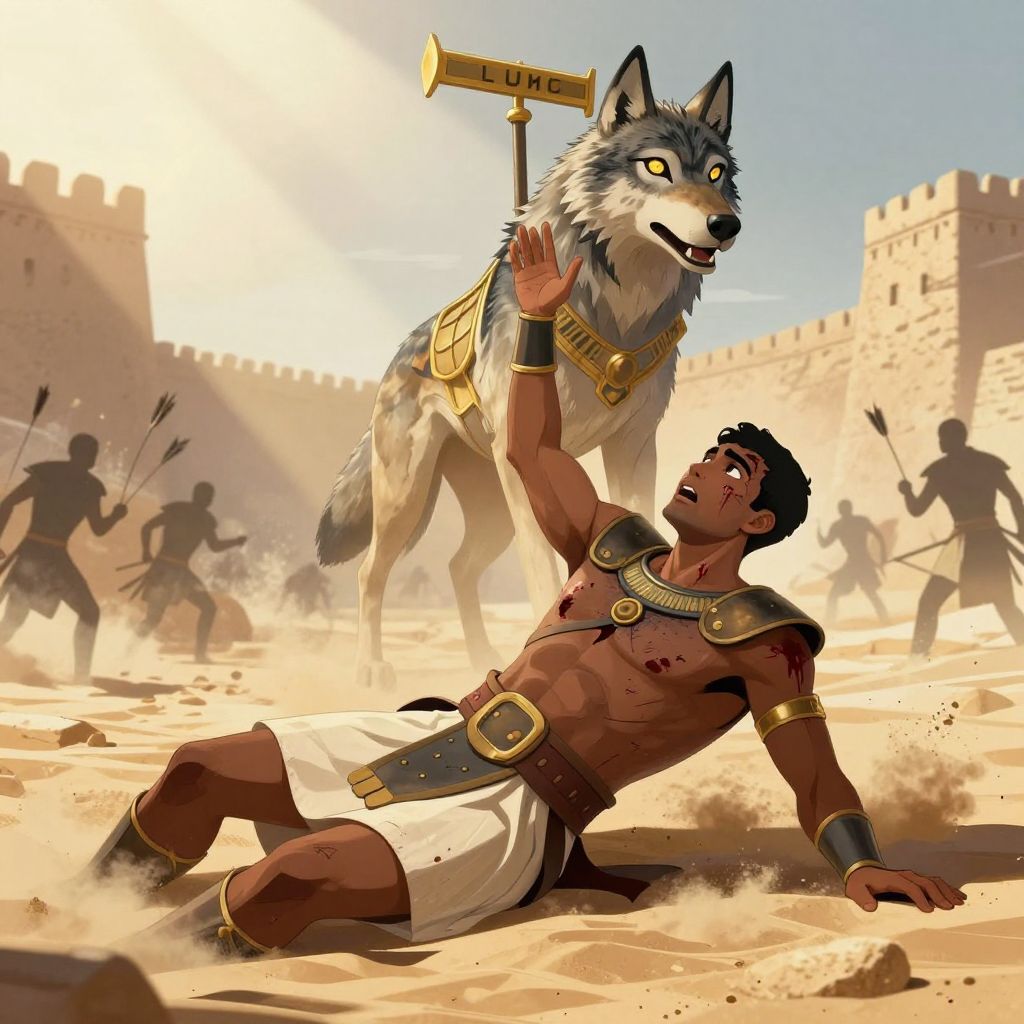
Experience history through immersive audio lessons narrated by Lumo, your immortal wolf guide.