The pharaoh's skull tells the story. Five distinct wounds, inflicted by different weapons. An axe blow to the forehead. Another to the right eye. A third cracked open the left cheek. Two more strikes from behind crushed the base of his skull. His hands were bound when he died.
Seqenenre Tao's mummified remains, discovered in the 1880s and examined by CT scan in 2021, preserve the moment Egypt went to war with itself. The pharaoh of Thebes had challenged the foreign kings who occupied the Nile Delta. The Hyksos rulers responded with brutal clarity. They didn't just defeat him in battle. They executed him.
But revolutions don't die with their leaders. Seqenenre's sons finished what their father started. His death sparked one of history's first wars of national liberation — a conflict that would reshape Egypt and birth an empire that dominated the ancient world for five centuries.
This is the story of Egypt. Conquest and rebellion. Female pharaohs and military genius. Erasure and the memory that survived it. Three thousand years that refused to end.
The Foundation: Old Kingdom and Divine Architecture (c. 2686-2181 BCE)
Before Egypt built an empire, it built the impossible.
The Old Kingdom pharaohs decided that mortality was negotiable. If flesh decayed, then stone would preserve. If death was inevitable, then ritual and monument could defeat it. The pyramids at Giza weren't tombs — they were resurrection machines, engineered according to religious texts that mapped the journey from death to divine rebirth.
Djoser's Step Pyramid came first around 2630 BCE, designed by Imhotep — architect, physician, and priest who became so legendary that later generations worshiped him as a god. Six massive steps ascending toward the heavens, a physical stairway for the pharaoh's soul to climb toward the sun god Ra.
Then came the experiments. Pharaohs pushed architectural limits, testing angles and weights. The Bent Pyramid at Dahshur demonstrates the trial-and-error engineering: the builders changed the angle mid-construction when they realized the original slope was too steep and the structure was compressing under its own weight. Another pyramid collapsed entirely during construction. They were iterating toward perfection.
Finally, Khufu achieved it. The Great Pyramid — 2.3 million limestone blocks, some weighing fifteen tons, fitted with tolerances of less than a millimeter. The exterior was originally covered in polished white limestone that reflected sunlight, making the structure visible from miles away. At 481 feet tall, it was the tallest man-made structure on Earth for 3,800 years.
And contrary to centuries of assumption, the workers weren't slaves. Recent archaeological excavations of worker villages near the pyramids reveal a different story: skilled laborers who rotated in seasonal shifts during the Nile flood months when farmland was underwater. They were paid in food — enough to feed themselves and their families. They received medical care; we've found mummies with healed fractures, evidence of successful orthopedic surgery. They built these monuments because they believed in resurrection, in the divine order that guaranteed cosmic stability if the pharaoh successfully reached the afterlife.
The Old Kingdom collapsed when that cosmic order failed. Seven consecutive years of low Nile floods between 2200-2150 BCE brought famine. Food reserves depleted. Provincial governors who had once paid tribute to Memphis declared independence. The central government fractured into competing power centers. Egypt broke apart for over a century — a period later texts called "the time when the land was destroyed."
Reunion and the Rise of the Middle Kingdom (c. 2055-1650 BCE)
Mentuhotep II reunited Egypt by force, reconquering the breakaway provinces one by one over a twenty-year military campaign. The Middle Kingdom pharaohs who followed were different from their Old Kingdom predecessors — less obsessed with building larger pyramids, more focused on practical governance, irrigation engineering, and fortification.
They pushed Egypt's borders south into Nubia, building a chain of massive mud-brick fortresses along the Nile's Second Cataract that still stand today. These weren't decorative monuments; they were functional military installations controlling trade routes and gold mines. The fortress at Buhen had walls over thirty feet high and sixteen feet thick, with towers, moats, and drawbridges.
Literature flourished. "The Tale of Sinuhe" — the story of an Egyptian official who flees to Syria after a political crisis, then spends his life longing to return home to be buried in Egyptian soil — became a classic that scribes copied for centuries. Medical papyri from this era document surgical procedures, prescriptions, and diagnostic techniques. The bureaucracy expanded and specialized; we have thousands of administrative documents recording everything from tax receipts to labor rosters to letters complaining about lazy workers.
But the Middle Kingdom made a fatal error. They allowed foreign traders and mercenaries to settle in the Nile Delta, particularly around the port city of Avaris. These were mostly Canaanite and Asiatic peoples looking for economic opportunity. At first, it was just merchant communities. Then extended families. Then entire settlements with their own governors.
When central authority weakened again around 1650 BCE — possibly due to another period of low Nile floods, possibly weak pharaohs, the historical record is unclear — one of those foreign settlement groups saw an opportunity.
The Hyksos didn't invade Egypt. They were already inside. They seized power.
Occupation: The Hyksos Period and the Seeds of Empire (c. 1650-1550 BCE)
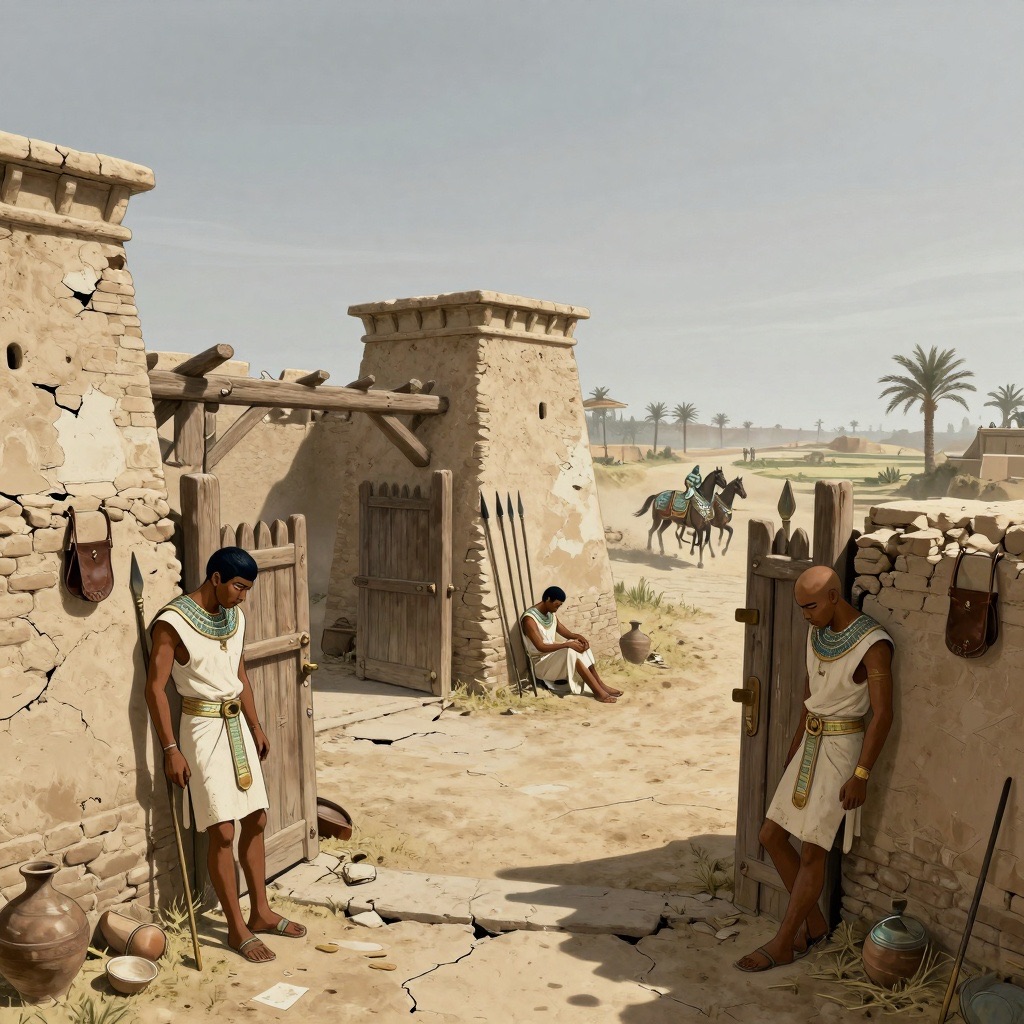
For over a century, Egypt was divided. The Hyksos controlled the north from their fortified capital at Avaris in the Nile Delta. They ruled as foreign kings, keeping Egyptian administrative structures but importing their own gods, particularly Baal and Astarte. They brought military innovations Egypt had never seen: composite bows, improved bronze weapons, and most importantly, the horse-drawn chariot.
In the south, the native Egyptian pharaohs of Thebes maintained a shrunken kingdom in Upper Egypt. They paid tribute to the Hyksos. They sent gifts north to acknowledge the foreign kings as overlords. They waited.
The historical record preserves fragments of the tension. The Quarrel of Apophis and Seqenenre records an incident where the Hyksos king sent a messenger to Thebes complaining that the hippopotamuses in the Theban sacred pool were "making too much noise" and keeping him awake — despite the fact that Avaris was several hundred miles away. It was provocation, a test to see how much humiliation the southern pharaohs would accept.
Seqenenre Tao refused the insult. He went to war.
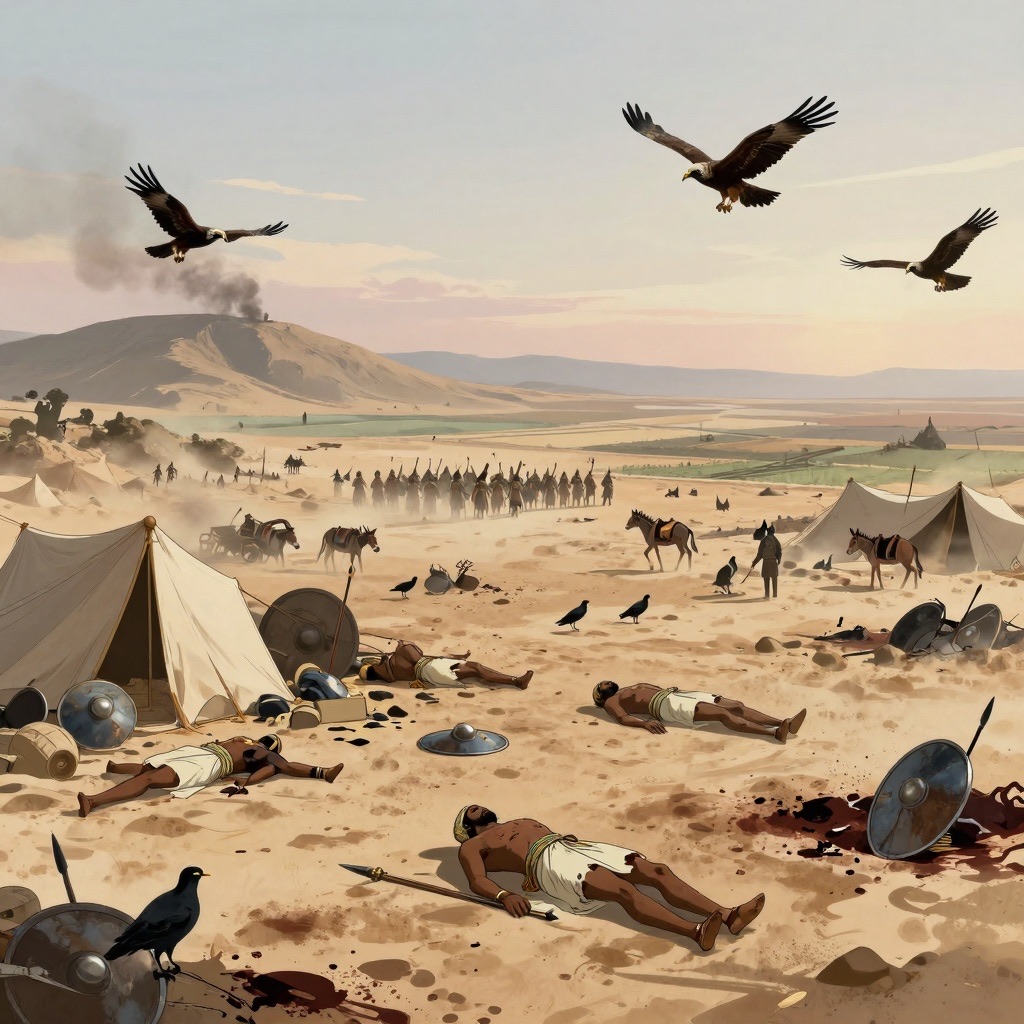
His mummy tells us he lost. Five axe wounds to the skull, inflicted with Hyksos weapons. His body was poorly mummified — rushed, done in the field rather than in proper temple facilities. He probably died in battle or was executed shortly after capture. His rebellion appeared to have failed.
But his sons continued the fight. Kamose, Seqenenre's eldest son, took up the war and pushed north, recapturing Egyptian territory and coming within striking distance of Avaris itself. When he died — possibly in battle, the circumstances are unclear — the war passed to his younger brother.
Ahmose I finished it. He besieged Avaris, starved it out, captured it, and then pursued the retreating Hyksos all the way to Sharuhen in Canaan, where he besieged them for three more years to ensure they could never threaten Egypt again. The liberation was complete.
But Egypt learned something from the occupation: never again. Never again would foreign powers be allowed to settle within Egypt's borders and accumulate power. Never again would Egypt wait passively while threats emerged. Egyptian foreign policy turned aggressively expansionist. Control neighboring territories before they can threaten you. Strike first. Build an empire to create a buffer zone.
The New Kingdom was born from trauma and revenge.
The Woman Who Claimed the Throne (c. 1479-1458 BCE)
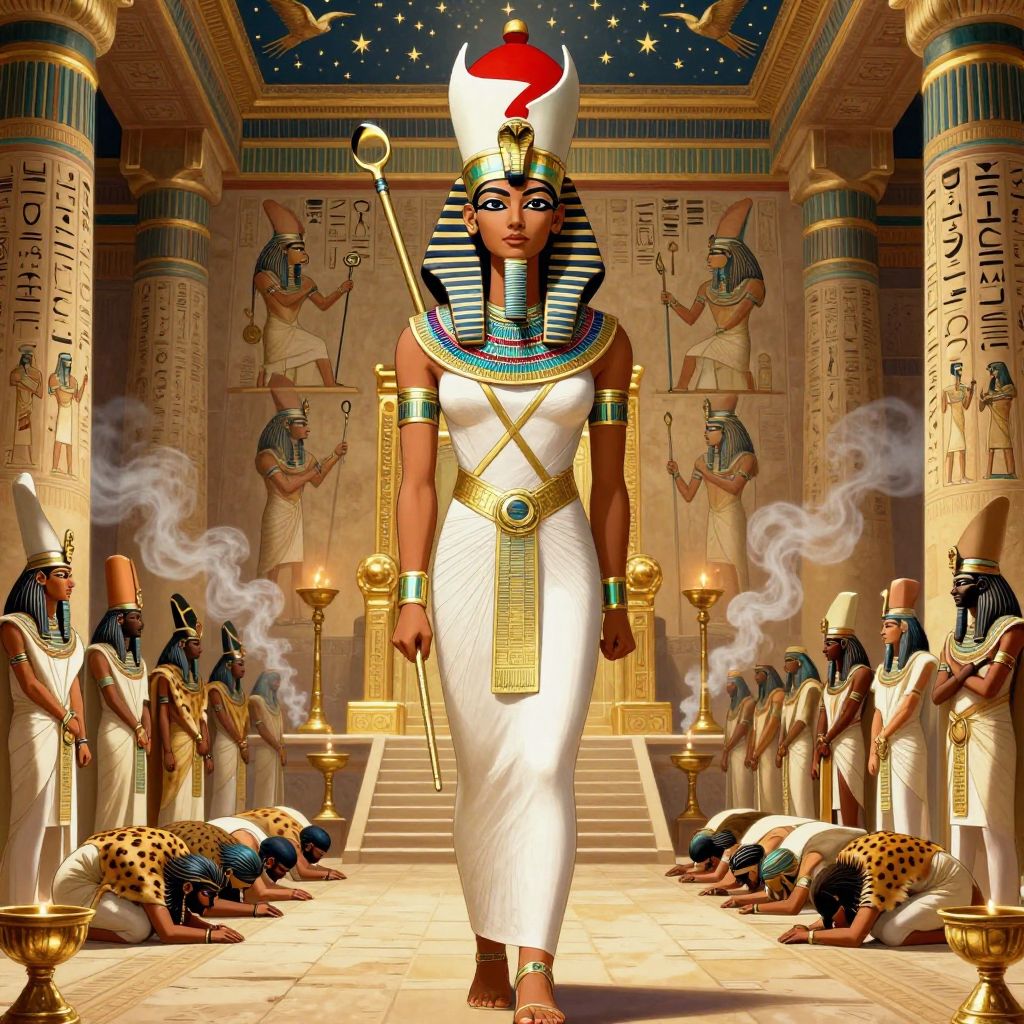
Hatshepsut was not supposed to rule. She was supposed to be regent — a placeholder managing the kingdom while her stepson, the child pharaoh Thutmose III, grew old enough to take power himself.
Instead, she claimed the throne.
She didn't call herself queen. The Egyptian language didn't have a word for "female pharaoh" because the concept was contradictory — pharaoh was a male office, connected to the masculine god Horus. So Hatshepsut adopted male titles, male grammatical forms, and eventually male presentation. She wore the false beard. She appeared in reliefs with a male body. She commissioned propaganda claiming she was the daughter of the god Amun himself, conceived when Amun took the form of her father Thutmose I and visited her mother's bedchamber.
The theological justification was elaborate. She claimed that before her birth, Amun had announced to the divine council: "I will unite all lands and all countries under her feet." She commissioned scenes showing her divine conception and birth on the walls of her mortuary temple at Deir el-Bahri. She had priests proclaim her legitimacy in ceremonies across Egypt.
And it worked. She ruled for twenty-two years.
Her reign was prosperous. She organized a massive trade expedition to the Land of Punt (probably modern Somalia or Yemen), the first in centuries. Ships returned laden with exotic goods: myrrh trees, ebony, ivory, gold, aromatic resins, live animals. She had the entire expedition documented in detailed reliefs at Deir el-Bahri, including scenes of the Puntite queen, who was depicted with such anatomical precision that modern doctors have diagnosed her with steatopygia.
Building projects rose across Egypt. Two great obelisks at Karnak — one still stands today, nearly a hundred feet tall, carved from a single piece of red granite. The mortuary temple at Deir el-Bahri, carved into the cliff face in three ascending terraces, one of the architectural marvels of ancient Egypt. Temples, monuments, inscriptions bearing her name and titles.
Then she died, probably around 1458 BCE. Thutmose III finally became sole pharaoh after more than two decades of waiting.
Twenty years later, someone decided Hatshepsut shouldn't exist.
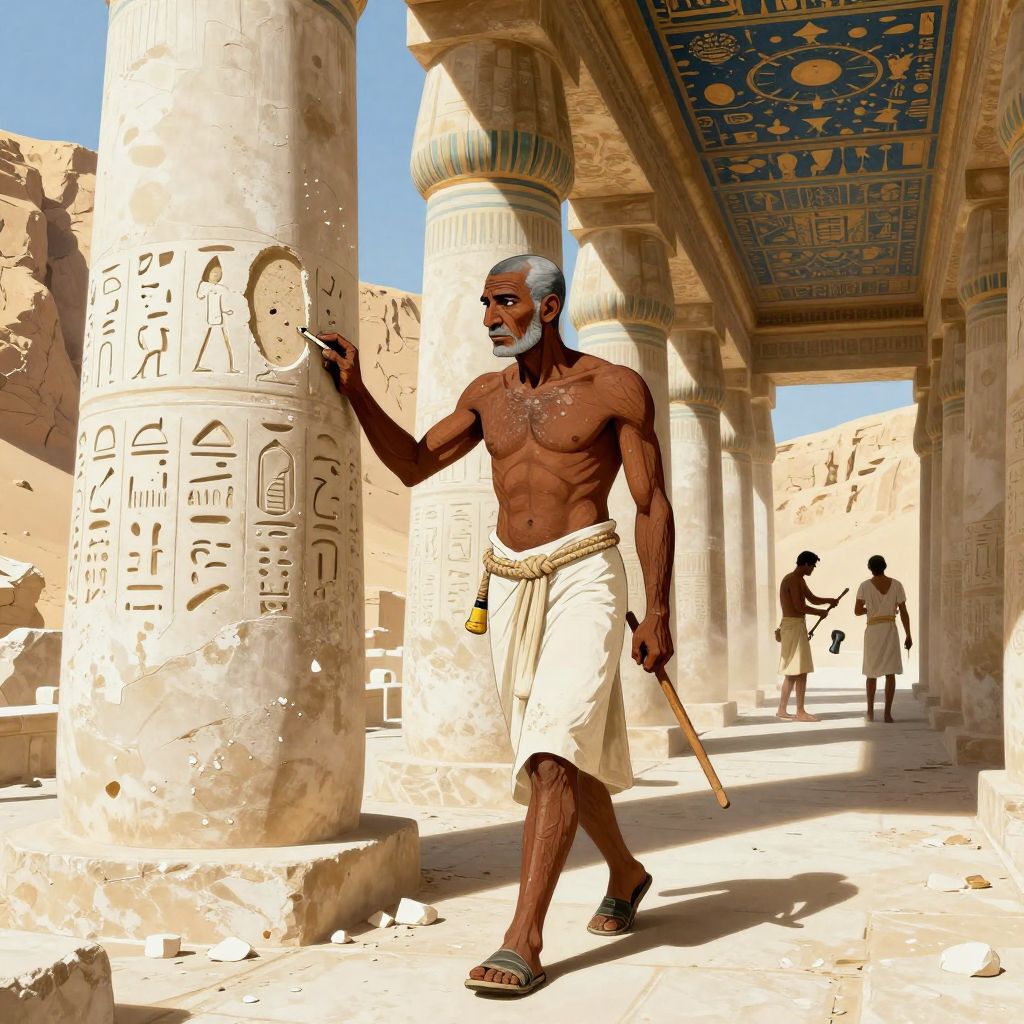
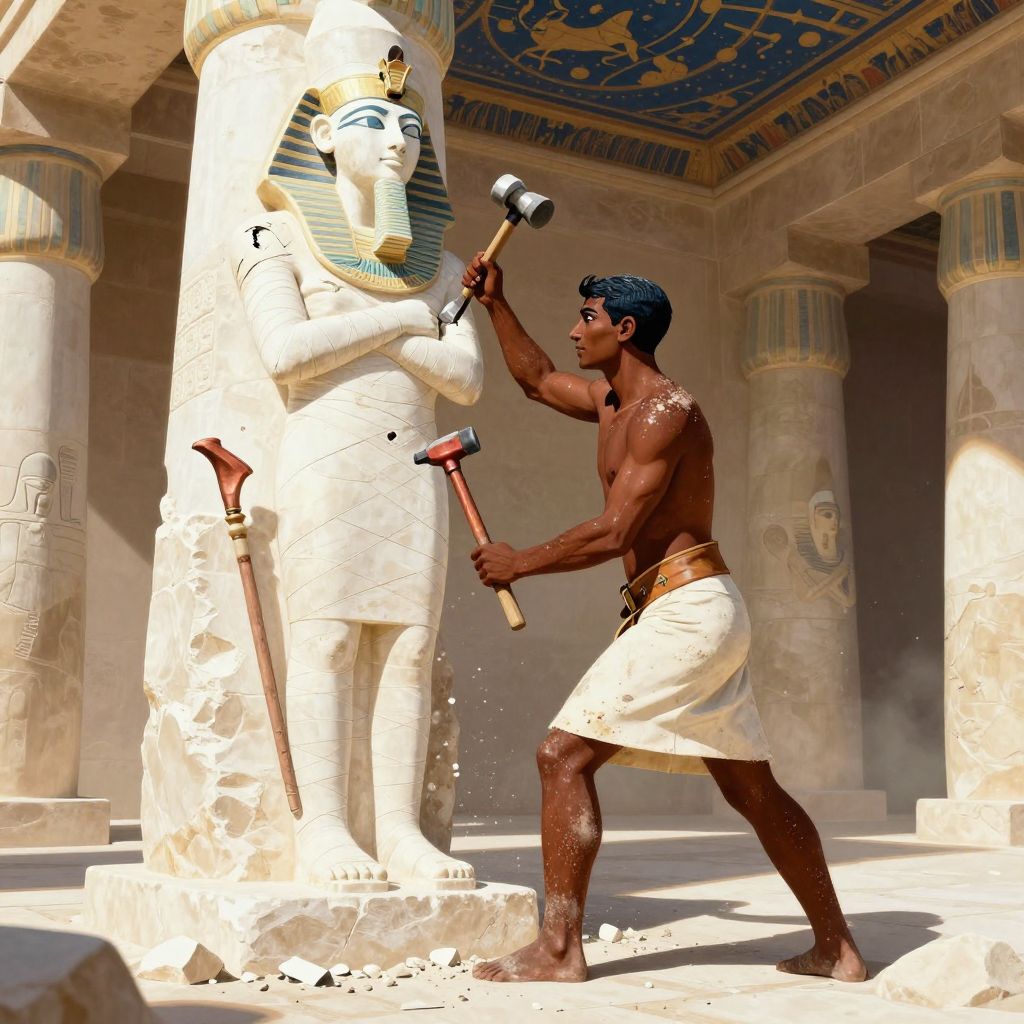
The erasure was methodical. Workers with chisels arrived at monuments across Egypt. They removed her name from cartouches, replacing it with the names of earlier pharaohs. They chiseled away her face from statues and reliefs. They destroyed images of her in royal regalia and references to her divine birth.
This wasn't vandalism. It was murder.
In Egyptian belief, the afterlife depended on the preservation of one's name and image. When someone died, their ka (life force) needed to recognize itself in statues, paintings, and inscriptions to survive. Destroying someone's name and image destroyed their ability to exist in the afterlife. You killed their soul.
Who ordered it? The timing points to Thutmose III, but the motives remain debated. Maybe it was political: near the end of his reign, Thutmose needed to secure his son's succession and couldn't risk the precedent of a female pharaoh being used to justify another woman claiming the throne. Maybe it was personal revenge, decades-delayed anger at being excluded from power. Or maybe it was about legitimacy — by erasing Hatshepsut, Thutmose could present an unbroken line of male succession from his grandfather Thutmose I directly to himself.
Whatever the motive, the erasure failed. Her temple still stands. Her obelisks still tower over Karnak. Her mummy was identified in 2007. We know her name. We know her story. The stone outlasted the chisels.
The Napoleon of Egypt (c. 1479-1425 BCE)
Thutmose III waited twenty-two years for his chance to rule. When Hatshepsut died, he exploded.
He launched the first military campaign within months of becoming sole ruler. Then a second. Then a third. By the end of his reign, he had conducted seventeen separate campaigns, expanding Egypt's empire to its greatest extent: from the Fourth Cataract of the Nile in Nubia to the Euphrates River in Syria. He conquered over 350 cities.
The Battle of Megiddo in his first campaign demonstrated his tactical brilliance — and his willingness to gamble.
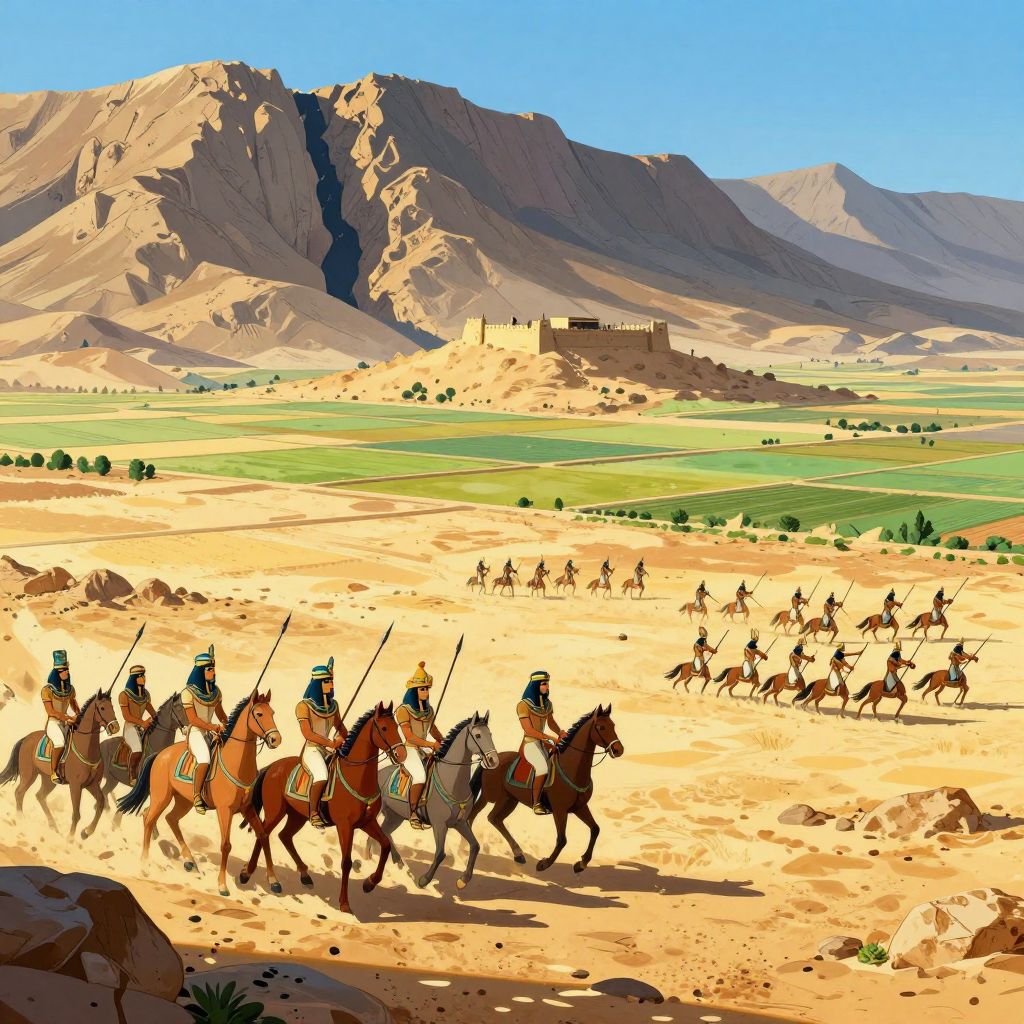
A coalition of Canaanite city-states led by the King of Kadesh had assembled near the fortress city of Megiddo, blocking Egyptian expansion into the Levant. Thutmose marched north with his army. When he reached the mountain ridge south of Megiddo, his generals presented him with three possible routes: two wide roads that circled around to approach Megiddo from safe directions, and a narrow mountain pass called Aruna that led directly to the city.
The Aruna pass was dangerous. So narrow that the army would have to march single-file for hours. If the enemy was waiting at the exit, the Egyptian army would emerge from the pass one soldier at a time and be slaughtered before they could form battle lines. Every general advised against it.
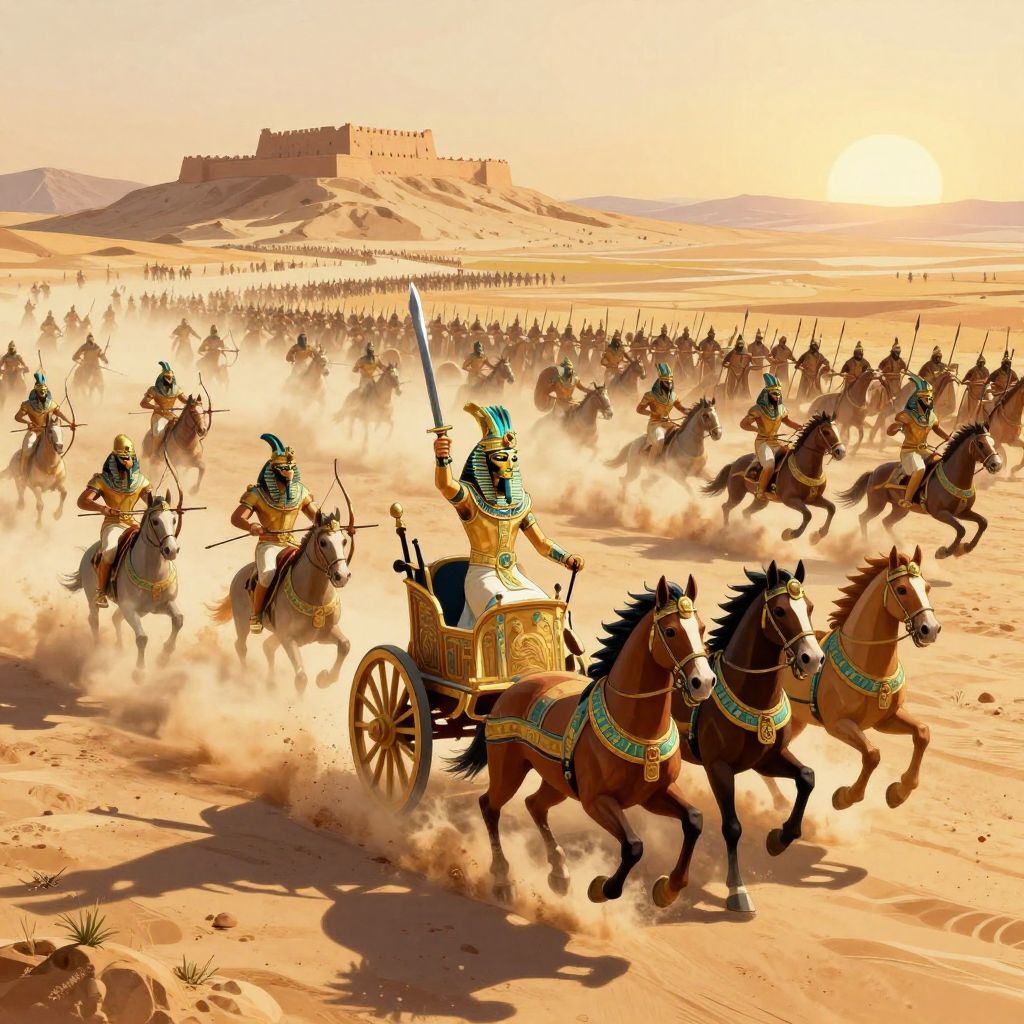
Thutmose chose Aruna. His reasoning: the enemy expected him to take one of the safer routes. They would position their armies there. The narrow pass would be unguarded because no rational commander would risk it.
He was right. The Canaanite coalition had split their forces to cover the two safer approaches. When the Egyptian army emerged from Aruna, they found themselves in perfect position to attack Megiddo from the south — exactly where the enemy didn't expect them.
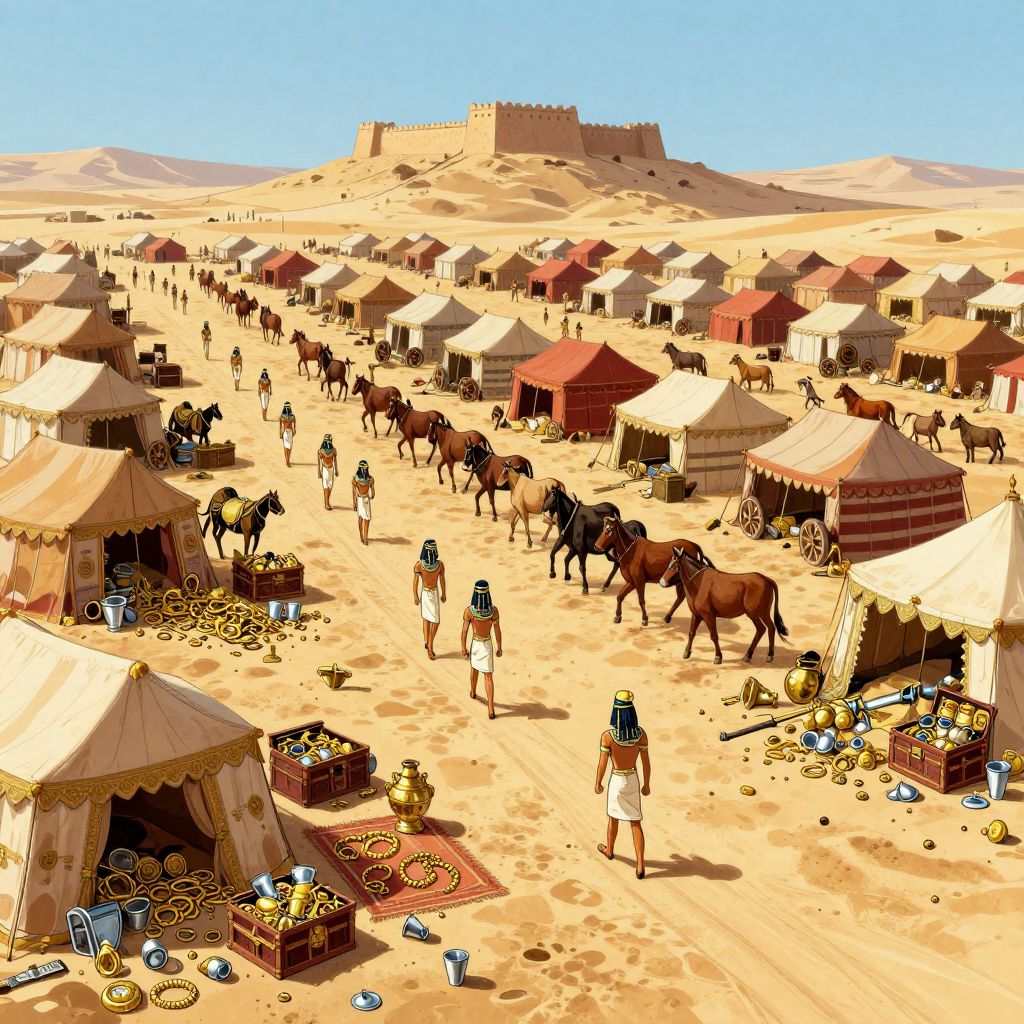
The battle itself was devastating. Egyptian chariots broke the Canaanite formations. The coalition army fled back to Megiddo. The city gates were closed — the garrison feared the Egyptians would pour in with the retreating soldiers — so the fleeing troops had to be hauled up the walls with ropes made from clothing.
Thutmose besieged the city for seven months. When Megiddo finally surrendered, he captured the entire coalition leadership, hundreds of chariots, thousands of horses, and secured Egypt's dominance over the Levant for generations.
The Annals of Thutmose III, carved on the walls of the Temple of Amun at Karnak, preserve detailed records of his campaigns. Lists of captured cities. Counts of prisoners and plunder. Descriptions of battles and sieges. The Egyptian word for "annals" literally means "that which really happened." Whether that's accuracy or just clever branding, we'll never know for certain.
Modern historians call Thutmose III "the Napoleon of Egypt" — and given that he conquered more territory, held it longer, and never suffered the equivalent of Waterloo, he probably deserved the comparison more than Napoleon did.
The Heretic Pharaoh and the Boy King (c. 1353-1323 BCE)
Akhenaten tried to erase three thousand years of religion in a single generation.
He declared that all the old gods — Amun, Ra, Osiris, Isis, Horus, Thoth, all of them — were false. There was only one deity: the Aten, the sun disk. Not the sun god Ra, but the physical sun itself, the disk visible in the sky. He closed the temples of the traditional gods. He defunded the priesthood. He moved the capital from Thebes to a brand new city he built in the middle of nowhere: Akhetaten, "Horizon of the Aten," modern Tell el-Amarna.
Priests whose families had served Amun for generations watched their temples closed, their incomes cut, their religious texts declared heretical. Artisans who had carved images of Osiris and Anubis were ordered to depict only the Aten, shown as a sun disk with rays ending in hands, offering the ankh symbol of life to Akhenaten and his queen Nefertiti.
Why? The reasons remain debated. Maybe it was theological conviction — Akhenaten genuinely believed in monotheism. Maybe it was political — an attempt to break the power of the Amun priesthood, which had accumulated enormous wealth and influence. Or maybe it was pragmatic: the traditional gods hadn't prevented the chaos and military setbacks of recent decades, so perhaps a new god would restore divine favor.
Whatever his motives, the revolution was deeply unpopular. Provincial governors, city leaders, and common people continued worshiping the old gods privately. The economy suffered because so much of it had been structured around temple administration. Foreign territories in Syria and Canaan, seeing Egypt distracted by internal religious turmoil, rebelled or allied with Egypt's enemies.
When Akhenaten died around 1336 BCE, Egypt couldn't restore the old order fast enough. His successor — possibly his son, possibly his younger brother, the evidence is ambiguous — was a child named Tutankhaten, "Living Image of the Aten." Within a few years, the boy pharaoh changed his name to Tutankhamun, "Living Image of Amun." The capital moved back to Thebes. The temples reopened. The priesthood was restored. Akhenaten's city was abandoned; people dismantled their houses and took the materials with them when they left.
Tutankhamun's reign lasted about ten years. He died around age nineteen, possibly from a leg infection that turned septic, possibly from complications of malaria, possibly from a combination of both. His reign was unremarkable — most decisions were probably made by his advisors, particularly the elderly courtier Ay and the general Horemheb.
What made Tutankhamun famous was dying young and being forgotten quickly enough that tomb robbers never found his burial. When Howard Carter opened that sealed door in the Valley of the Kings in 1922 and saw "wonderful things" — gold everywhere, furniture, chariots, jewelry, four nested coffins including one of solid gold — he had found the only royal tomb that survived ancient robbery essentially intact.
The treasures in Tutankhamun's relatively minor tomb suggest what must have been buried with great pharaohs like Thutmose III or Ramesses II before the robberies. We'll never know. Their tombs were plundered in antiquity, their mummies unwrapped and destroyed by thieves searching for amulets and jewelry buried with the body.
The Age of Monuments (c. 1279-1213 BCE)
Ramesses II ruled for sixty-six years and spent every one of them ensuring nobody would ever forget his name.
He carved it on everything. Temple walls. Statues. Obelisks. He added inscriptions to monuments built by earlier pharaohs, essentially claiming credit for their construction. He built more monuments than any pharaoh in Egyptian history: Abu Simbel with its four sixty-foot statues of himself; the Ramesseum, his enormous mortuary temple; massive additions to Karnak, Luxor, and temples across Egypt and Nubia.
The Battle of Kadesh in 1274 BCE became the centerpiece of his propaganda. Ramesses led his army north into Syria to contest Hittite control of the region. Near the city of Kadesh, he fell into an ambush. The Hittites had hidden a large force beyond the city. When Ramesses arrived with the first division of his army, the Hittites attacked from behind and surrounded him. He was cut off from the rest of his forces, vastly outnumbered, facing imminent capture or death.
According to the Egyptian accounts — which Ramesses had carved on temple walls across Egypt in what's been called the world's first propaganda campaign — he single-handedly turned the tide of battle. He charged into the Hittite army with superhuman valor, scattering enemies like chaff, until reinforcements arrived and the Hittites retreated.
The Hittite version of events, preserved in cuneiform archives, tells a different story: they ambushed the Egyptians, inflicted heavy casualties, and Ramesses barely escaped with his life. The battle was a stalemate or possibly a Hittite victory.
But facts mattered less than narrative. Ramesses controlled the story. He presented Kadesh as his greatest triumph, and for three thousand years, that was the version history remembered — until archaeologists in the 19th century discovered the Hittite records and realized Egyptian royal inscriptions might not be entirely reliable historical sources.
Ramesses fathered over a hundred children with his many wives and concubines. He outlived his first twelve heirs. By the time he died in his early nineties, he had become a living legend, a pharaoh who ruled longer than most Egyptians' lifetimes. His successor, Merenptah, was already elderly when he inherited the throne.
Some scholars identify Ramesses II as the pharaoh of the Exodus story in the Bible, though there is no Egyptian record of the events described in Exodus, and archaeological evidence of massive Israelite populations in Egypt during this period is absent. If the Exodus occurred, Egyptian records — which documented military campaigns, construction projects, and administrative details with obsessive precision — say nothing about the loss of a large slave population or the destruction of an army pursuing them.
The Long Decline (c. 1200-332 BCE)
Egypt didn't fall all at once. It eroded.
Around 1200 BCE, the Bronze Age Collapse devastated the eastern Mediterranean. The Sea Peoples — raiders of uncertain origin, possibly displaced populations from failing civilizations — destroyed empires across the region. The Hittites fell. Mycenaean Greece collapsed. Ugarit burned. Canaanite city-states were annihilated.
Egypt survived, but barely. Ramesses III fought off multiple invasions by the Sea Peoples in land and naval battles. But the cost was enormous. The economy strained under military expenditures. Trade networks that had sustained Egyptian prosperity for centuries collapsed when trading partners ceased to exist.
The New Kingdom ended not with conquest but with fragmentation. Central authority weakened. Provincial governors became independent rulers. Libyans settled in the western Delta and eventually their leaders claimed the Egyptian throne. Nubian kings from the south conquered Egypt and ruled as the Twenty-Fifth Dynasty, presenting themselves as restorers of proper Egyptian tradition.
The Assyrians invaded in 671 BCE, sacking Memphis, and in 663 BCE Ashurbanipal's forces reached Thebes itself, carrying off two tall obelisks to Assyria. The Persians conquered Egypt in 525 BCE, ruling it as a province until native Egyptian rulers briefly regained independence, then lost it again.
Egypt remained ancient, wealthy, and culturally influential. But it was no longer the dominant power in the Mediterranean. That role passed to younger empires: Assyria, Persia, Greece, Rome.
The Ptolemies and the Final Queen (332-30 BCE)
When Alexander the Great arrived in Egypt in 332 BCE, Egyptians welcomed him as a liberator from Persian rule. He visited the Oracle of Amun at the Siwa Oasis in the western desert, where the priests allegedly proclaimed him the son of Amun — exactly the kind of divine endorsement Egyptian pharaohs had claimed for millennia.
Alexander died nine years later in Babylon. His generals divided his empire among themselves. Ptolemy I Soter took Egypt and founded a dynasty that would rule for three centuries.
The Ptolemies were Greek. They spoke Greek at court. They practiced Greek customs. They married each other — brothers to sisters, uncles to nieces — to keep power and wealth within the family, creating a family tree that's notoriously tangled and difficult to chart.
But they presented themselves as Egyptian pharaohs to the native population. Temple reliefs show them in traditional Egyptian style, wearing the double crown, making offerings to Osiris and Amun and the other ancient gods. They funded temple construction and restoration across Egypt. They maintained the fiction of being legitimate successors to three thousand years of pharaonic tradition while simultaneously running Egypt as a Hellenistic kingdom.
After three centuries of Ptolemaic rule, the dynasty produced one final remarkable figure: Cleopatra VII.
She spoke nine languages, including Egyptian — the first Ptolemy in three hundred years to bother learning the language of the people they ruled. She was brilliant and politically astute. She understood that Egypt's survival depended on navigating the growing power of Rome.
She allied with Julius Caesar, bearing him a son (Caesarion) and traveling to Rome as Caesar's guest. When Caesar was assassinated, she returned to Egypt and later formed an alliance with Mark Antony, one of the three men fighting for control of the Roman Republic. She bore Antony three children. Together they claimed to be building a new Hellenistic empire in the East.
Octavian — Caesar's adopted heir, the future Emperor Augustus — saw Antony's alliance with Cleopatra as a threat to Roman interests and his own power. He declared war.
The Battle of Actium in 31 BCE was a naval disaster. Antony and Cleopatra's fleet was defeated. They fled back to Egypt. Octavian followed. When his armies reached Alexandria in 30 BCE, Antony received false news that Cleopatra had committed suicide. He fell on his sword. Cleopatra, finding Antony dying, had him brought to her and held him as he died.
Then she chose her own death. The famous story says she used an asp — a small venomous snake, sacred to Egyptian royalty. Modern scholars debate whether that's true or just romantic myth. What matters is that she denied Octavian the chance to parade her through Rome in chains as a captured queen.
Egypt became a Roman province. Three thousand years of pharaohs ended not with a dramatic battle but with a bureaucratic transfer of administration from Ptolemaic to Roman control.
What Survived

Three thousand years of continuous civilization. No other ancient culture comes close. When the Greeks built the Parthenon, the Great Pyramid was already two thousand years old. When Rome fell, Egyptian hieroglyphic inscriptions were still being carved.
Egypt developed a writing system that recorded everything. Hieroglyphics for monumental inscriptions. Hieratic for everyday writing. Demotic for administrative documents. Religious texts, medical procedures, love poetry, tax receipts — all preserved. The Ebers Papyrus, a medical text from around 1550 BCE, describes surgical procedures, prescriptions for various ailments, and diagnostic techniques that Greek and Roman doctors borrowed centuries later.
Egyptian mathematics was sophisticated enough to survey flooded farmland every year with precision, calculate the volumes of pyramids, and solve geometric problems. The Rhind Mathematical Papyrus shows solutions to equations involving fractions, areas, and volumes.
The concept of the afterlife was so developed it required instruction manuals. The Book of the Dead wasn't a single text but a collection of spells, prayers, maps, and instructions for navigating the underworld, defeating demons, and passing judgment before Osiris. Families bought customized versions for their dead, with the deceased's name inserted into the spell texts.
Egyptian art developed conventions that lasted millennia. The profile view with the eye shown frontally. Important figures drawn larger than subordinates. Narrative scenes arranged in registers, read like comic strips from bottom to top. These weren't failures of perspective. They were deliberate choices that prioritized clarity over naturalism.
And the understanding that what you build matters. That stone outlasts flesh. That names carved deep enough might survive attempts to destroy them.
When workers tried to erase Hatshepsut from history, they failed. Her temple still stands. Her obelisks still tower over Karnak. Her name survived.
When Ahmose I liberated Egypt from Hyksos occupation, he founded a dynasty that would create the greatest empire the ancient world had yet seen. Thutmose III, waiting decades for his turn to rule, proved himself one of history's greatest military commanders at the Battle of Megiddo.
The pyramids still stand. The temples still rise from the sand. The mummies still rest in museums around the world, their names preserved across millennia. Seqenenre Tao's skull still shows the wounds that killed him thirty-five centuries ago.
Egypt proved that civilizations can endure. Not forever — nothing is forever — but longer than empires, longer than languages, longer than religions. Three thousand years of continuous culture, surviving invasion, occupation, internal collapse, and foreign rule. Time reduced contemporary civilizations to scattered ruins and forgotten languages. Egypt kept going.
The Nile still floods, though the Aswan Dam controls it now. The sun still rises over the desert. And somewhere in the sand, there are monuments we haven't found yet, names we haven't read, stories we haven't heard.
Egypt endures.
Explore Ancient Egypt
From the Hyksos invasion to Hatshepsut's erasure, experience Egypt's three thousand years of triumph and tragedy through interactive lessons with Lumo, your immortal guide.


Explore Ancient Egypt
The Hyksos Invasion: When Foreign Kings Ruled Egypt
For over a century, foreign rulers called the Hyksos controlled northern Egypt from their fortress capital at Avaris. They brought horses, chariots, and bronze weapons that changed warfare forever. Driving them out took three generations of Egyptian pharaohs.
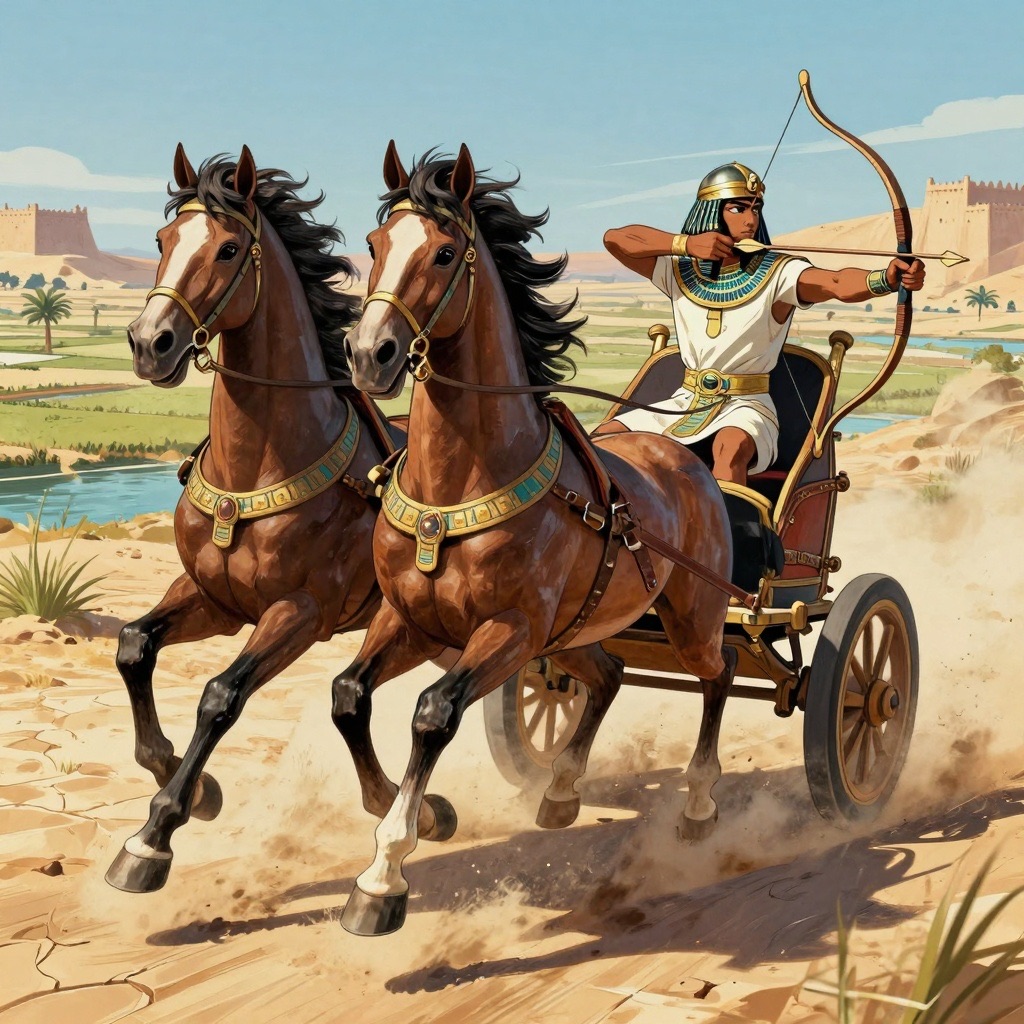
Ahmose I: The Pharaoh Who Drove Out the Hyksos and Founded Egypt's Golden Age
Around 1550 BCE, a young pharaoh named Ahmose I completed what his father and brother died trying to achieve. He expelled the Hyksos invaders, reunified Egypt, and founded the 18th Dynasty. The New Kingdom had begun.
Hatshepsut: The Woman Who Became King
For 22 years, Hatshepsut ruled Egypt as pharaoh—not queen. She wore the false beard, took the throne name Maatkare, and built monuments that still stand. Twenty years after her death, someone tried to erase her from history entirely.
Hatshepsut's Rise to Power: How a Regent Became Pharaoh
In 1479 BCE, Hatshepsut was supposed to keep the throne warm for a child king. Seven years later, she wore the double crown herself. Here's how a royal widow rewrote the rules of Egyptian kingship.
The Erasure of Hatshepsut: When Egypt Tried to Kill a Soul
Twenty years after Hatshepsut died, workers arrived at her monuments with chisels. They weren't just removing her name from history — in Egyptian belief, they were destroying her chance at eternal life.
Battle of Megiddo (1457 BCE): History's First Documented Battle
Thutmose III's decisive victory at Megiddo established Egyptian dominance in the Near East and gave us history's first detailed battle records. Learn about the daring mountain pass gamble that caught the Canaanite coalition off guard.
Experience Ancient Egypt Through Audio
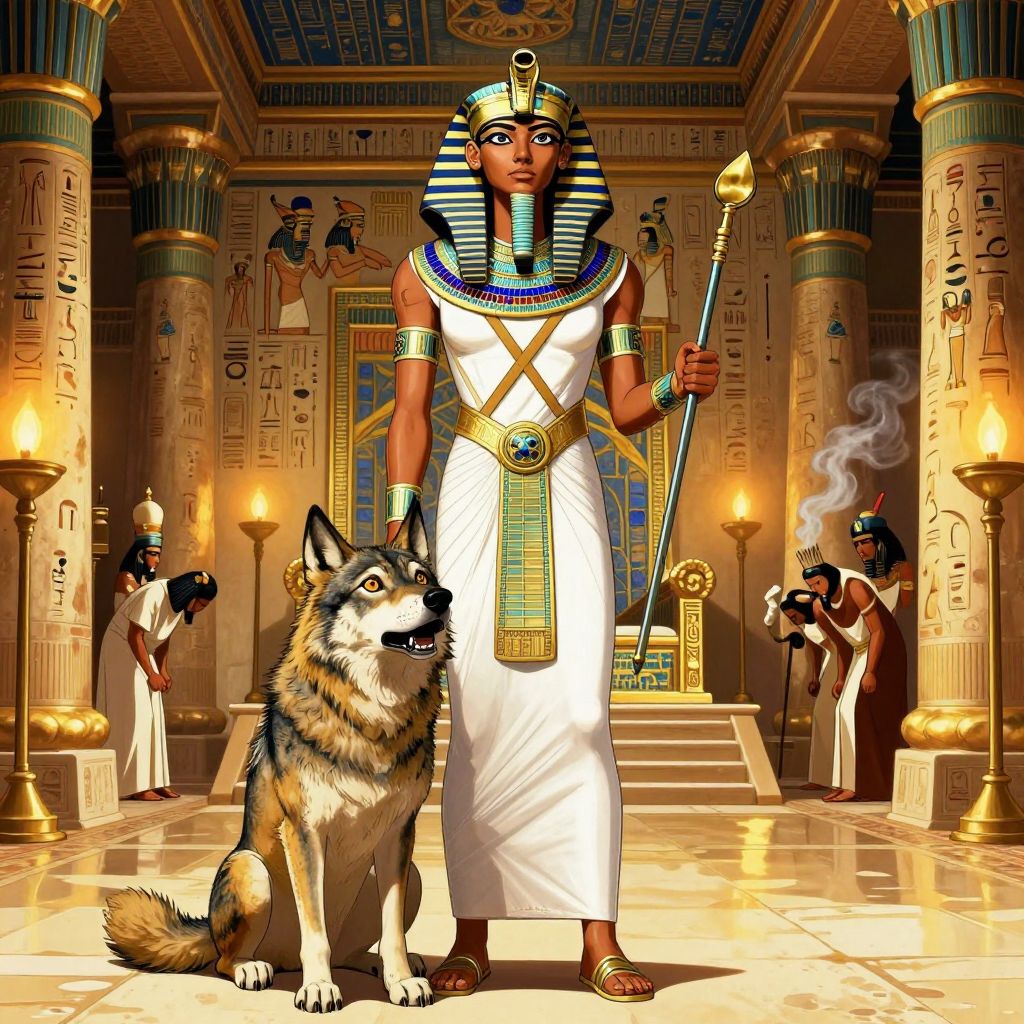
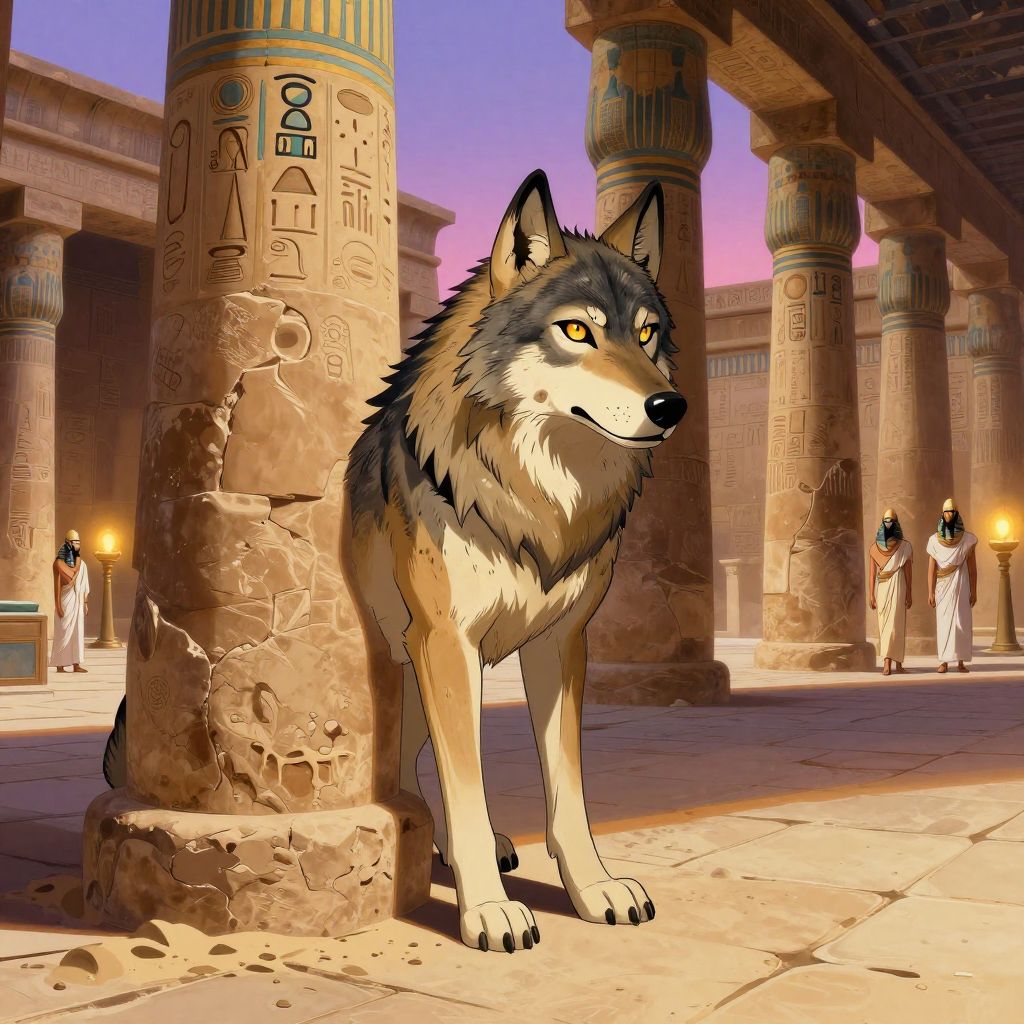
Go beyond articles. Listen to dramatic stories from Ancient Egypt narrated by Lumo, your immortal wolf guide.