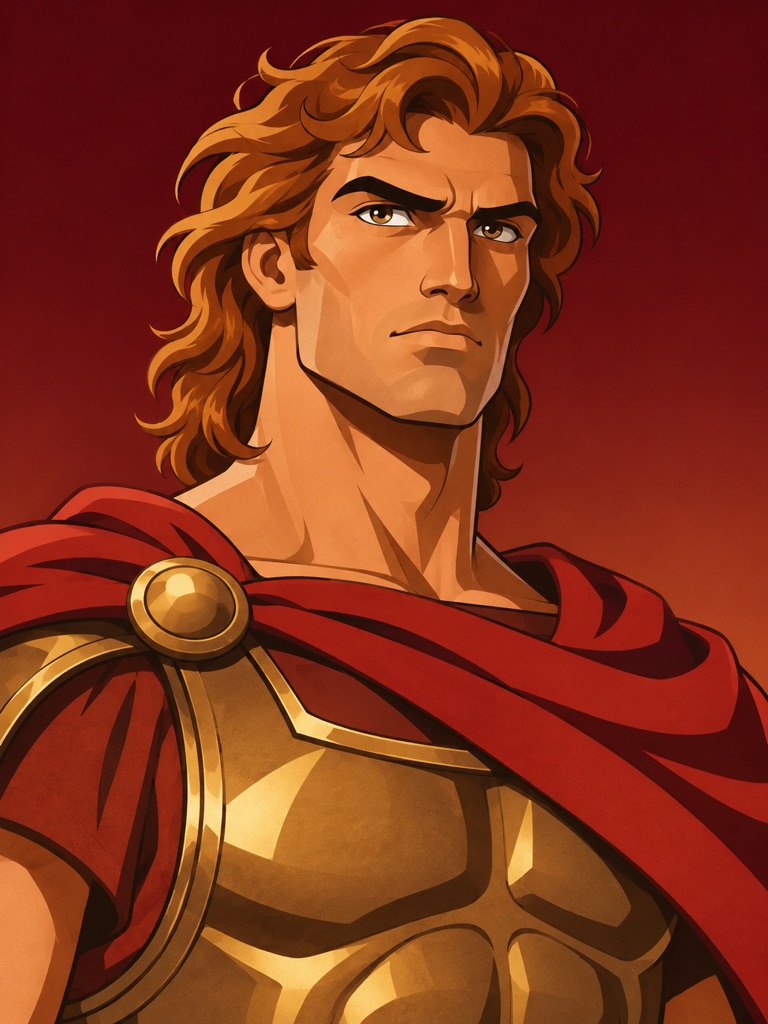
Achilles in Brief
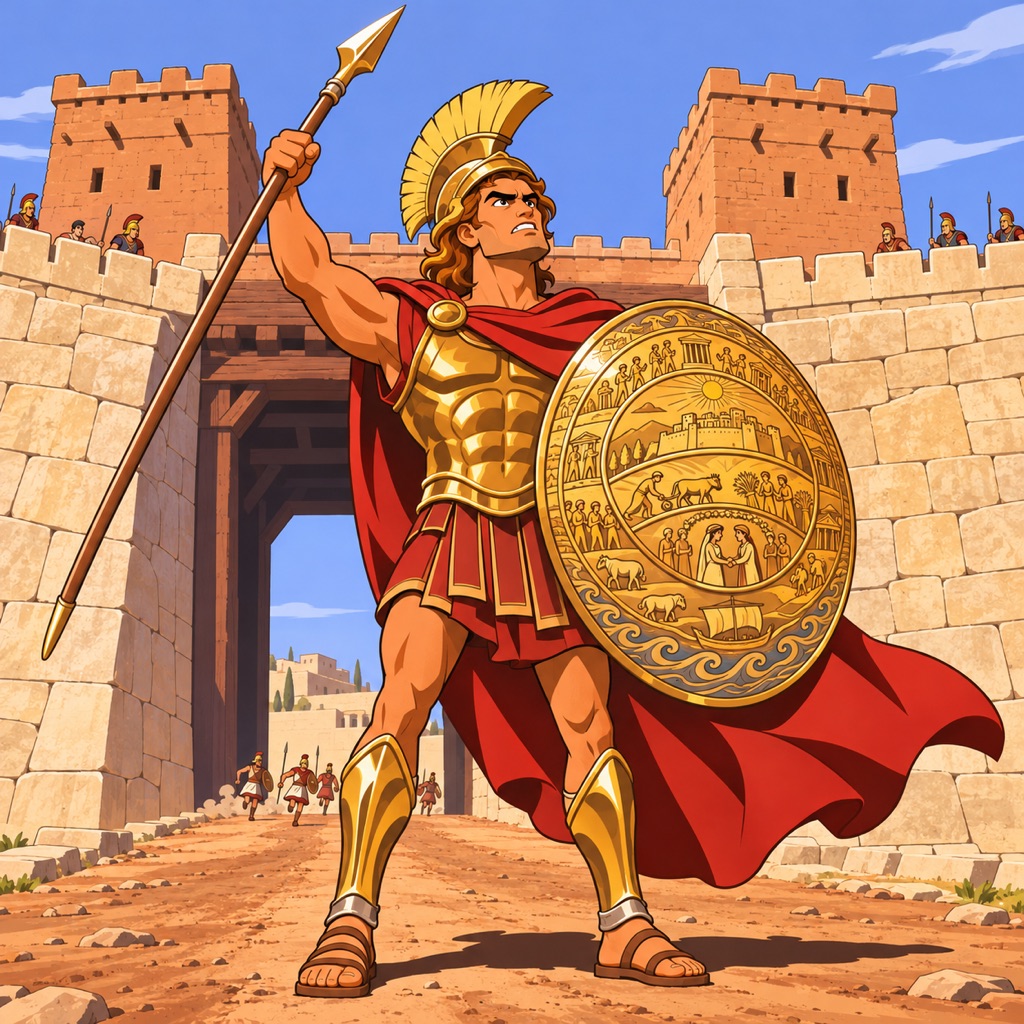
Achilles is the greatest Greek warrior of the Trojan War and the hero of Homer's Iliad. The story of the Achilles heel comes later: in the oldest Greek sources, Paris and the god Apollo kill him with an arrow in the ankle at the gates of Troy, and only Roman-era writers explain that his mother dipped him in the river Styx and left one weak spot. His bond with his friend Patroclus, whose death turns him back into a killer, is the emotional center of the Iliad.
Achilles is a figure of legend, not a historical person. Nothing outside poetry and myth proves that he lived. But for a thousand years of Greek history, people treated him as real. Alexander the Great slept with a copy of the Iliad under his pillow, according to Plutarch, and when he reached Troy he laid a wreath on the mound said to be Achilles' tomb. Arrian reports that Alexander called Achilles lucky, because he had Homer to sing his fame.
This page follows his life as the ancient sources tell it: Homer first, then the lost epics summarized by the later scholar Proclus, then the mythographers Apollodorus and Hyginus, with notes where the versions disagree.
Birth: A Goddess and a Mortal
Achilles' mother was Thetis, a sea goddess, one of the daughters of the old sea god Nereus. Both Zeus and Poseidon wanted her. Then a prophecy warned that Thetis would bear a son greater than his father. No god wanted to be outdone by his own child, so the gods married her off to a mortal, Peleus, king of Phthia in Thessaly. The poet Pindar tells this version in the 5th century BCE.
The wedding was the most famous party in Greek myth. Every god came except one. Eris, the goddess of strife, was left out, and she threw the golden apple that started the quarrel among Hera, Athena and Aphrodite. That quarrel led to the judgment of Paris, and so to the Trojan War. The war that killed Achilles began at his parents' wedding.
Thetis knew her son was mortal and tried to fix it. In the version told by Apollodorus, she put the baby into a fire at night to burn away his mortal parts and rubbed him with ambrosia by day. Peleus caught her at it and cried out, and Thetis, furious, left him and went back to the sea. The boy was given to the wise centaur Chiron, who raised him on Mount Pelion and fed him on the entrails of lions and wild boars. In the Iliad, his old tutor Phoenix says he also helped raise him, and that the baby Achilles used to spit wine down his tunic.
The Achilles Heel Story: Where It Really Comes From
The famous version goes like this: Thetis dipped the baby Achilles in the river Styx to make him invulnerable, holding him by the heel. The heel stayed dry and became his one weak point. Paris later shot an arrow into it.
This is not the oldest version, and Homer does not tell it. In the Iliad, Achilles can be wounded: in Book 21 a Trojan spear grazes his forearm and draws blood. Homer's Achilles is not invulnerable at all. He is simply the fastest and strongest man in the army.
The dipping in the Styx first appears clearly in the Achilleid of the Roman poet Statius, written near the end of the 1st century CE, more than seven hundred years after Homer. Later retellings fixed the heel as the spot his mother held. That version took over in Western art and language, which is why we say "Achilles heel" for a single fatal weakness, and why the tendon at the back of your foot is called the Achilles tendon.
The older Greek story is simpler and, in a way, darker. Achilles died because his fate said so, not because of a flaw in a magic treatment. In the Iliad the dying Hector tells him exactly how it will happen: Paris and Phoebus Apollo will kill him at the Scaean Gate. The Greek mythographer Apollodorus says he was "shot with an arrow in the ankle" by Paris and Apollo. Hyginus, writing in Latin, has Apollo take Paris's shape and strike the one mortal spot. The arrow in the ankle is the Greek tradition. The heel and the Styx came later.
Hidden on Skyros
Thetis knew a second thing about her son: if he went to Troy, he would die there. So, in a story told by Apollodorus and Hyginus, she dressed the young Achilles as a girl and hid him among the daughters of Lycomedes, king of the island of Skyros.
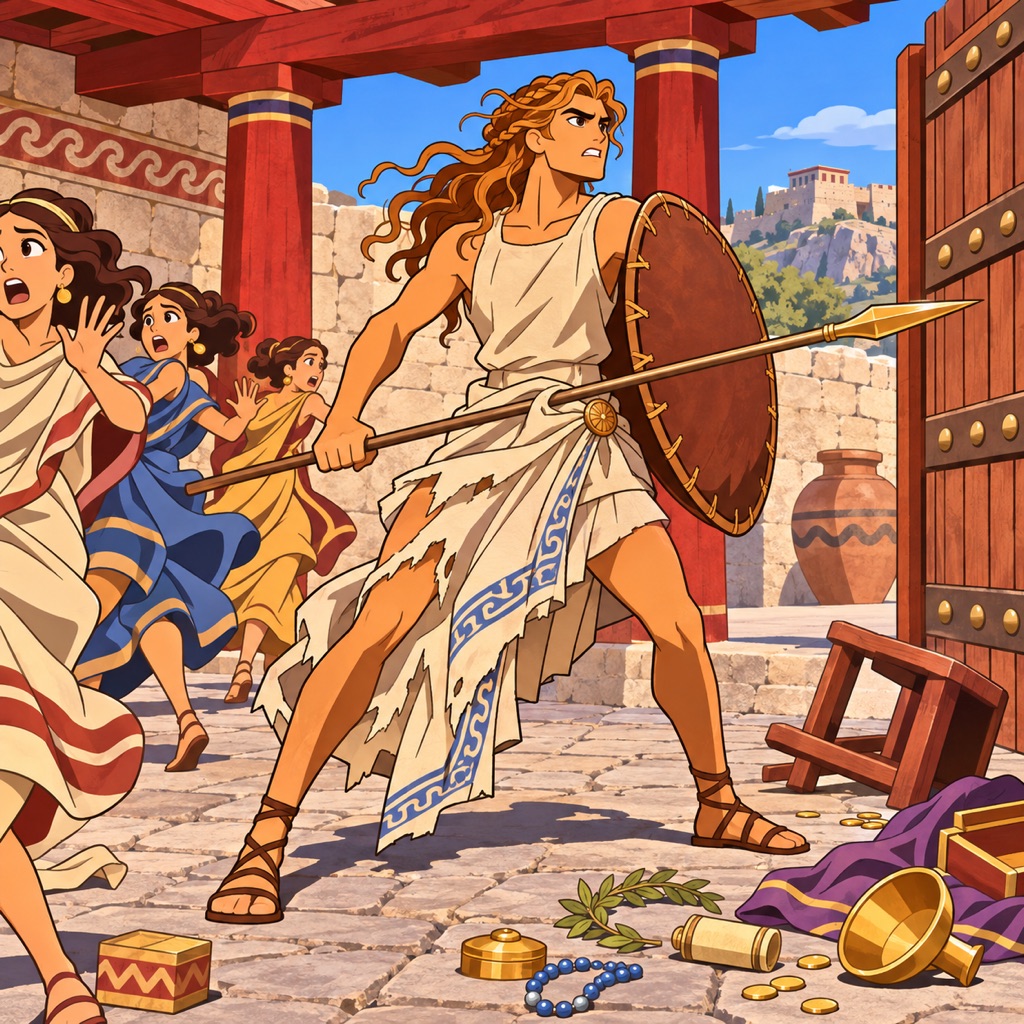
The Greeks had been told they could not take Troy without him. Odysseus came looking. In Hyginus's version he laid out gifts for the girls, jewellery and cloth, with a shield and a spear mixed in, and then had a trumpet sounded as if the palace were under attack. The girls ran. One of them grabbed the weapons. That was Achilles.
The story is not in Homer, who has Achilles recruited from his father's house in Thessaly. But it was well known in classical Athens: Euripides wrote a play about it, now lost, and a painting of Achilles among the girls hung on the Athenian Acropolis, according to Pausanias. While on Skyros, Achilles fathered a son with the king's daughter Deidamia. That son, Neoptolemus, came to Troy after his father's death and killed King Priam at the altar when the city fell.
The Choice: A Short Life or a Long One
The core of Achilles in the Iliad is a choice. In Book 9 he tells the embassy sent to win him back that his mother told him of two fates. If he stays at Troy and fights, he will never go home, but his glory will never die. If he goes home, his glory is gone, but he will live a long life.
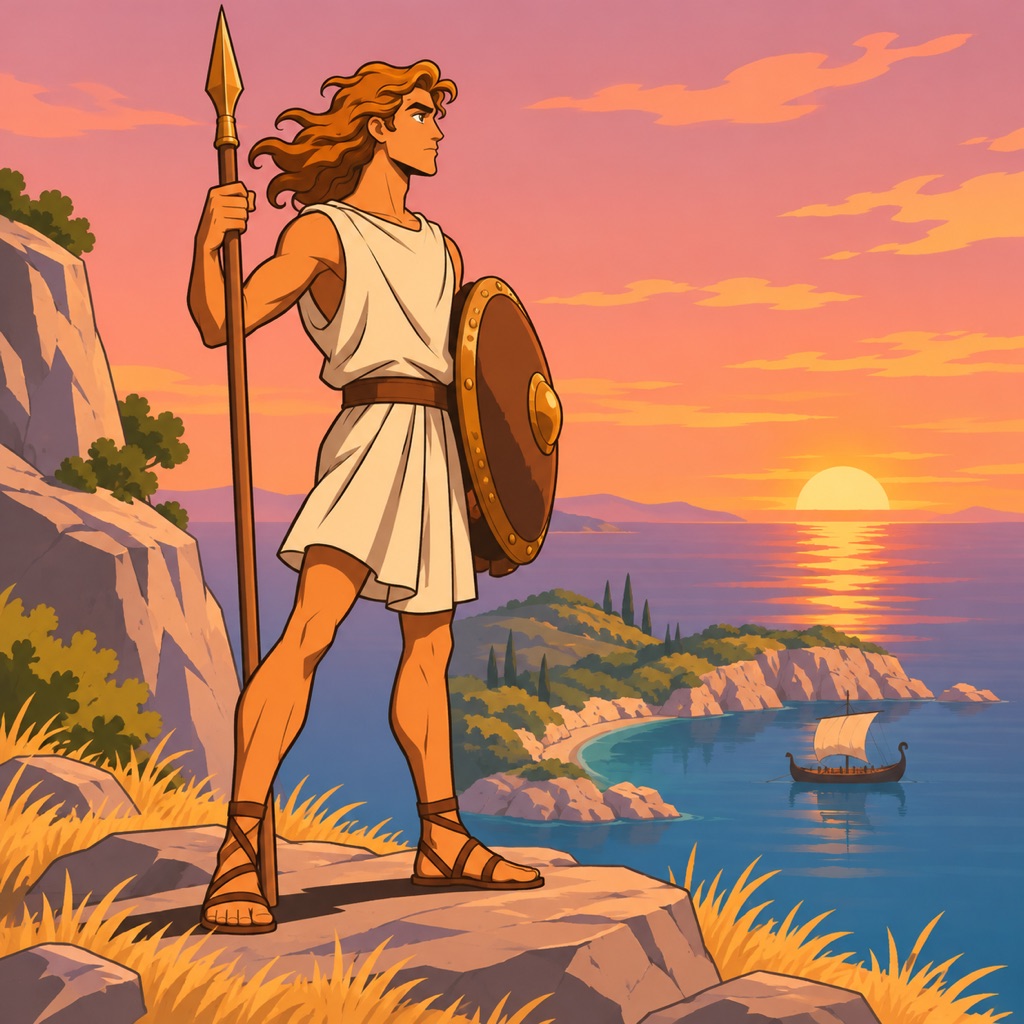
The Greek word for that glory is kleos: what people hear about you after you are gone. Achilles chose it. Every Greek who heard the poem knew how it ended. The Iliad is the story of a man who knows he will die young and keeps choosing to.
At Troy he was the most feared fighter on the Greek side. Before the poem begins, he has led raids all around the region and sacked, in his own words, twelve cities by sea and eleven by land. In one of those raids he killed the father and seven brothers of Andromache, the woman who became Hector's wife.
The Quarrel with Agamemnon
The Iliad opens with "the rage of Achilles". The army's commander, Agamemnon, is forced to give back a captive girl to appease Apollo's plague. He takes Achilles' prize, a captive woman named Briseis, to replace her. Achilles reaches for his sword. Athena catches him by the hair from behind, visible only to him, and tells him to use words instead. He calls Agamemnon a drunk with "the eyes of a dog and the heart of a deer", and quits the war.
Then he asks his mother to ask Zeus for something terrible: let the Greeks lose until they understand what they lost. Zeus agrees. For most of the poem, Achilles sits in his tent while the Greeks are slaughtered and driven back to their ships. When Agamemnon offers him a fortune to come back, he turns it down.
Achilles and Patroclus
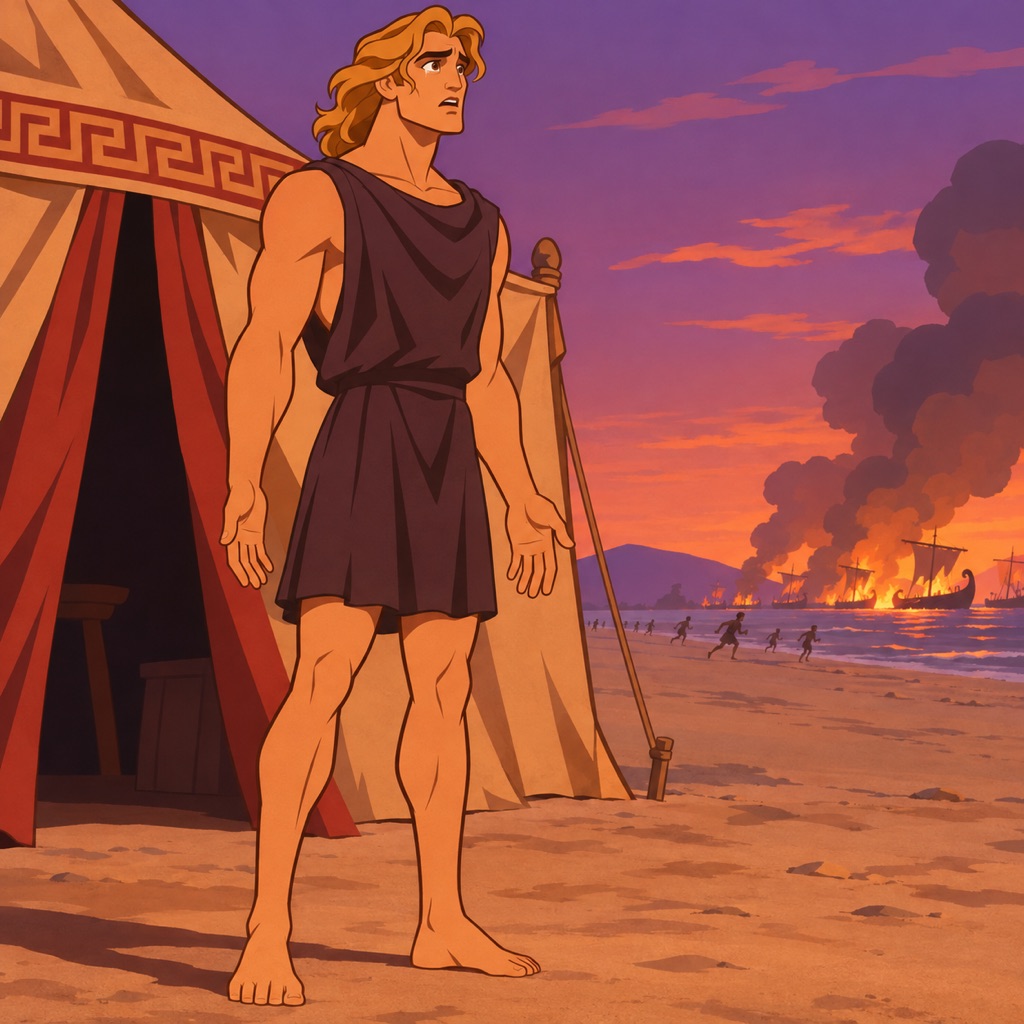
Patroclus is the person Achilles loves most. In the Iliad he is slightly older, and his story is told by the ghost of Patroclus himself in Book 23. As a boy he killed a playmate in a quarrel over a game of knucklebones and had to flee his home. Peleus took him in and raised him with Achilles. His father had told him to advise Achilles, since Achilles was the stronger but Patroclus the older.
When the Greek ships begin to burn, Patroclus begs to go out in Achilles' armour so the Trojans will think Achilles is back. Achilles agrees, and warns him not to go too far. Patroclus drives the Trojans back, forgets the warning, and is killed at the walls by Apollo, a young Trojan named Euphorbus, and finally Hector.
Achilles' grief is the most violent in the poem. He pours ash over his head and lies in the dust, tearing his hair. He says he loved Patroclus "as much as my own life". When Patroclus's ghost appears to him, it asks that their bones be kept in one urn, as they were raised in one house. In the Odyssey, the ghost of Agamemnon confirms that this was done: the bones of Achilles and Patroclus lie mixed together in a golden urn.
Were Achilles and Patroclus lovers? This is one of the most searched questions about Achilles, and the honest answer is that the ancient Greeks themselves disagreed. Homer never says they were lovers. He describes a bond deeper than any other in the poem, and he gives each man a woman who sleeps beside him in the tent. But Greek writers of the classical age, three centuries after Homer, often read the relationship as a romantic and sexual one. The tragedian Aeschylus, in his lost play The Myrmidons, made it explicit: surviving fragments have Achilles mourning Patroclus's body and speaking of their kisses. In Plato's Symposium, a speaker named Phaedrus takes it for granted that they were lovers, and argues only about which one was the older partner. The orator Aeschines, in 346 BCE, said Homer had hidden the love out of tact but that educated listeners could see it. On the other side, in Xenophon's Symposium, Socrates insists that Homer shows them as comrades, not lovers. Modern readers still divide along the same lines, and Madeline Miller's novel The Song of Achilles (2011) made the romantic reading famous for a new generation. What is certain is that in every ancient version, Patroclus's death is what breaks Achilles.
Achilles and Hector
His mother rises from the sea when she hears him cry out. She tells him that if he kills Hector, his own death will come soon after. He answers that he wants to die at once, since he failed his friend. That night, the smith god Hephaestus makes him new armour and a shield showing the whole world.
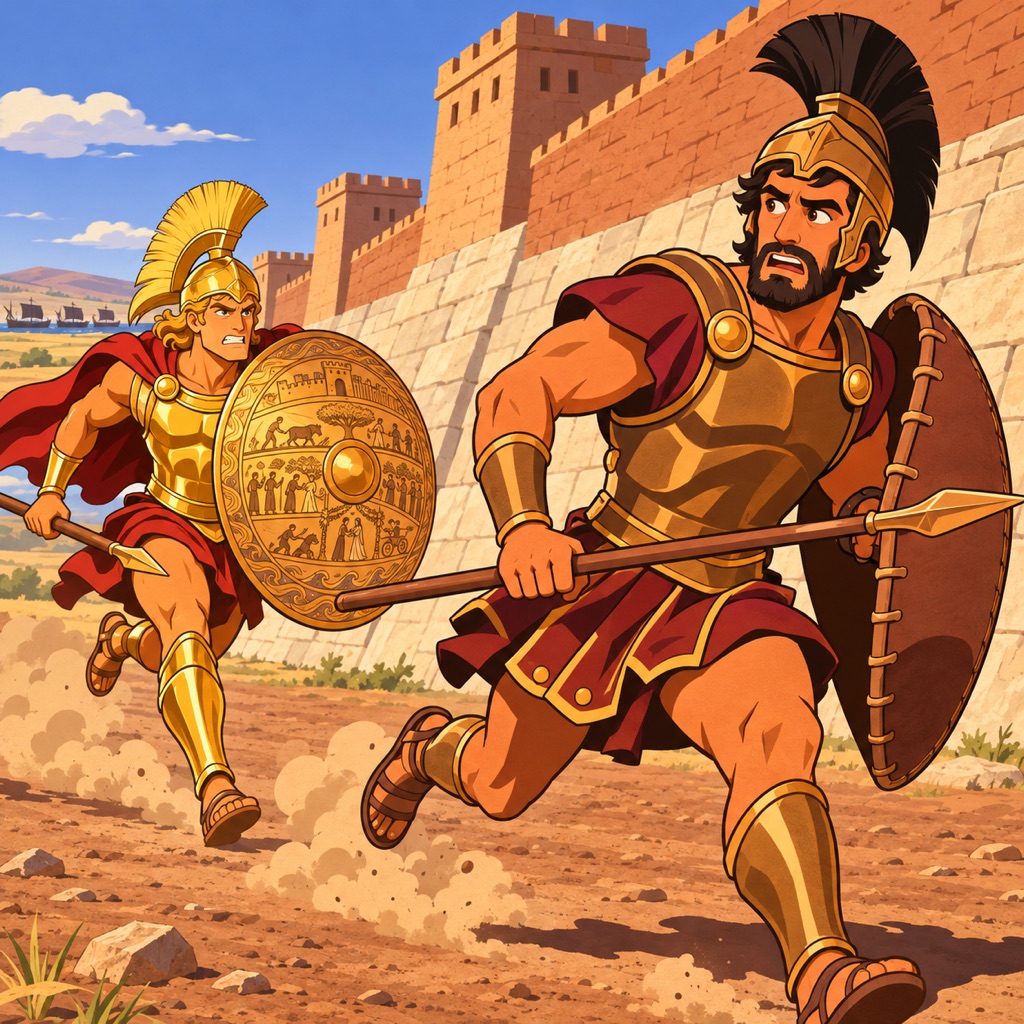
He makes peace with Agamemnon, goes out, and kills so many Trojans that the river Scamander rises to drown him. Then he finds Hector alone outside the gates and chases him three times around the city. With Athena's help, which is really a trick on Hector, he kills him with a spear through the throat. Hector begs for his body to be returned to his family. Achilles says he wishes he could eat him raw. He pierces the tendons of Hector's feet, ties the body to his chariot, and drags it to the ships. For twelve days afterwards, every dawn, he drags it around Patroclus's grave. At Patroclus's funeral he sacrifices twelve Trojan prisoners on the pyre.
Priam in the Tent
This is the scene that redeems him. King Priam of Troy, an old man, crosses the plain at night with a wagon of ransom, guided by the god Hermes, and walks into Achilles' tent. He kneels and kisses Achilles' hands, "the terrible, man-killing hands that had killed so many of his sons". He asks him to remember his own father.
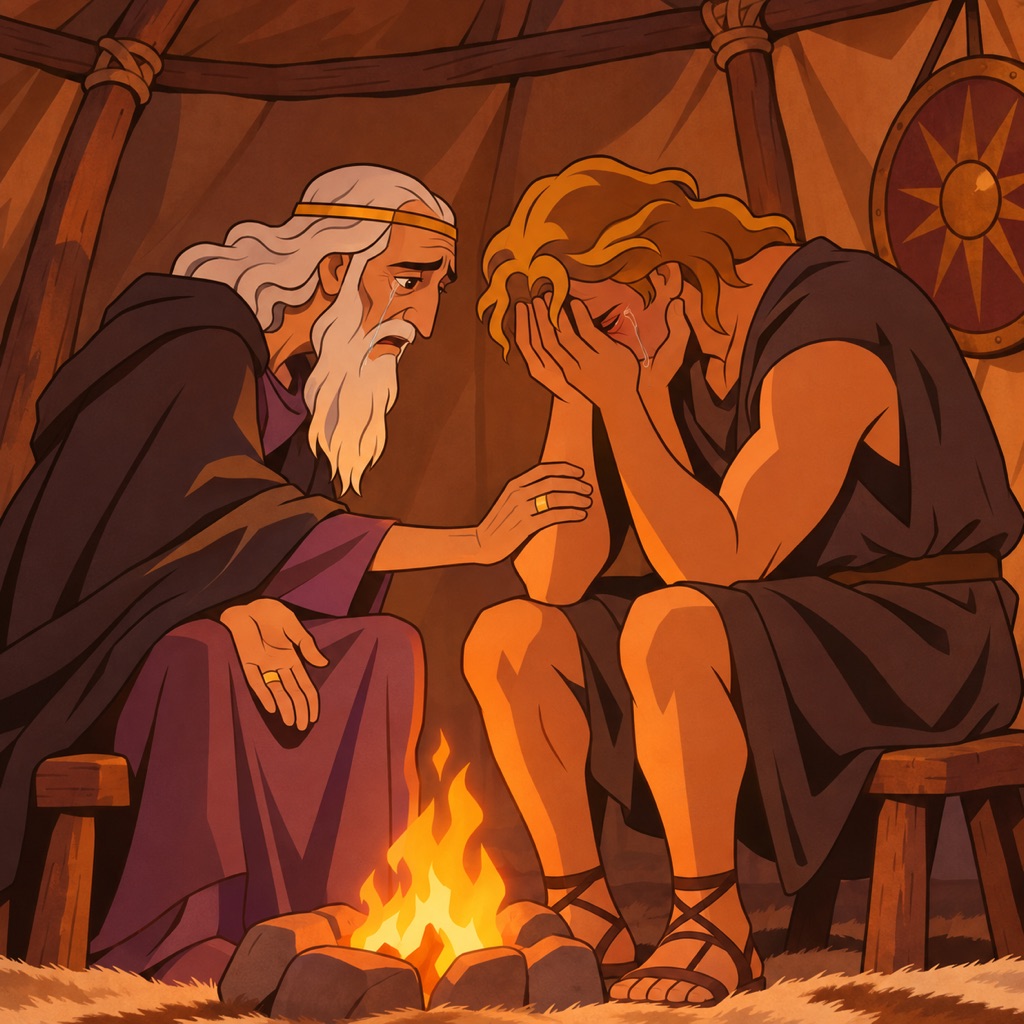
Achilles weeps for his father and for Patroclus. Priam weeps for Hector. Then Achilles gives the body back, makes the old man eat, and grants eleven days of truce for the funeral. The Iliad ends there, with Achilles still alive.
How Did Achilles Die?
Achilles' death is not in the Iliad. It was told in a lost epic called the Aethiopis, which survives only in a short summary by Proclus. After Hector's death, new allies came to help Troy. Achilles killed Penthesilea, queen of the Amazons, and then Memnon, son of the Dawn goddess. Then he drove the Trojans back to their city, and at the gates Paris and Apollo killed him. Paris, the prince whose choice started the war, fired the arrow; Apollo, who had hated Achilles for his treatment of Hector, guided it. Apollodorus says the arrow hit his ankle.
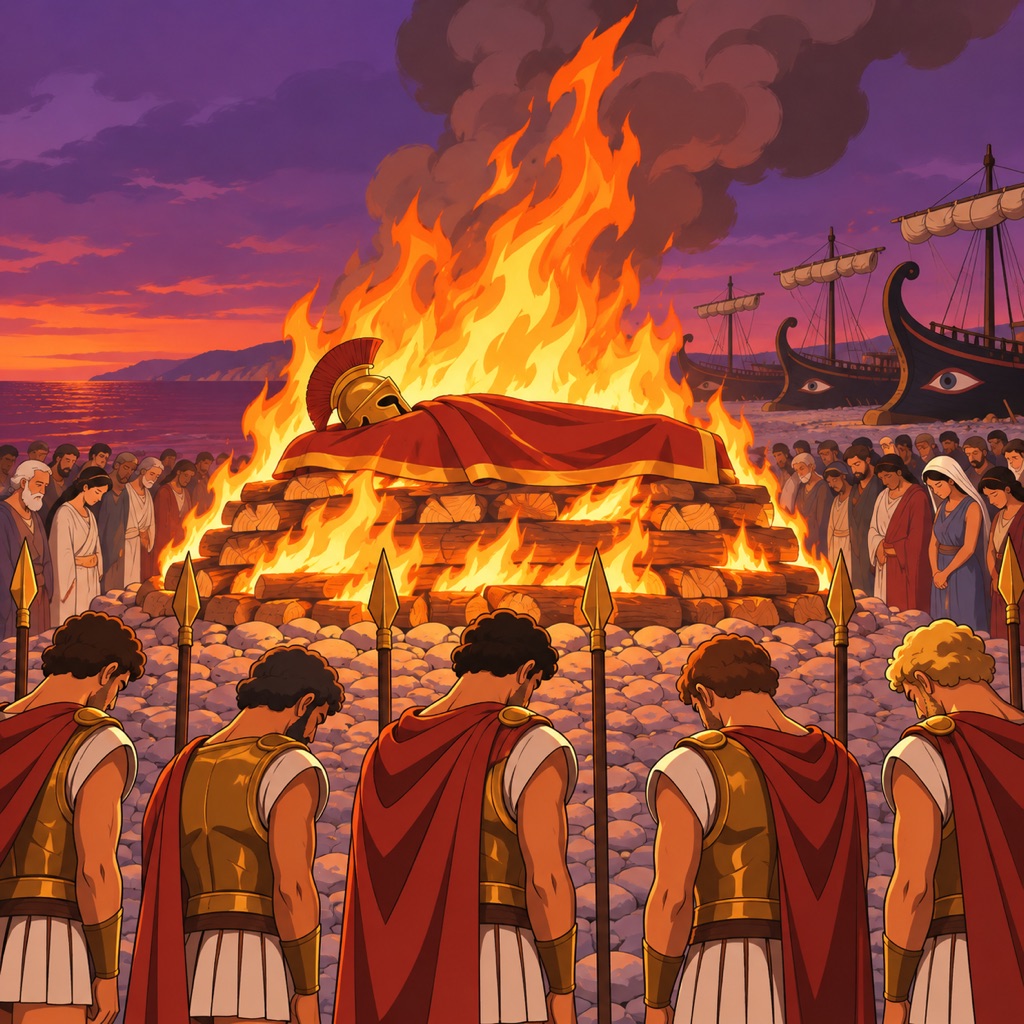
A great fight broke out over the body. The giant Ajax carried it out on his shoulders while Odysseus held off the Trojans. In the Odyssey, Agamemnon's ghost describes the funeral: Thetis rose from the sea with her sister sea goddesses, the nine Muses sang the lament, and the Greeks mourned for seventeen days before the burning. The Aethiopis adds that Thetis snatched her son from the pyre and carried him to the White Island in the Black Sea. Greeks really did worship Achilles there in historical times, at a sanctuary on a small island off the mouth of the Danube.
The Armour Contest
The armour made by Hephaestus was to go to the best of the remaining Greeks. Ajax, who had carried the body, and Odysseus, who had defended it, both claimed it. According to the Odyssey and the lost Little Iliad, it was awarded to Odysseus. One ancient tradition says Trojan prisoners were asked which of the two had hurt them more. Ajax went mad with shame and killed himself, a story Sophocles turned into his tragedy Ajax. Odysseus later gave the armour to Achilles' son Neoptolemus.
The Ghost in the Odyssey
The last word on Achilles comes from Homer. In Book 11 of the Odyssey, Odysseus visits the edge of the underworld and meets the ghost of Achilles. Odysseus tries to comfort him: no man was ever more honoured, in life or now among the dead.
Achilles refuses the comfort. He says he would rather be a hired labourer for a poor farmer, alive on the earth, than king over all the dead. The man who chose glory over a long life now says it was not worth it. The only thing that cheers him is news of his son: Odysseus tells him Neoptolemus fought bravely at Troy, and the ghost of Achilles walks away across the field of asphodel, happy.
It is one of the strangest moments in Greek poetry. Homer gives his greatest hero the glory he chose, and then lets him say he would trade it all for one more day of ordinary life.
Frequently Asked Questions
1What is the Achilles heel story?
In the later, mainly Roman version, Thetis dipped the baby Achilles in the river Styx to make him invulnerable, holding him by the heel, which stayed vulnerable. Paris later killed him with an arrow there. The dipping first appears in the Roman poet Statius in the late 1st century CE. The older Greek sources simply say Paris and Apollo shot him in the ankle.
2How did Achilles die?
In the lost Greek epic Aethiopis and in Apollodorus, Achilles chased the Trojans to the gates of Troy and was killed there by an arrow fired by Paris and guided by Apollo. Apollodorus says it hit his ankle. His death is not shown in the Iliad, but the dying Hector predicts it.
3Were Achilles and Patroclus lovers?
Homer never says so; he shows a bond deeper than any other in the Iliad. Later Greeks disagreed. Aeschylus and Aeschines treated them as lovers, and Plato's Phaedrus assumes it, while Xenophon's Socrates says they were only comrades. Both readings are ancient.
4Who killed Achilles?
Paris, the Trojan prince who took Helen, with the help of the god Apollo. Hector predicted it with his last breath in the Iliad: Paris and Apollo would kill Achilles at the Scaean Gate.
5Was Achilles a real person?
There is no evidence that Achilles existed. He is a hero of legend and epic poetry. The ancient Greeks treated him as real and worshipped him at shrines around the Black Sea, and Alexander the Great honoured his supposed tomb at Troy.
6Why did Achilles refuse to fight?
Agamemnon took Briseis, the captive woman given to Achilles as his prize of honour. Achilles saw it as a public insult and withdrew from the war, and he only returned after Hector killed Patroclus.
Hear the Story of Achilles
From the trumpet on Skyros to the arrow at the gates of Troy, follow Achilles through the Ancient Greece chapters in short audio stories.


Hear Their Story
Which One Is Achilles?
5 minHis mother hid him among a king's daughters in a dress. A trumpet blast found him anyway.

The Eyes of a Dog
4 minOne stolen prize, and the best of the Greeks walked out of the war.
Three Times Around the Walls
3 minKill Hector, his mother said, and your own death comes soon after. He didn't even pause.
The Hands He Kissed
4 minAn enemy king knelt in his tent at night, and Achilles wept with him.
Who Gets the Armour?
4 minOne arrow at the gates of Troy, and then a quarrel over the armour of a god.
Related Articles
Iliad Summary: Achilles' Rage, Book by Book
Iliad summary, book by book: the quarrel, Patroclus, the death of Hector and Priam's ransom. Plus the main characters, the themes, and Iliad vs Odyssey.
Judgment of Paris: The Apple of Discord
The Judgment of Paris myth: Eris and the golden apple of discord at a gods' wedding, three goddesses, three bribes, and the choice that started the Trojan War.
The Trojan Horse: The Real Story
The Trojan Horse real story, from Homer and the lost epics: who built it, who hid inside, Cassandra's warning, Helen's trick, and whether a horse ever existed.
Trojan War Summary: The Whole Story
Trojan War summary in order: the golden apple, Helen and Paris, Achilles and Hector, the wooden horse and the fall of Troy, with a timeline and the archaeology.
Experience Achilles's Story
Go beyond the biography. Hear Achilles's story told by Lumo, your immortal wolf guide who witnessed these events firsthand.