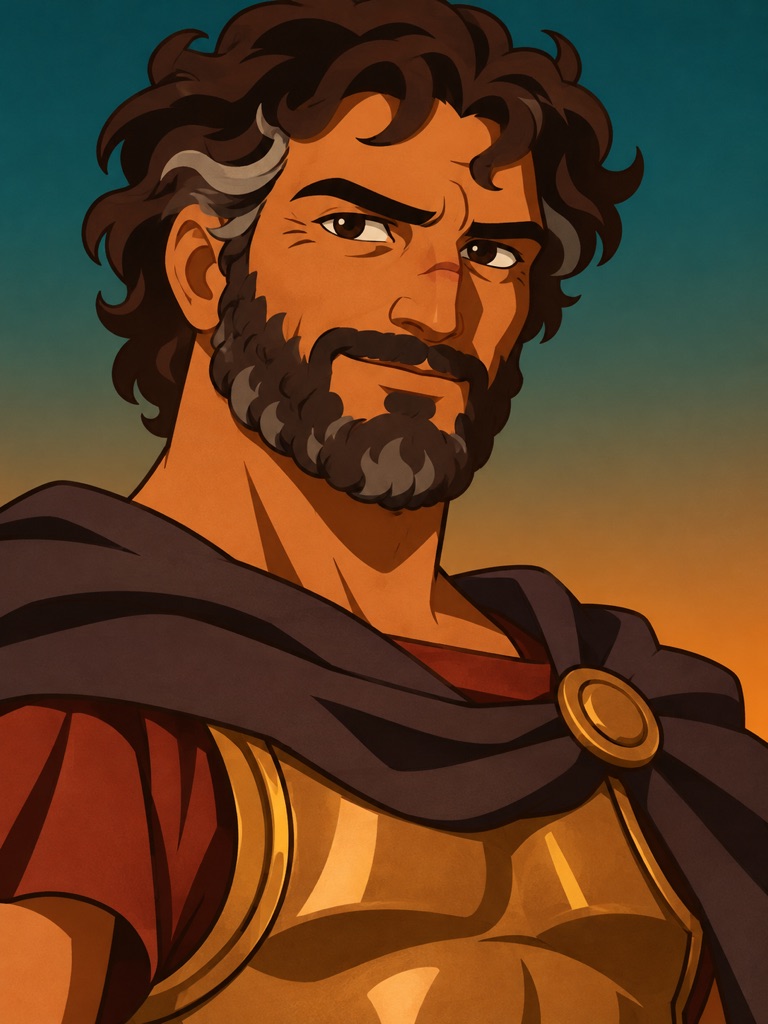
Who Was Odysseus?
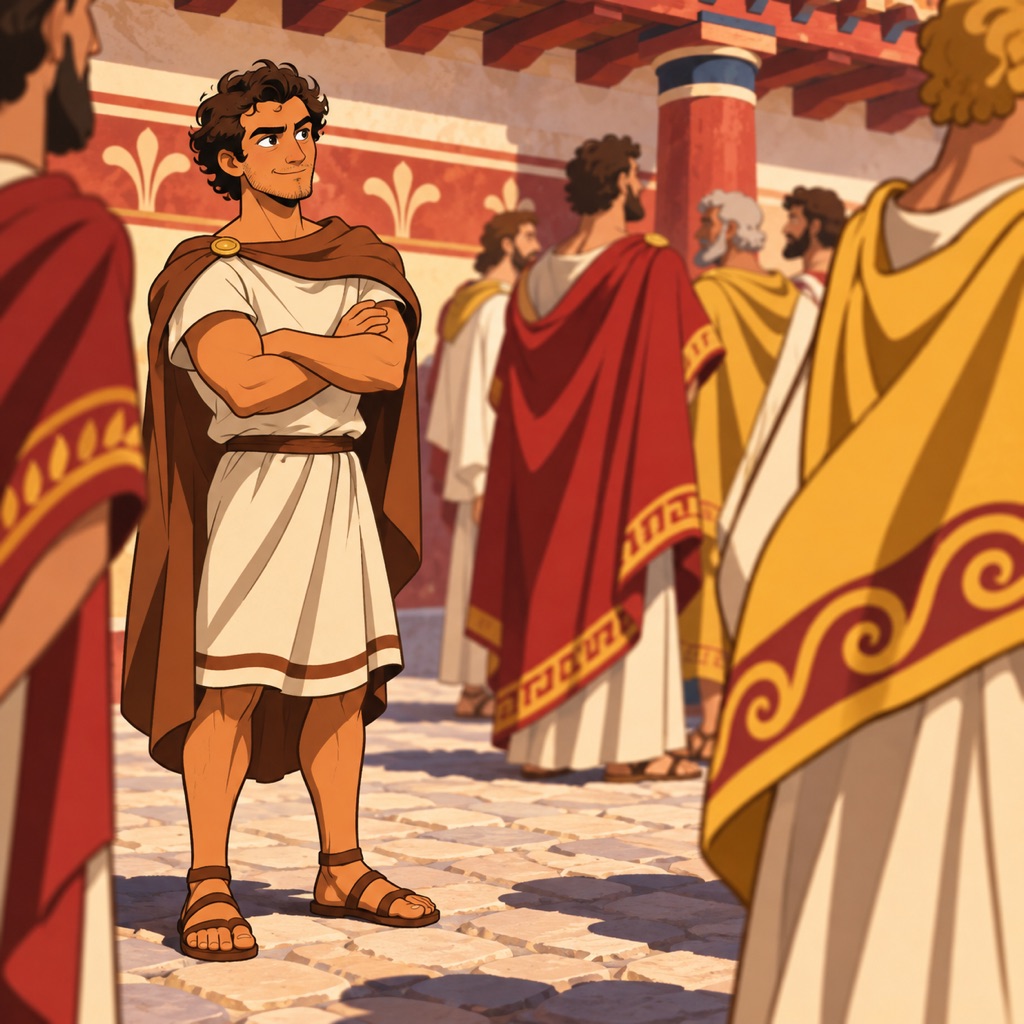
Odysseus is the legendary king of Ithaca, a small rocky island off the west coast of Greece, and the hero of Homer's Odyssey. In Greek myth he is the cleverest of the Greeks who fought at Troy: the man behind the wooden horse, and the man who then took ten years to sail home. His wife was Penelope, his son was Telemachus, and his old dog Argos is the one creature on Ithaca who knows him at once when he finally comes back.
The Romans called him Ulysses. Homer calls him polytropos, "the man of many turns", in the first line of the Odyssey, and the word fits. He lies, he disguises himself, he talks his way out of caves and into cities. He is also a farmer who can plough a straight furrow, a carpenter who built his own bed, and a man who weeps when a singer reminds him of the war.
Everything on this page is legend. Odysseus belongs to the stories the Greeks told about the Trojan War, which they placed in the late Bronze Age. The archaeology of Troy is real (see Was Troy Real?), but there is no evidence that a king named Odysseus ever lived. What follows is what the ancient sources say about him, and which source says what.
The poems even explain his name. In Odyssey 19 his grandfather Autolycus, a famous thief and liar, names the baby. Autolycus says he has been "odysseus", angry or hated, with many people, so the boy should carry that name. As a young man, on a boar hunt with that grandfather on Mount Parnassus, Odysseus took a tusk wound above the knee. The scar will matter twenty years after the war.
Odysseus' Wife: How He Won Penelope
The story of Odysseus' wife begins with someone else's wedding. When Helen of Sparta came of age, every unmarried king in Greece arrived to court her (see Helen of Troy). Her father, Tyndareus, feared that whichever man he chose, the losers would turn on the winner.
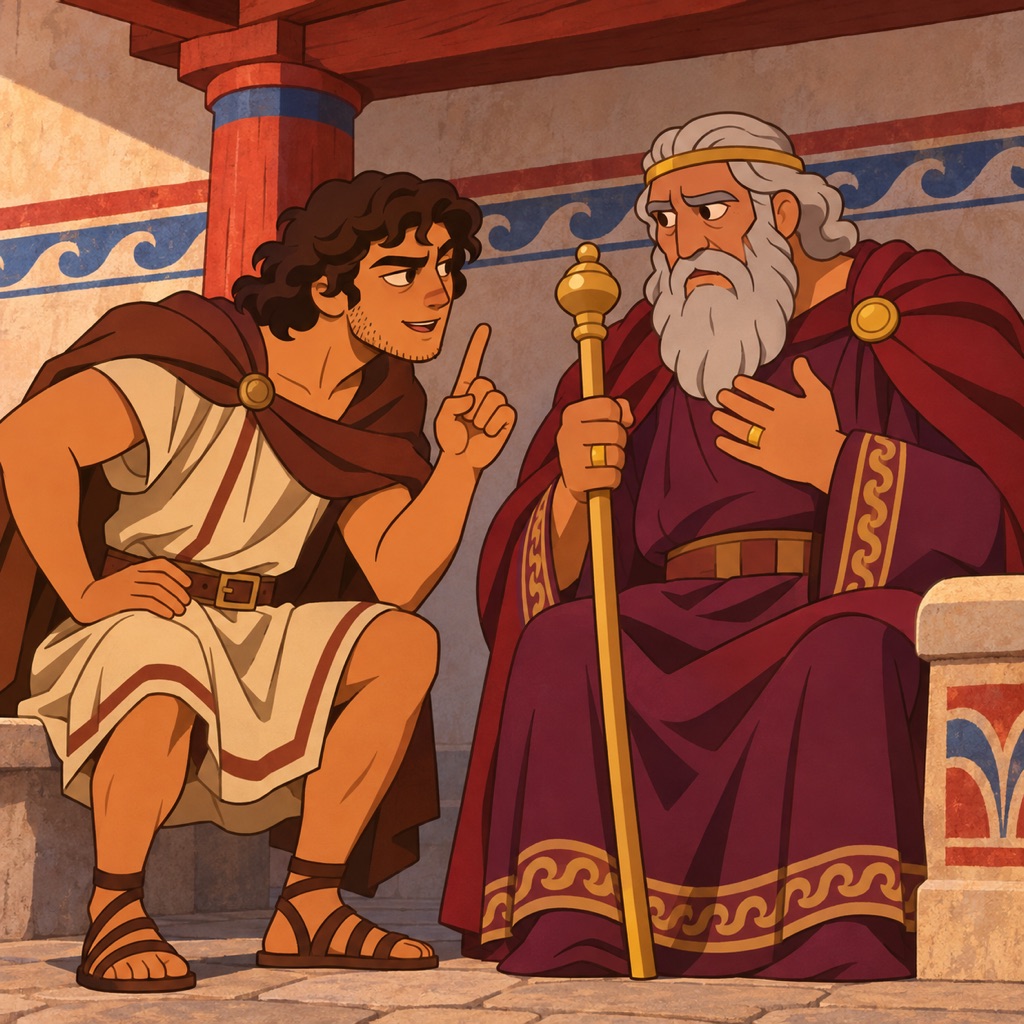
According to the mythographer Apollodorus (Library 3.10.9), Odysseus came with little hope of winning Helen and offered a way out. Make every suitor swear to defend the chosen husband against anyone who wronged him. In return, Tyndareus would help Odysseus win the woman he actually wanted: Penelope, daughter of Tyndareus' brother Icarius. Hyginus (Fabulae 78) tells the same story. Every suitor swore. Helen chose Menelaus. And Odysseus sailed home with Penelope.
The irony is the whole story in miniature. Odysseus invented the oath that would later drag every king in Greece to Troy, and he invented it to win the wife he would then leave for twenty years because of that oath.
The travel writer Pausanias (3.20.10–11) adds a scene from Sparta. Icarius begged his daughter to stay. Odysseus told her to choose: come to Ithaca with him, or stay with her father. Penelope said nothing. She drew her veil over her face, and her father understood that she had chosen her husband. Icarius set up a statue of Modesty on the spot, which Pausanias says still stood in his day. Pausanias also records a version in which Icarius held a footrace for the suitors and Odysseus won it.
Penelope is the most famous faithful wife in Greek literature. In the Odyssey she holds off more than a hundred suitors for years with a trick worthy of her husband: she promises to choose one of them when she finishes weaving a burial shroud for Odysseus' father Laertes, and every night she unpicks what she wove that day. She keeps it up for three years before a maid betrays her (Odyssey 2.93–110).
Odysseus' Son and the Madness at the Plough
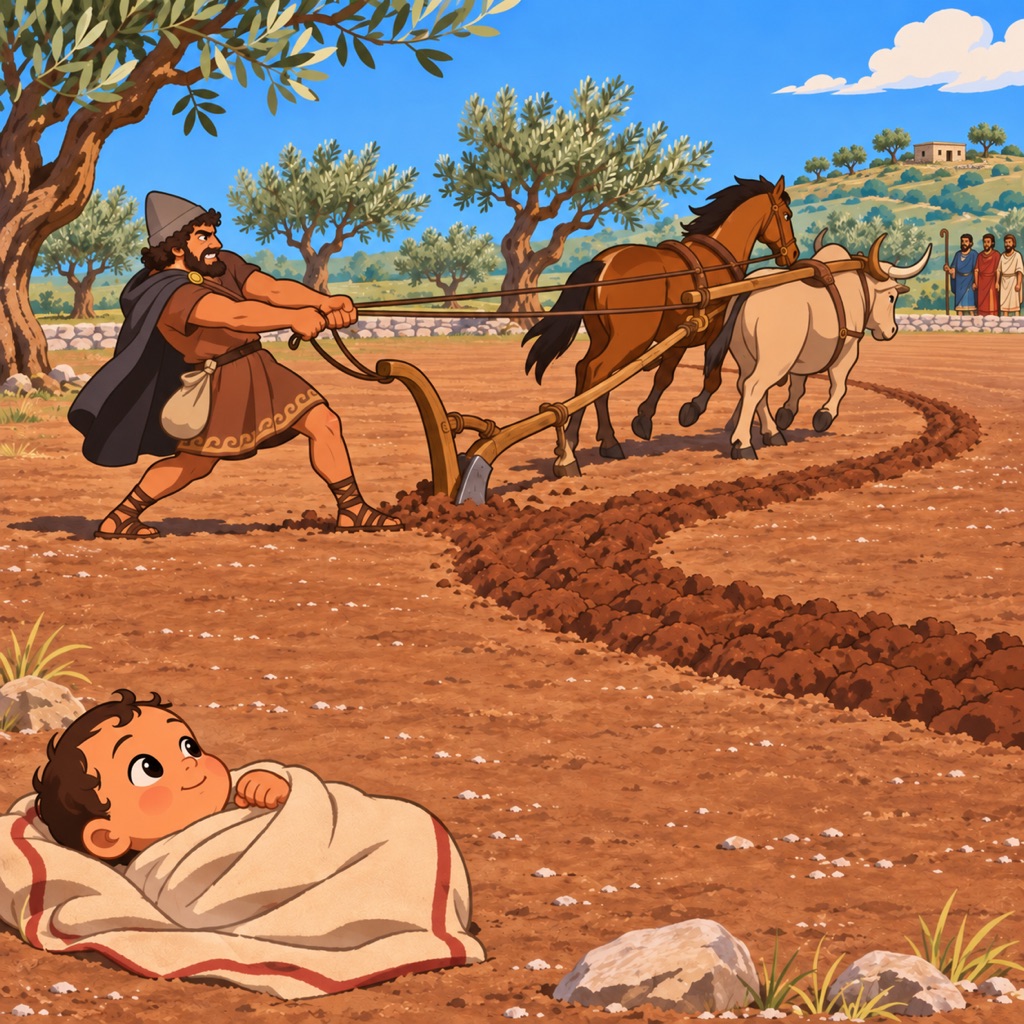
Odysseus' son is Telemachus, and the boy's first appearance in the legend is as bait.
When Paris carried Helen off to Troy, Menelaus and his brother Agamemnon called in the oath. Odysseus did not want to go. A prophecy in Hyginus (Fabulae 95) says he had been told that if he went to Troy he would come home after twenty years, alone, a beggar, with all his companions lost. In the Odyssey (2.171–176) the seer Halitherses recalls making the same kind of prophecy as the fleet sailed.
So Odysseus pretended to be mad. In Hyginus' version, when the recruiting party arrived he put on a felt cap, yoked a horse and an ox together, and ploughed his field. Much later sources, such as the Roman commentator Servius, add that he sowed salt in the furrows. Among the visitors was Palamedes, a clever man who did not believe the act. He took the infant Telemachus from his cradle and laid him in front of the plough. Odysseus turned the team aside. He was sane, and he was caught.
The sources tell the trap in different ways. The lost epic Cypria, as summarized by Proclus, says only that Palamedes exposed the madness by seizing Telemachus. Apollodorus (Epitome 3.7) has Palamedes snatch the baby from Penelope's arms and draw a sword as if to kill him. Hyginus has the plough. All agree on the outcome: Odysseus went to war, with twelve ships from Ithaca and the nearby islands (Iliad 2.631–637), and he never forgave Palamedes.
Telemachus grows up without a father. When the Odyssey opens he is about twenty, his house is full of suitors eating his inheritance, and the goddess Athena sends him to Pylos and Sparta for news of the father he cannot remember.
The Recruiter: Achilles on Skyros and Iphigenia at Aulis
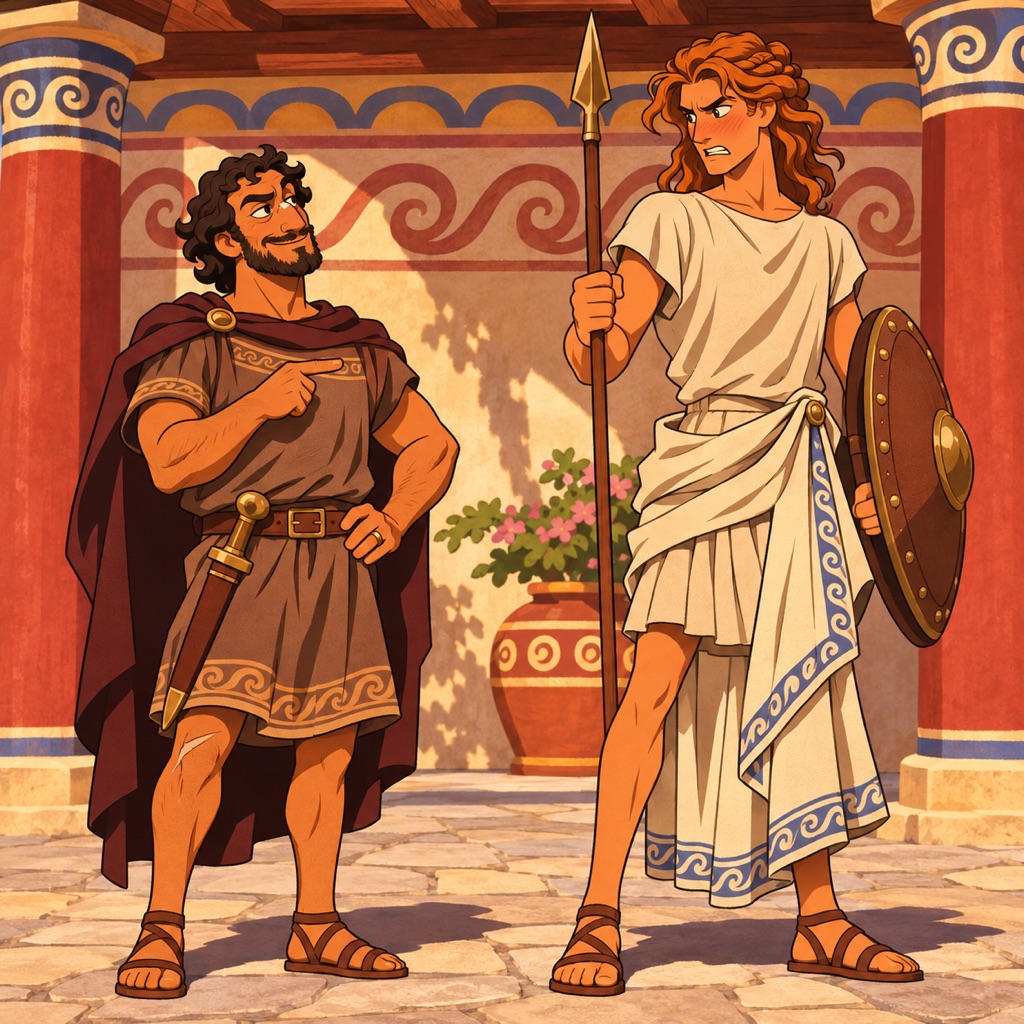
Once he was in the war, Odysseus became its best recruiter. A prophecy said Troy could not fall without Achilles, and Achilles' mother, the sea goddess Thetis, knew her son would die there. According to Hyginus (Fabulae 96) and Apollodorus (Library 3.13.8), she hid him on the island of Skyros, dressed as a girl among the daughters of King Lycomedes.
Odysseus went to Skyros with gifts for the girls: jewellery and cloth, with a shield and a spear mixed in. Then he had a trumpet sound as if the palace were under attack. The girls ran. One of them grabbed the weapons. That was Achilles. The man who had faked madness to avoid the war had caught the boy who was hiding in a dress to avoid it.
Homer does not tell this story. In the Iliad (11.765–790), Nestor remembers that he and Odysseus simply went to the house of Achilles' father Peleus in Thessaly and asked for the boy. The Skyros disguise comes from the later mythographers.
The next errand was darker. The fleet gathered at Aulis, on the east coast of Greece, and the winds turned against it. The goddess Artemis was angry with Agamemnon, and the army's prophet said she wanted his daughter Iphigenia as a sacrifice. Apollodorus (Epitome 3.22) says Agamemnon sent Odysseus to Mycenae with a lie: the girl was to come to the camp to marry Achilles. Iphigenia came in her wedding clothes. In Euripides' play Iphigenia at Aulis the lie travels by letter instead, but the trick is the same. The Cypria ends the scene with Artemis snatching the girl away and leaving a deer on the altar. Other versions, such as Aeschylus' Agamemnon, let the sacrifice happen.
Odysseus at Troy: Palamedes, the Spy and the Armour
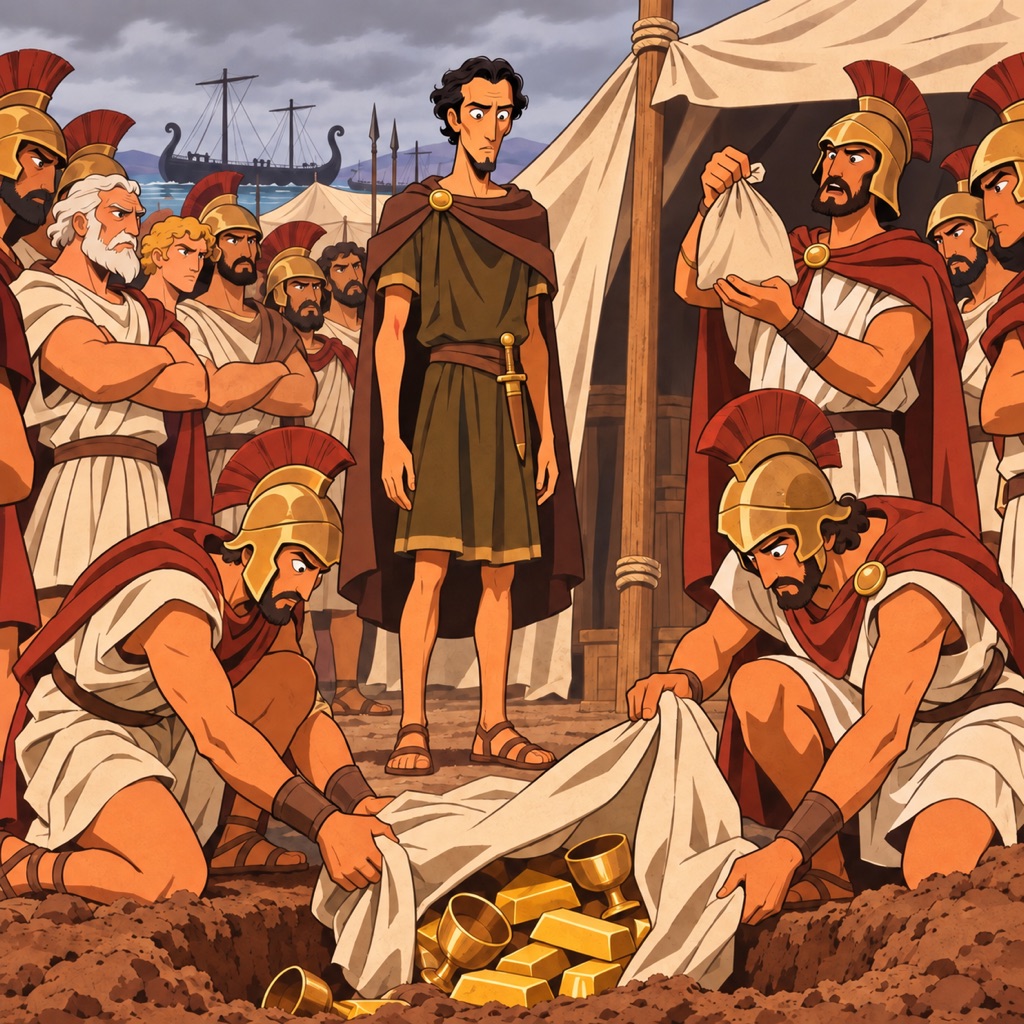
The war lasted ten years in the legend, and Odysseus used some of that time to settle his debt with Palamedes. Apollodorus (Epitome 3.8) and Hyginus (Fabulae 105) give the most famous version. Odysseus forced a Trojan prisoner to write a letter, as if from King Priam, offering Palamedes gold to betray the Greeks. He buried gold under Palamedes' tent and let the letter be found in the camp. The gold was dug up, and the army stoned Palamedes to death as a traitor. Pausanias (10.31.2) reports that the Cypria told it differently: Odysseus and Diomedes drowned Palamedes while he was out fishing. Either way, the Greeks remembered it as murder.
In the Iliad itself Odysseus is a speaker and a fixer. He stops the army from running for the ships in Book 2 and beats the loudmouth Thersites with his staff. The Trojan elder Antenor remembers that when Odysseus spoke, his words came "like winter snowflakes" (3.221–223). He goes on the embassy that begs Achilles to come back in Book 9, and in Book 10 he and Diomedes make a night raid on the Trojan lines. For that raid he borrows a helmet covered in plates of boar's tusk (10.261–265), a real Bronze Age type that archaeologists have found in Greek graves.
After the Iliad ends, the lost epics take over. When Paris' arrow killed Achilles at the gates, the Aethiopis (in Proclus) says the giant Ajax carried the body out of the fighting while Odysseus held off the Trojans. Then came the contest for Achilles' armour, made by the god Hephaestus. Ajax and Odysseus both claimed it, and Odysseus won. In the Odyssey (11.543–551) Odysseus himself says he wishes he had never won it, and when he meets Ajax's ghost in the underworld, Ajax turns away without a word (11.563). The Little Iliad and Sophocles' play Ajax tell how Ajax went mad with shame and killed himself.
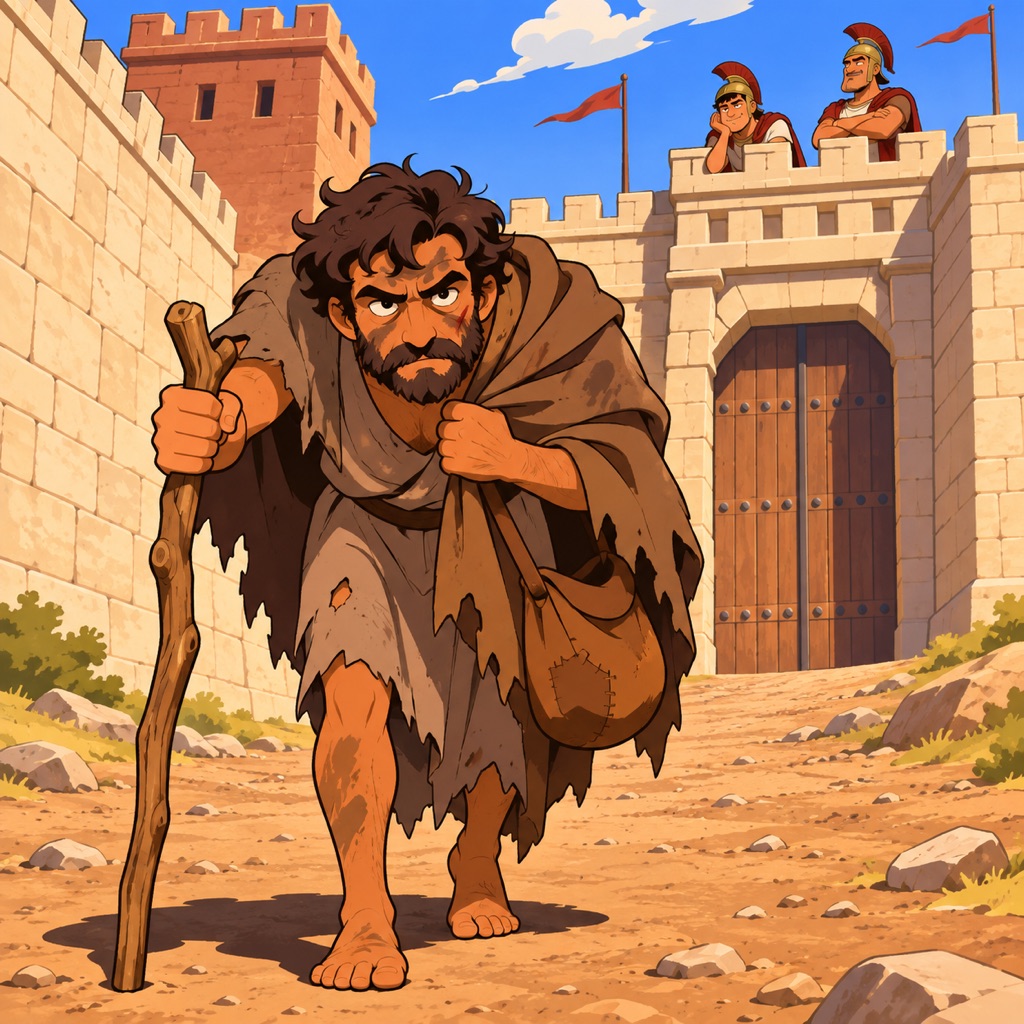
The most daring story is the spy mission. In the Odyssey (4.240–264), Helen tells how Odysseus whipped himself, dressed in rags and walked into Troy as a beggar. No one knew him except Helen. She bathed him, swore to keep his secret, and he walked out again with his information, killing a number of Trojans on the way. The Little Iliad includes the same mission and adds a second raid in which Odysseus and Diomedes steal the Palladium, the sacred image of Athena that protected the city. The beggar's disguise is a rehearsal: he will use it again on Ithaca.
The Trojan Horse
Ten years of fighting had not broken the walls. Apollodorus (Epitome 5.14) credits the plan to Odysseus. In the Odyssey (8.492–495) the carpenter Epeius builds a great wooden horse with Athena's help. The best fighters hide inside with Odysseus. The rest of the Greeks burn their camp and sail out of sight, and the Trojans drag the horse into the city as an offering. The full story, including which details are Greek and which come from the Roman poet Virgil, is on our Trojan Horse page.
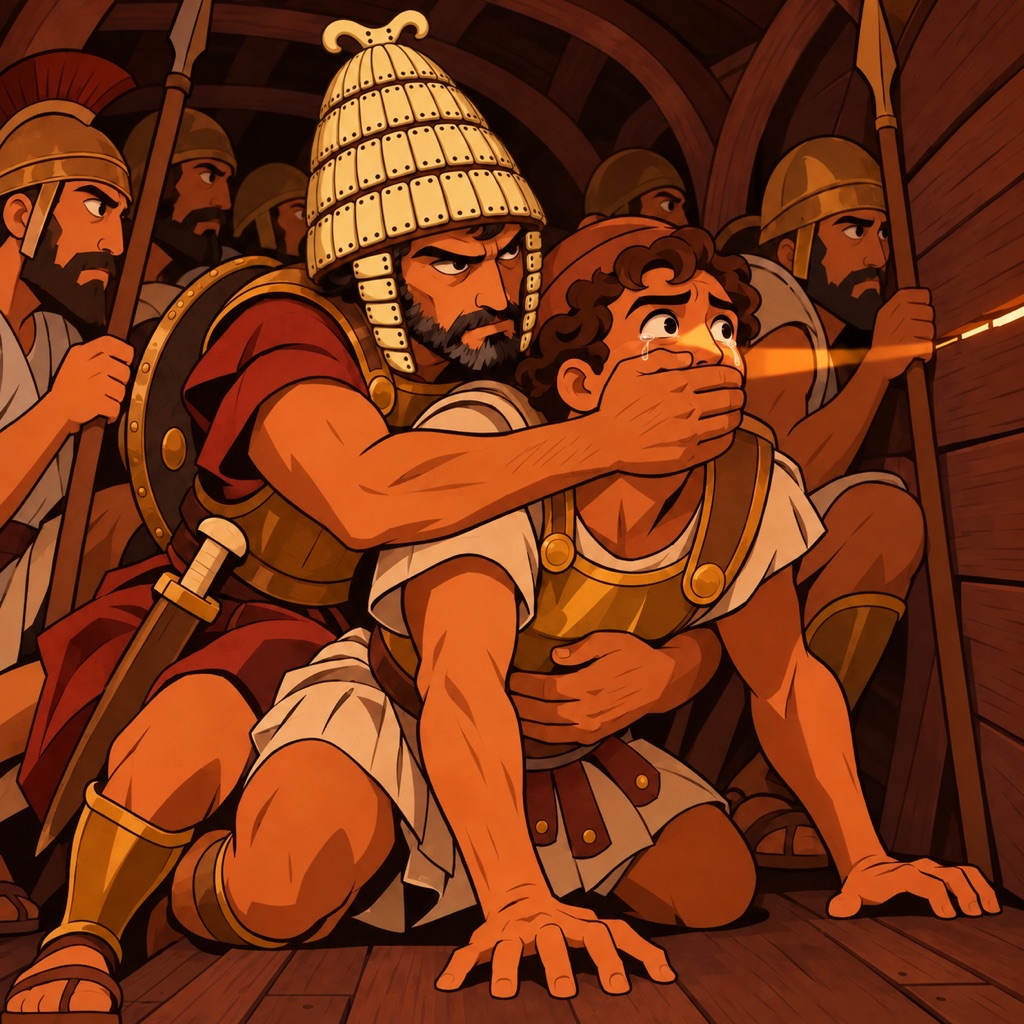
Homer adds one scene almost nobody remembers. That night Helen walks around the horse and calls out to the Greek leaders by name, imitating the voices of their wives. Menelaus and Diomedes nearly answer. One man, Anticlus, cannot stop himself, and Odysseus presses his hand over Anticlus' mouth until Athena leads Helen away (Odyssey 4.271–289). In the underworld, Odysseus later tells the ghost of Achilles that his son Neoptolemus was the one man in the horse who never went pale (11.523–532).
The sack was brutal. In Euripides' Trojan Women, it is Odysseus' argument in the Greek council that condemns Hector's baby son Astyanax to be thrown from the walls; the lost Sack of Troy also names Odysseus as the killer. For the rest of the war, see the Trojan War and the Iliad summary.
Odyssey Summary Before the Movie
Christopher Nolan's film The Odyssey (July 2026), with Matt Damon as Odysseus, has sent many people back to the poem. Here is the story Homer tells, in order. The Odyssey is about 12,110 lines in 24 books, and it does not begin at the beginning.
Ithaca, twenty years on (Books 1–4). Odysseus has been gone for twenty years. More than a hundred young nobles have moved into his palace to court Penelope, eating his herds. Athena, in disguise, sends Telemachus to Pylos and Sparta for news. At Sparta, Menelaus and Helen tell him stories of his father at Troy.
Calypso and the Phaeacians (Books 5–8). Odysseus is a prisoner of love on the island of the nymph Calypso, who offers to make him immortal if he stays. He has been there seven years. Zeus sends Hermes to order his release. Odysseus builds a raft, the sea god Poseidon wrecks it, and he washes up naked on the island of the Phaeacians. The princess Nausicaa finds him on the beach. At her father's feast a blind singer, Demodocus, sings about the wooden horse, and Odysseus covers his face and weeps. Then he tells them who he is.
The wanderings, in his own words (Books 9–12). After Troy his ships raid the Ciconians and visit the Lotus-Eaters, whose fruit makes men forget home. In the cave of the one-eyed giant Polyphemus, a son of Poseidon, Odysseus says his name is "Nobody", gets the Cyclops drunk and blinds him. As he sails away he cannot resist shouting his real name, and Polyphemus prays to his father for revenge (9.526–535). The wind god Aeolus gives him a bag holding all the storm winds; within sight of Ithaca the crew opens it, thinking it holds gold, and they are blown back. The cannibal Laestrygonians destroy every ship but his. The witch Circe turns his men into pigs; Hermes gives Odysseus a herb called moly to resist her, and the crew stays a year. He sails to the edge of the world to speak with the dead: the prophet Tiresias warns him never to touch the cattle of the Sun, and he meets his own mother, who died of grief waiting for him. He hears the Sirens while tied to the mast, his men's ears stopped with wax. He loses six men to the monster Scylla rather than lose the ship to the whirlpool Charybdis. On the island of the Sun the starving crew kills the sacred cattle, and Zeus destroys the ship with a thunderbolt. Odysseus alone survives and drifts to Calypso.
The return (Books 13–24). The Phaeacians carry him home asleep and leave him on the beach. Athena disguises him as an old beggar. He stays with his loyal swineherd Eumaeus, and reveals himself to Telemachus.
Odysseus' Dog: Argos at the Gate
Then he walks to his own palace, and the most famous dog in Greek literature lifts his head.
In Odyssey 17.290–327, Odysseus, in rags, reaches the gate with Eumaeus. A dog lies on the dung heap outside, neglected and full of ticks. His name is Argos. Odysseus raised him before he left for Troy but never had the use of him; in his youth the young men took him hunting wild goats, deer and hares. Now he is old and nobody looks after him. When Argos hears his master, he wags his tail and drops his ears, but he no longer has the strength to come to him. Odysseus wipes away a tear without letting Eumaeus see. And then, Homer says, "the fate of black death took Argos, as soon as he had seen Odysseus again in the twentieth year."
It is a short passage, and it is the emotional key to the whole return. Odysseus cannot stop. If he greets the dog, the beggar is unmasked.
The bow and the bed. Penelope, who has not recognized him, announces a contest: she will marry the man who can string Odysseus' great bow and shoot an arrow through the holes of twelve axe heads (Book 21). The old nurse Eurycleia, washing the beggar's feet, has already found the boar scar on his leg (Book 19). No suitor can string the bow. The beggar strings it easily, shoots through the axes, and then turns the bow on the suitors. With Telemachus and two loyal servants he kills them all (Book 22).
Penelope still tests him. She tells a maid to move their bed out of the bedroom. Odysseus is furious: he built that bed himself around the trunk of a living olive tree, and it cannot be moved unless someone has cut the tree. Only the two of them know that secret. Penelope runs to him (Book 23).
Laertes in the orchard. In the last book, Odysseus finds his old father digging in the orchard. To prove who he is he shows the scar, then lists the trees Laertes gave him as a boy: thirteen pear trees, ten apple trees, forty fig trees (24.340–342). The families of the dead suitors come for revenge, and Athena and Zeus end the feud. The poem stops there. Tiresias had foretold one more journey inland and a gentle death "away from the sea" in old age (11.119–137). A later lost epic, the Telegony, tells another ending, in which Odysseus is killed by Telegonus, his son by Circe.
Why Odysseus Still Matters
Greek writers argued about Odysseus for a thousand years. In Homer he is a hero whose cleverness keeps him alive. In Athenian tragedy he often looks like a cynical politician: in Sophocles' Philoctetes he coaches a young man to lie, and in Euripides he votes to kill a child. The Romans, who claimed descent from the Trojans, liked him even less. The legend holds both men: the husband who turns down a goddess to go home to an ageing wife, and the man who framed Palamedes and argued for Astyanax's death.
His story starts with an oath and ends with a bed. For the wider world those stories came from, start at Ancient Greece, read about the poet in Who Was Homer?, and see how the war began with the Judgment of Paris and Paris of Troy.
Frequently Asked Questions
1Who was Odysseus' wife?
Penelope, daughter of the Spartan prince Icarius and cousin of Helen of Troy. According to Apollodorus, Odysseus won her by inventing the suitors' oath for Helen's father. In the Odyssey she stays faithful for twenty years and holds off more than a hundred suitors by weaving and secretly unweaving a burial shroud.
2What was the name of Odysseus' dog?
Argos. In Odyssey 17, Odysseus comes home disguised as a beggar after twenty years. Argos, old and neglected on a dung heap at the gate, recognizes him, wags his tail and drops his ears, then dies. Odysseus has to hide a tear so that he does not give himself away.
3Who was Odysseus' son?
Telemachus. He was a baby when Odysseus left for Troy, and in Hyginus' version of the legend he was laid in front of his father's plough to prove that Odysseus was only pretending to be mad. In the Odyssey, Telemachus is about twenty, searches for news of his father, and fights beside him against the suitors.
4How long did it take Odysseus to get home?
Ten years after the ten-year Trojan War, so twenty years away from Ithaca in total. Seven of those years he spent on Calypso's island and one with Circe.
5Did Odysseus come up with the Trojan horse?
In the Greek tradition, yes. Apollodorus credits the idea to Odysseus, Homer says the carpenter Epeius built it with Athena's help, and Odysseus led the men hidden inside.
6What should I know about the Odyssey before the movie?
The poem opens near the end of the story, with Odysseus trapped on Calypso's island and suitors filling his palace. He tells most of his adventures (the Cyclops, Circe, the Sirens, the underworld) as a flashback to the Phaeacians. The second half is set on Ithaca: the beggar disguise, the dog Argos, the bow contest, the killing of the suitors and the test of the olive-tree bed.
Hear Odysseus' Story From the Beginning
The oath, the madness at the plough, the trick on Skyros, the beggar spy and the night in the horse: follow Odysseus through the Golden Apple and Walls of Troy chapters in Histolumo.


Hear Their Story
Everything He Needs
4 minA minor king from a rocky island invented the oath that started the war, just to win the girl he wanted.

Salt in the Furrows
4 minThe king of Ithaca was ploughing salt into his field. Then a stranger laid his baby son in front of the plough.
Which One Is Achilles?
5 minThe man who faked madness to dodge the war goes hunting for the boy hidden among a king's daughters.
Who Gets the Armour?
4 minAjax carried the dead Achilles out of the fight. Odysseus only talked. Guess who got the armour.
Voices in the Horse
5 minIn the dark belly of the horse, a soldier hears his wife's voice, and Odysseus clamps a hand over his mouth.
Related Articles
Iliad Summary: Achilles' Rage, Book by Book
Iliad summary, book by book: the quarrel, Patroclus, the death of Hector and Priam's ransom. Plus the main characters, the themes, and Iliad vs Odyssey.
The Trojan Horse: The Real Story
The Trojan Horse real story, from Homer and the lost epics: who built it, who hid inside, Cassandra's warning, Helen's trick, and whether a horse ever existed.
Trojan War Summary: The Whole Story
Trojan War summary in order: the golden apple, Helen and Paris, Achilles and Hector, the wooden horse and the fall of Troy, with a timeline and the archaeology.
Experience Odysseus's Story
Go beyond the biography. Hear Odysseus's story told by Lumo, your immortal wolf guide who witnessed these events firsthand.