Ancient Greece was never one country. It was a world of hundreds of independent cities and islands, from the coast of what is now Turkey to southern Italy, that shared one language, one family of gods and two great poems. Its history starts with the Bronze Age palaces of Mycenae, falls into a dark age after 1200 BCE, and comes back with the alphabet, Homer's Iliad and Odyssey, and the city-states of the classical age. Greek mythology, the stories of Zeus, Athena, Achilles and the Trojan War, is the thread that runs through all of it.
Picture a hall on the Ionian coast around 700 BCE. Men on benches, cups in their hands, a fire in the middle of the floor. A singer with a small lyre starts a song about a war that ended five hundred years before anyone in the room was born. He describes a helmet made of boar's tusks. Nobody in the hall has ever seen one. Archaeologists would dig them out of Bronze Age graves 2,600 years later, exactly as he described them.
That gap, between what the songs remembered and what the Greeks of Homer's day could actually see, is the story of ancient Greek history in miniature. This page follows it from the palaces to the poems, and from the poems to the people who treated them as scripture, textbook and legal evidence all at once.
Homer and the Songs That Made Ancient Greece
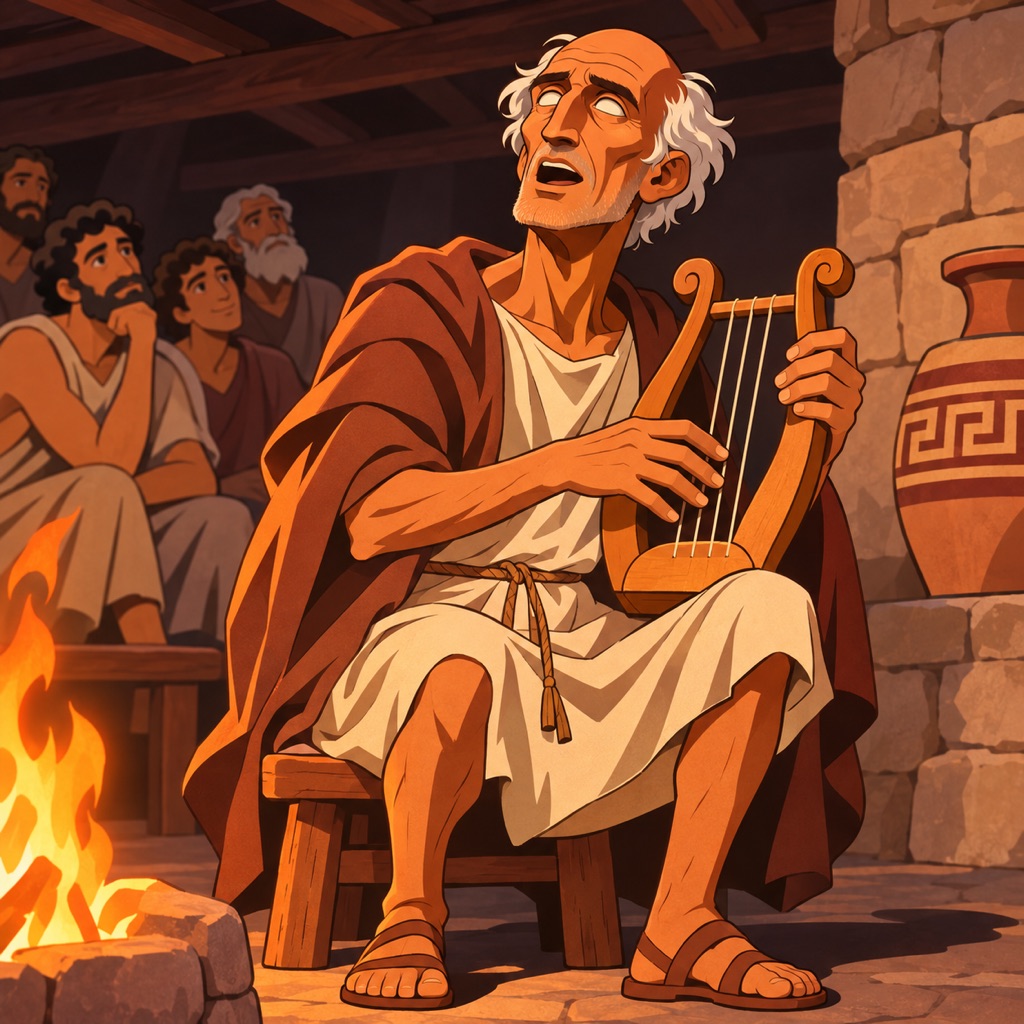
Almost everything we know about Homer is a guess the Greeks made themselves. They said he was blind. Several cities claimed him, Chios and Smyrna above all. The Homeric Hymn to Apollo has a singer describe himself as "a blind man, who lives in rocky Chios," and later readers took that as Homer's self-portrait. The ancient Lives of Homer fill in more, but they were written centuries after him and contradict each other freely.
What we do have are the poems. The Iliad runs to 15,693 lines and covers a few weeks in the tenth year of the war at Troy, built around one man's rage. The Odyssey runs to 12,110 lines and follows one man's ten-year journey home and what he found there. Most scholars date the Iliad to around 750–700 BCE and the Odyssey a little later. (Read the Iliad summary for the plot book by book.)
Whether "Homer" was one poet, two, or a name for generations of singers is the oldest argument in literary studies. It even has a name: the Homeric question. The strongest clue came in the 1920s and 1930s, when the American scholar Milman Parry studied the poems' repeated phrases: "rosy-fingered dawn," "the wine-dark sea," "swift-footed Achilles." He showed they fit the rhythm of the verse like interchangeable parts. Parry and his student Albert Lord then recorded illiterate singers in Yugoslavia who could perform epics of many thousands of lines, building each line from stock phrases as they went. Homer's poems, they argued, came out of the same kind of oral craft. Somebody eventually wrote them down, but they were made to be heard.
That matters for everything else on this page. The Iliad and the Odyssey are not history books. They are the end product of centuries of singers carrying a memory of the Bronze Age across a period when nobody in Greece could write.
The Bronze Age Palaces: Mycenae and Linear B
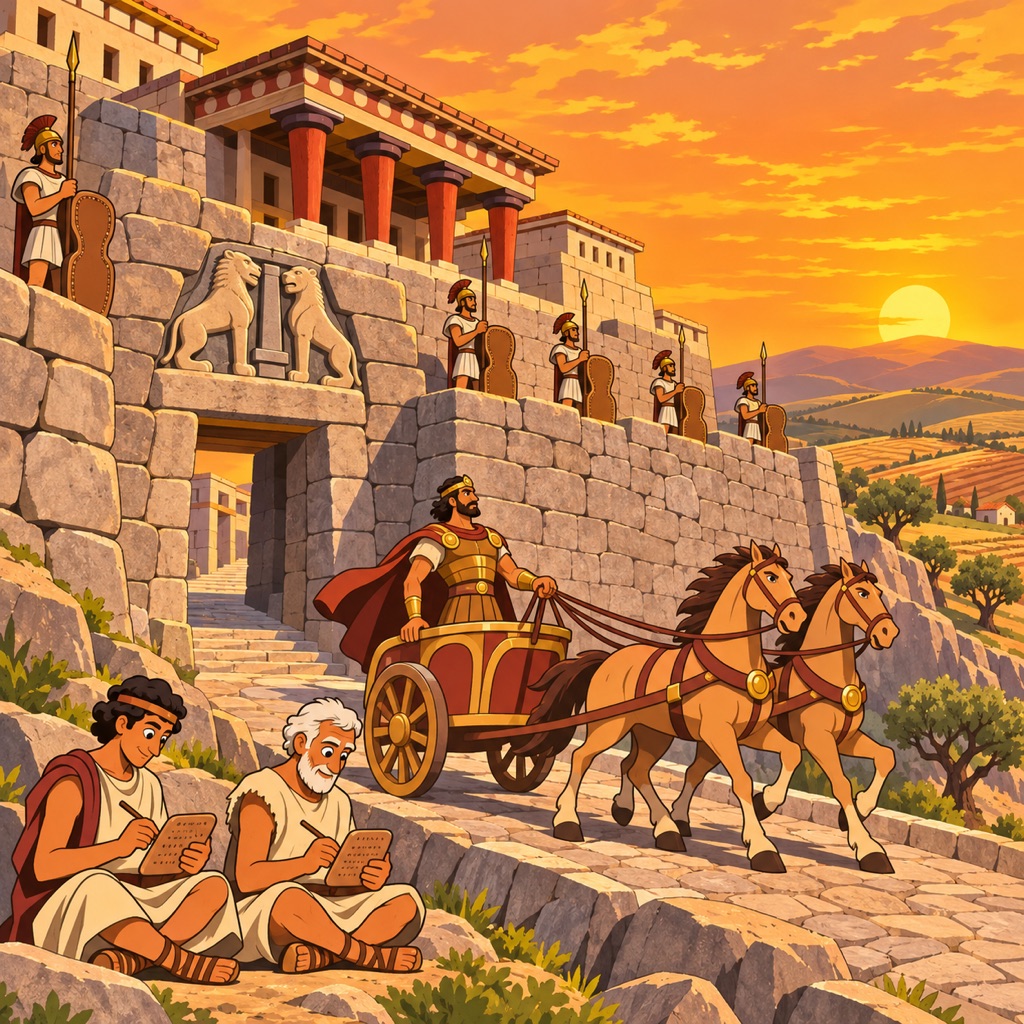
The world the songs remember is the Late Bronze Age, roughly 1600 to 1200 BCE. Historians call its Greek culture "Mycenaean," after Mycenae, the hilltop fortress in the Peloponnese that Homer calls "rich in gold" and makes the seat of King Agamemnon.
Mycenae deserves the description. In 1876 the German businessman Heinrich Schliemann opened a circle of shaft graves inside its walls and found gold death masks, gold cups and inlaid bronze daggers. He wired a famous message claiming he had looked on the face of Agamemnon. He hadn't. The graves date to around 1600–1500 BCE, centuries before any Trojan War could have happened. But they proved that Homer's "golden Mycenae" was a real place of real wealth.
The Mycenaean kingdoms were run from palaces: Mycenae and Tiryns in the Argolid, Pylos in the southwest, Thebes in Boeotia, and Knossos on Crete after the Greeks took control there. The walls of Mycenae and Tiryns are built of stones so large that later Greeks believed one-eyed giants, the Cyclopes, must have stacked them. The Lion Gate at Mycenae, with two carved lions over the lintel, dates to around 1250 BCE.
These palaces wrote. Their script, Linear B, was found on clay tablets at Knossos by Arthur Evans in 1900 and in a large archive at Pylos by Carl Blegen in 1939. For decades nobody could read it. In 1952 a young English architect, Michael Ventris, showed that the language was an early form of Greek. Working with the philologist John Chadwick, he opened the palace records to the world.
What they found was bookkeeping. The tablets list sheep, wheat, oil, bronze, chariot wheels, slaves and offerings. No poems, no letters, no histories. The tablets were never meant to last: they were unbaked clay, wiped and reused. They survive because the palaces burned, and the fires baked them hard.
They still hold surprises. The tablets name gods the Greeks would worship for another thousand years: Zeus, Hera, Poseidon, Hermes, Artemis, even Dionysus, once thought a late arrival. Scholars have also read men's names on them that match Homer's heroes, including forms of Achilles and Hector, borne by ordinary people.
And the archaeology matches small details in the poems. In Iliad 10.261–265, Odysseus is lent a leather cap covered with rows of boar's tusks. Helmets made exactly that way, with tusk plates cut from dozens of boars, turn up in Mycenaean graves. They had gone out of use long before Homer's day. The song kept the memory of an object nobody had seen for centuries.
The Collapse of c. 1200 BCE
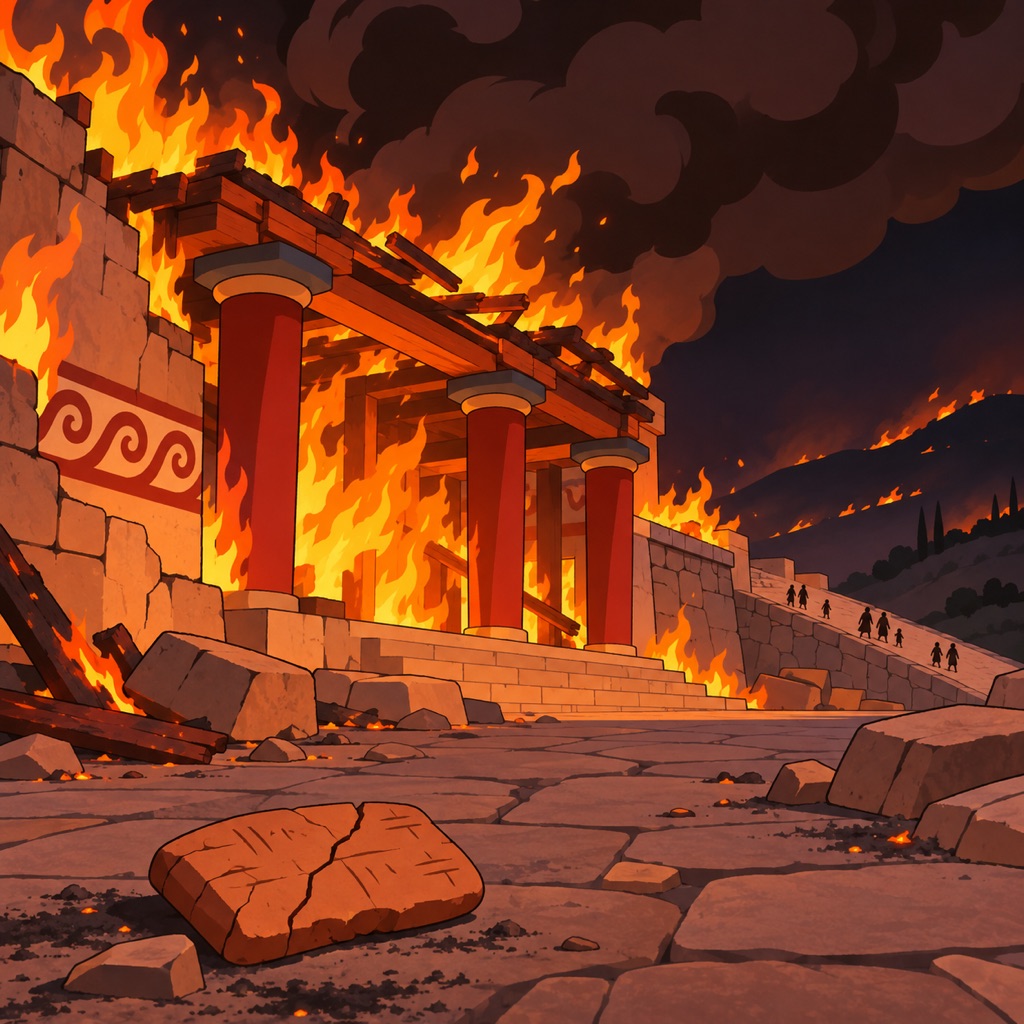
Around 1200 BCE, give or take a few decades, the palace world came apart. Pylos burned and was never rebuilt. Mycenae and Tiryns suffered destructions. Thebes went up in flames. Across the eastern Mediterranean the story repeats: the Hittite capital Hattusa in central Anatolia was abandoned, and the rich trading city of Ugarit on the Syrian coast was destroyed.
Nobody knows exactly why. The candidates include drought and famine, a series of earthquakes, raiders by sea, revolts, and the breakdown of the long-distance trade in copper and tin that bronze depended on. Most historians now think several of these hit at once, and that palace economies, which controlled almost everything from the center, had little room to absorb a shock. Whatever the cause, the result in Greece was stark. The palaces were gone, the population fell sharply, and Linear B vanished. Writing disappeared from Greece for about four hundred years.
The Greeks of later centuries had no memory of this as a collapse. They remembered it as an age of heroes that ended. Hesiod, writing around 700 BCE, described a "race of heroes" who fought at Thebes and at Troy and were followed by his own grim "age of iron." The songs about Troy carried the glory of the palace world across the silence, and that is why the Trojan War story survived when the tablets themselves were forgotten.
The Dark Age and the Return of Writing
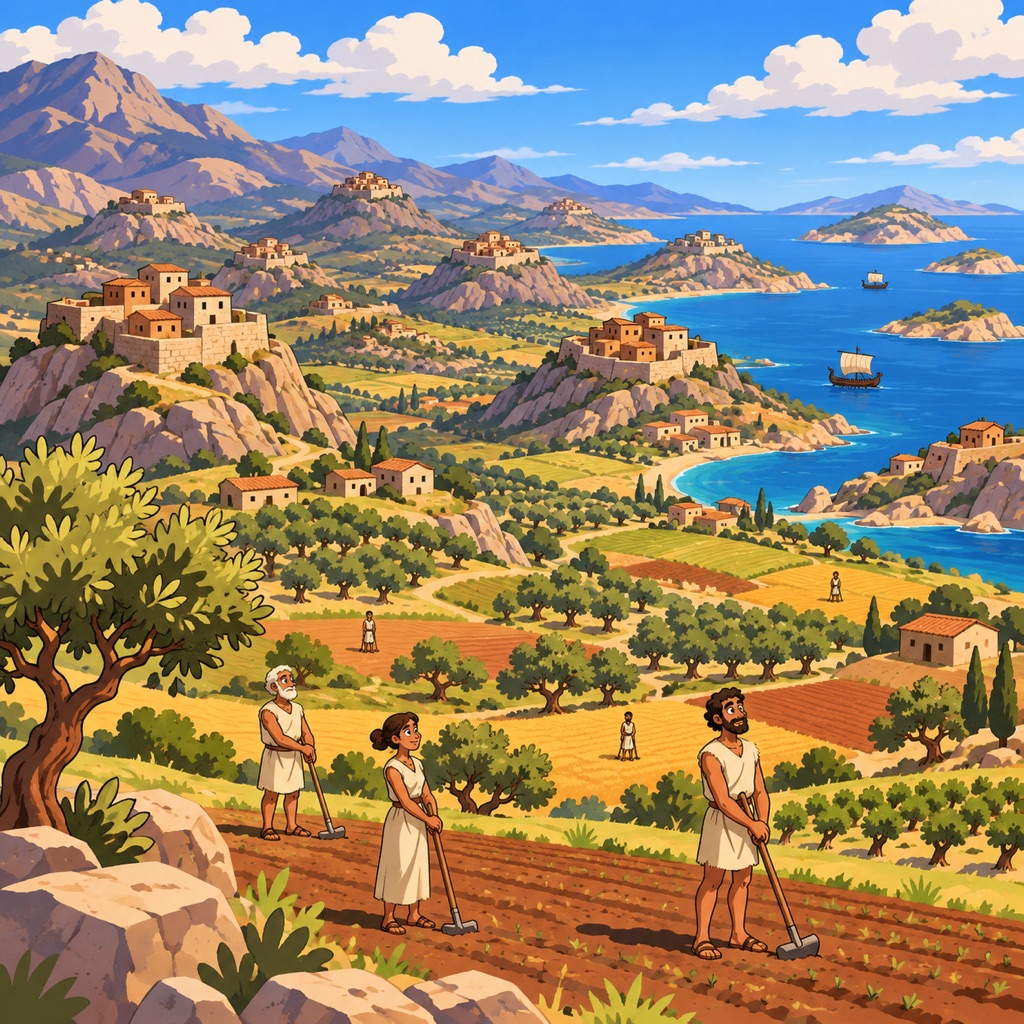
The centuries after the collapse, roughly 1100 to 800 BCE, are often called the Greek Dark Age. The name is half true. Life was poorer and smaller, and with no writing the period is dark to us. But it was not empty.
At Lefkandi on the island of Euboea, archaeologists found a long building from around 950 BCE, nearly 50 meters long, raised over the burial of a warrior, a woman wearing gold, and four horses. Somebody in the "dark" age could still command enough labor and wealth to honor the dead like a king. Greeks were also moving: across the Aegean to the coast of Asia Minor, the region later called Ionia, where the tradition says Homer lived.
In the eighth century BCE the lights came back on fast. Greek traders adapted the Phoenician alphabet and added letters for vowels, which Greek needed and Phoenician did not write. Some of the earliest Greek alphabetic writing is poetry. A wine jug from Athens, around 740 BCE, carries a line of verse promising it as a prize to the best dancer. A clay cup buried around 730–720 BCE on the island of Pithekoussai, off Naples, jokes in verse that it is "Nestor's cup," the great cup of the old king in the Iliad, and that whoever drinks from it will be seized by desire for Aphrodite. Somebody at a drinking party was already making Homer jokes.
The same century saw the rise of the polis, the independent city-state with its own laws, gods and citizen army, and the first Greek colonies in Sicily, southern Italy and around the Black Sea. The Greeks dated the first Olympic Games to 776 BCE. Hundreds of cities, often at war with one another, met there as Greeks. They had no king, no capital and no single state. What held them together was language, religion, festivals and the poems.
The Olympian Gods: Greek Mythology as the Greeks Told It
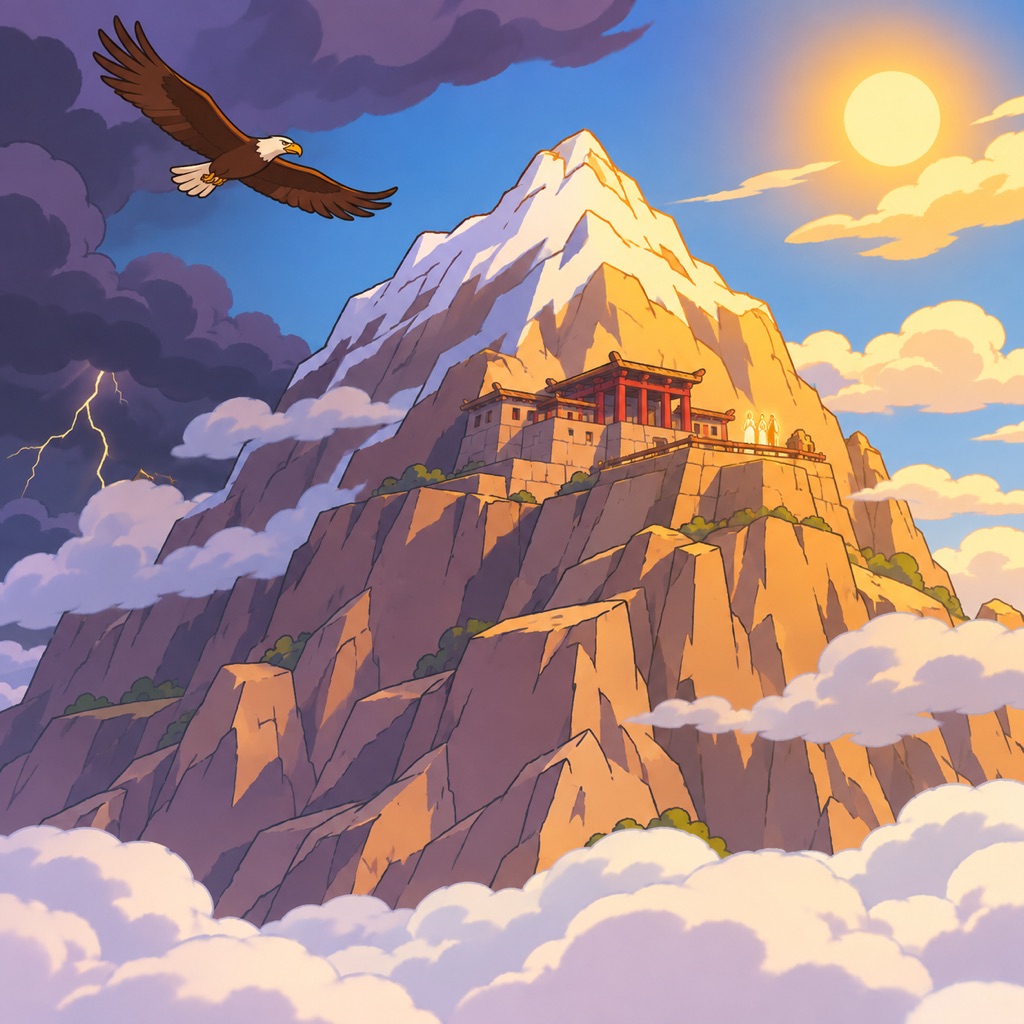
Greek mythology had no holy book and no single church. It had poets. The historian Herodotus, writing around 430 BCE, put it bluntly: Homer and Hesiod, who lived "not more than four hundred years before my time," were the ones who "gave the Greeks their theogony, gave the gods their names, divided their honors and crafts, and described their forms" (Herodotus 2.53). He overstated it, since the gods are already in the Linear B tablets, but he was right about who shaped how Greeks pictured them.
Hesiod's Theogony tells the family history. First came Chaos, then Earth. Earth's son and husband, Sky, was overthrown by his son Kronos. Kronos swallowed his own children to stop them doing the same to him, until his wife hid the youngest, Zeus, and fed Kronos a stone wrapped in swaddling clothes. Zeus grew up, forced his father to vomit up his brothers and sisters, and won a ten-year war against the Titans. Then he and his siblings divided the world: Zeus took the sky, Poseidon the sea, Hades the underworld.
The Olympians were the gods who lived with Zeus on Mount Olympus, at 2,918 meters the highest mountain in Greece. Greeks usually counted twelve, though the lists vary: Zeus, his wife Hera, Poseidon, Demeter, Athena, Apollo, Artemis, Ares, Aphrodite, Hephaestus, Hermes, and either Hestia or Dionysus.
What strikes modern readers is how badly they behave. In Homer the gods take sides in human wars, lie to each other, cheat on each other, and settle family quarrels at mortal expense. The Trojan War itself starts, in the legend, with a beauty contest between three goddesses (see the Judgment of Paris). Some Greeks hated this. The philosopher Xenophanes complained around 500 BCE that "Homer and Hesiod attributed to the gods everything that is a shame and reproach among men: theft, adultery and deceiving each other."
But the gods of the Iliad are not only petty. Zeus weighs the fates of two heroes on golden scales and accepts what the scales decide. Hermes guides an old king through an enemy camp at night. The gods live forever and therefore risk nothing. The humans die, and so everything they do counts. That contrast is the engine of Greek myth, and it is why the stories still work.
The Trojan War: The Legend in Brief
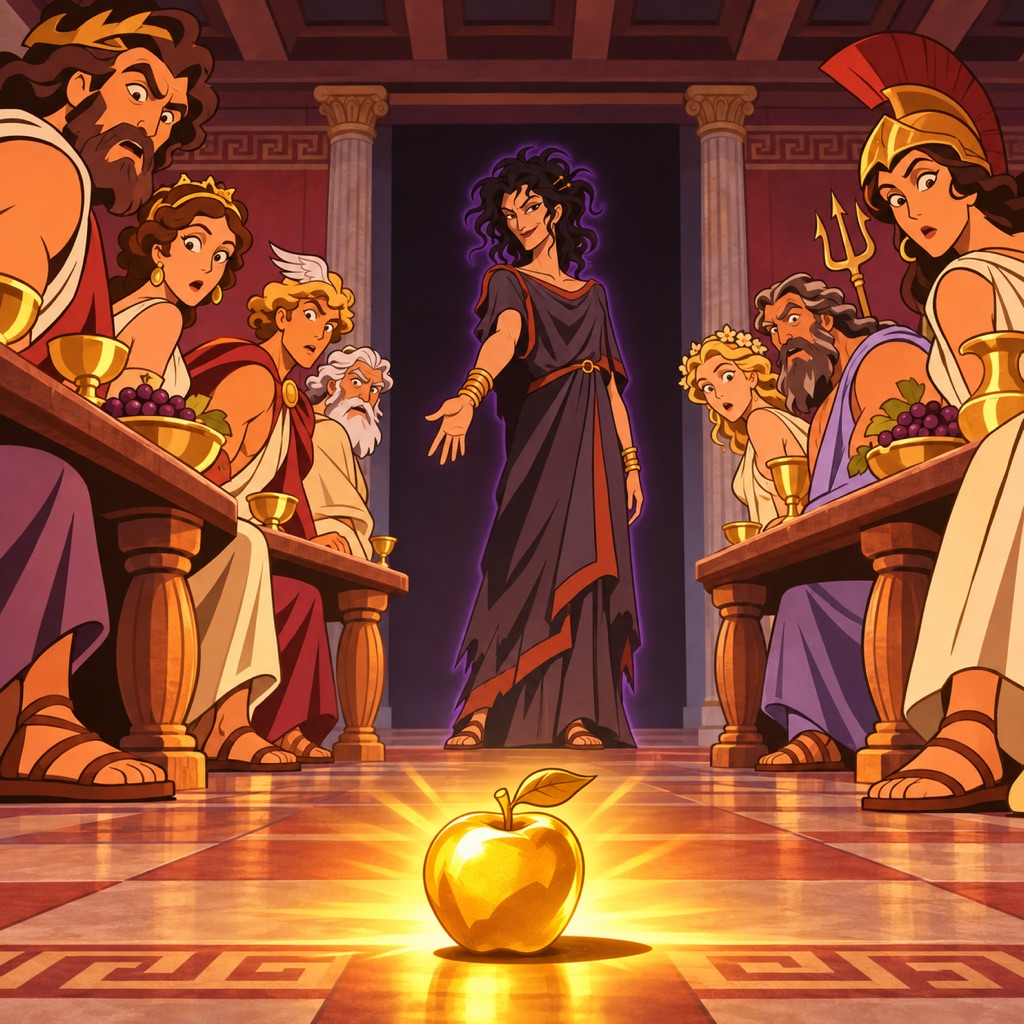
The most famous story in Greek mythology is the Trojan War. In outline: the goddess of strife, Eris, threw a golden apple into the wedding feast of the sea goddess Thetis and the mortal king Peleus. Hera, Athena and Aphrodite each claimed it, and Zeus had them judged by a young Trojan prince, Paris. Aphrodite bribed him with the most beautiful woman in the world. The woman was Helen, and she was already married to Menelaus, king of Sparta.
When Paris carried her off to Troy, he broke the sacred law of hosts and guests, and every king in Greece was bound by an old oath to help Menelaus get her back. A great fleet sailed under Menelaus's brother Agamemnon, king of Mycenae. The war lasted ten years. Achilles, the greatest Greek fighter, killed the Trojan champion Hector and was then killed by an arrow from Paris. In the end, the clever Odysseus had the Greeks build a wooden horse, hide their best men inside it and pretend to sail home. The Trojans pulled the horse into their city, ignoring the prophet Cassandra, and Troy fell in one night. (The full story of the trick is on our Trojan Horse page.)
Homer tells only part of this. The Iliad covers a few weeks in the tenth year; the Odyssey tells the horse in flashback. The rest comes from a set of lost epics known as the Epic Cycle (the Cypria, Aethiopis, Little Iliad and Sack of Troy among them), which survive mainly as short plot summaries by a later scholar named Proclus, and from later Greek writers such as Apollodorus and the Athenian tragedians. Where these sources disagree, which is often, the Greeks never felt the need to pick one official version.
Was Troy Real? The Archaeology
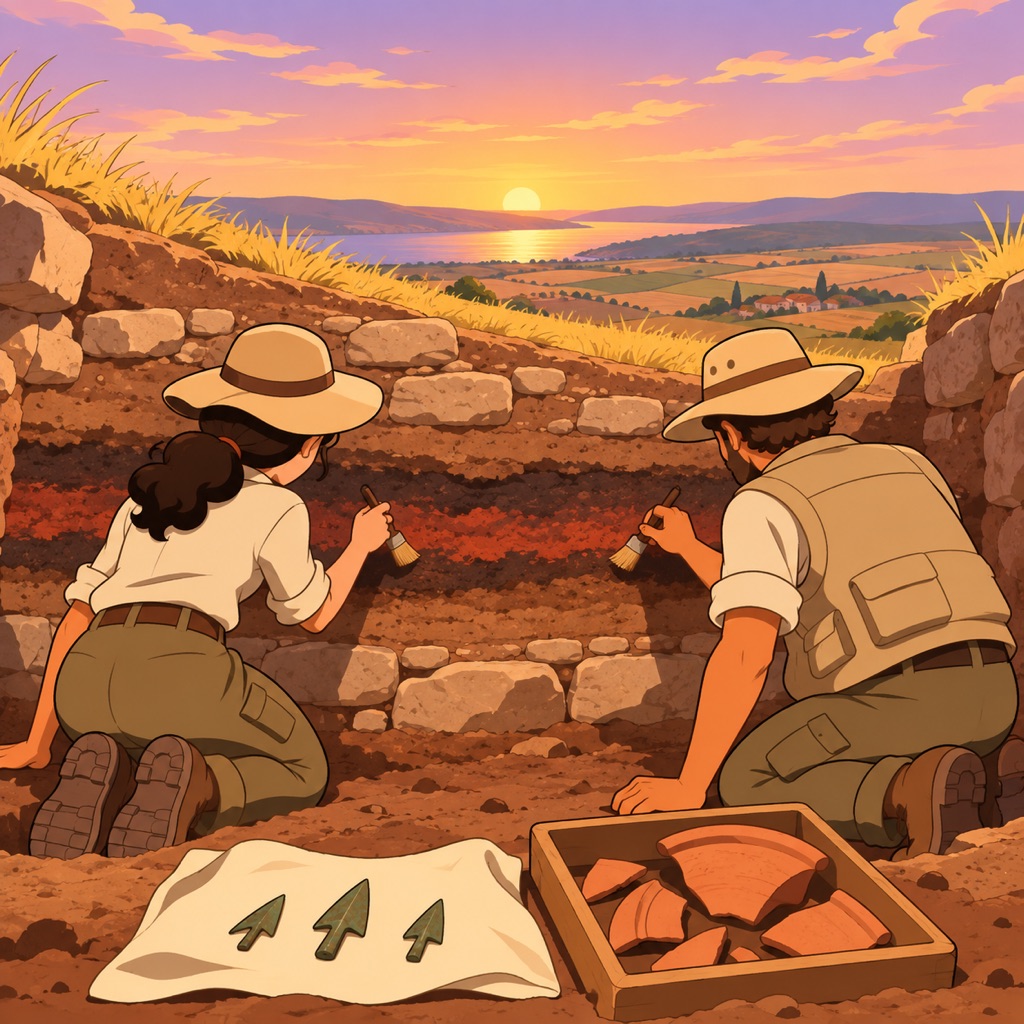
For a long time educated Europeans assumed Troy was a poet's invention. Then people started digging. In the 1860s the British consul Frank Calvert, who owned part of a mound called Hisarlik near the Dardanelles in northwest Turkey, identified it as the likely site and dug trial trenches. From 1870 Heinrich Schliemann, partly on Calvert's land, cut a huge trench through the mound. In 1873 he found a hoard of gold jewellery and named it "Priam's Treasure." It was about a thousand years too old for Priam, and his trench destroyed much of the later levels he was actually looking for.
Later excavators, Wilhelm Dörpfeld, Carl Blegen in the 1930s, and Manfred Korfmann's team from 1988, sorted the mound into layers from Troy I to Troy IX. Two matter most for the legend. Troy VI was a large, wealthy fortified city with sloping limestone walls, much like Homer's "well-walled" Troy. The level that followed, called Troy VIIa (or VIi), ended in a destruction by fire around 1180 BCE, with arrowheads and human remains in the ruins. Korfmann's work also showed a lower town outside the citadel, making Late Bronze Age Troy a far bigger place than Schliemann had imagined.
Written evidence comes from the Hittites, the great Anatolian empire of the time. Their archives mention a kingdom called Wilusa in northwest Anatolia, and most scholars identify Wilusa with Troy, whose other Greek name was (W)ilios. They also mention a power across the sea called Ahhiyawa, which most scholars take to mean Mycenaean Greeks (Homer's "Achaeans"). A treaty from around 1280 BCE names a king of Wilusa called Alaksandu, which sounds remarkably like Alexandros, Paris's other name in Homer. And in a letter of the mid-thirteenth century BCE, known as the Tawagalawa letter, a Hittite king writes to the king of Ahhiyawa about "the matter of Wilusa, over which we were hostile."
None of this proves the legend. No find names Achilles, Helen or a wooden horse. What it shows is a real, rich city in the right place, a conflict involving it and probably Greeks, and a destruction at about the right time. Our page Was Troy Real? sets out the evidence layer by layer.
Homer as the Teacher of Greece
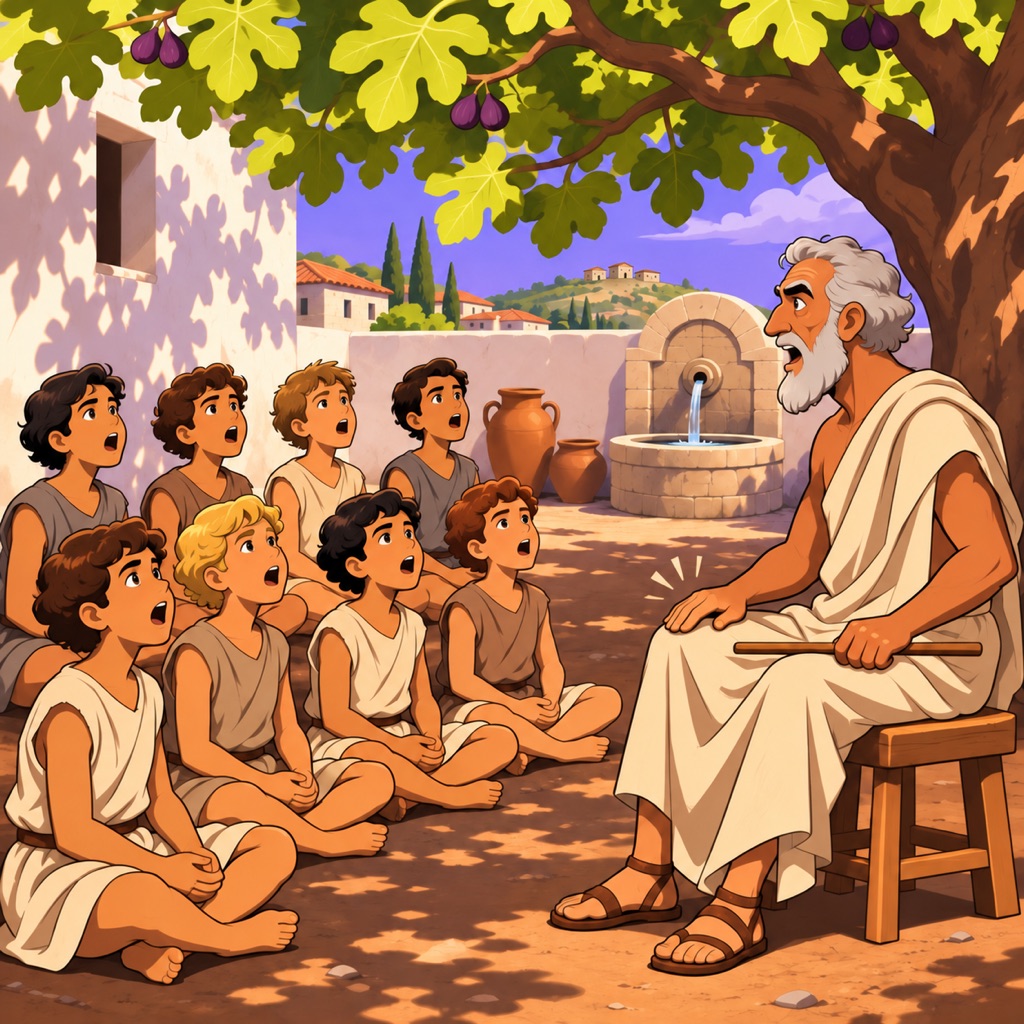
By the classical age, the fifth and fourth centuries BCE, the Greek world had changed beyond recognition. Athens had invented democracy, the Greeks had beaten back the Persian Empire at Marathon and Salamis, and the Parthenon stood on the Acropolis. Through all of it, Homer stayed at the center of Greek life.
Boys learned the poems at school, and grown men quoted them in court, in politics and over dinner. At Athens' great festival, the Panathenaia, professional reciters called rhapsodes performed Homer in competition. In Xenophon's Symposium, a guest boasts that his father made him learn the whole Iliad and Odyssey by heart.
Homer could even win you territory. Athens and its neighbor Megara fought over the island of Salamis, and according to Plutarch (Solon 10), the Athenians made their case with the Iliad. In the Catalogue of Ships, Ajax brings twelve ships from Salamis "and stationed them where the battalions of the Athenians stood" (Iliad 2.557–558). Plenty of Greeks said the Athenian statesman Solon had slipped that second line into the poem himself.
The philosopher Plato loved Homer and wanted him censored. In the Republic he argues that the poems show gods lying and heroes weeping, and that his ideal city should ban most poetry. Yet he admits the scale of what he was up against: there were people, he writes, who praised Homer as the poet who "has educated Greece" (Republic 606e). Plato's student Aristotle tutored Alexander the Great, and Plutarch says Alexander kept an annotated copy of the Iliad under his pillow on campaign. When he crossed into Asia in 334 BCE, one of his first stops was Troy.
That is the arc of ancient Greece in one line. A palace world burned around 1200 BCE. Singers carried its memory through four centuries without writing. When writing came back, the songs were written down, and a scattered people of rival cities agreed on very little except that these were their stories. Those stories, gods and monsters and grieving fathers included, are still told today.
Frequently Asked Questions
1What is ancient Greece known for?
Ancient Greece is known for Homer's Iliad and Odyssey, Greek mythology and the Olympian gods, the Olympic Games, democracy at Athens, philosophy (Socrates, Plato, Aristotle), and temples like the Parthenon. Before all that came the Bronze Age palace civilization of Mycenae, which collapsed around 1200 BCE.
2When was ancient Greece?
Historians usually trace ancient Greek history from the Mycenaean Bronze Age (c. 1600 to 1200 BCE), through the Dark Age (c. 1100 to 800 BCE) and the Archaic period (c. 800 to 480 BCE), to the Classical period (480 to 323 BCE) and the Hellenistic age after Alexander the Great.
3Who was Homer?
Homer is the name the Greeks gave to the poet of the Iliad and the Odyssey, composed around 750 to 700 BCE. Later Greeks said he was blind and came from Chios or Smyrna, but nothing about his life is certain. Many scholars think the poems grew out of generations of oral singers.
4Who were the Olympian gods in Greek mythology?
The Olympians were the twelve main gods who lived on Mount Olympus with Zeus: Zeus, Hera, Poseidon, Demeter, Athena, Apollo, Artemis, Ares, Aphrodite, Hephaestus, Hermes, and Hestia or Dionysus, depending on the list. Several of them already appear in Bronze Age Linear B tablets.
5Was the Trojan War real?
The legend as Homer tells it is poetry, but there was a real Troy. At Hisarlik in northwest Turkey, a city level called Troy VIIa ended in fire around 1180 BCE, and Hittite texts mention a kingdom called Wilusa, most likely Troy, and a conflict over it involving a power most scholars identify as the Greeks.
6What is the difference between the Iliad and the Odyssey?
The Iliad (15,693 lines) covers a few weeks in the tenth year of the Trojan War, centered on the rage of Achilles and the death of Hector. The Odyssey (12,110 lines) follows Odysseus's ten-year journey home after the war and his return to his wife Penelope on Ithaca.
Hear Ancient Greece Come Alive
Start with the free chapter The Golden Apple: Homer, the gods and the road to Troy, told as an audio story in the Histolumo app. Then follow Achilles and Hector to the walls of Troy.


Explore Ancient Greece
Judgment of Paris: The Apple of Discord
The Judgment of Paris myth: Eris and the golden apple of discord at a gods' wedding, three goddesses, three bribes, and the choice that started the Trojan War.
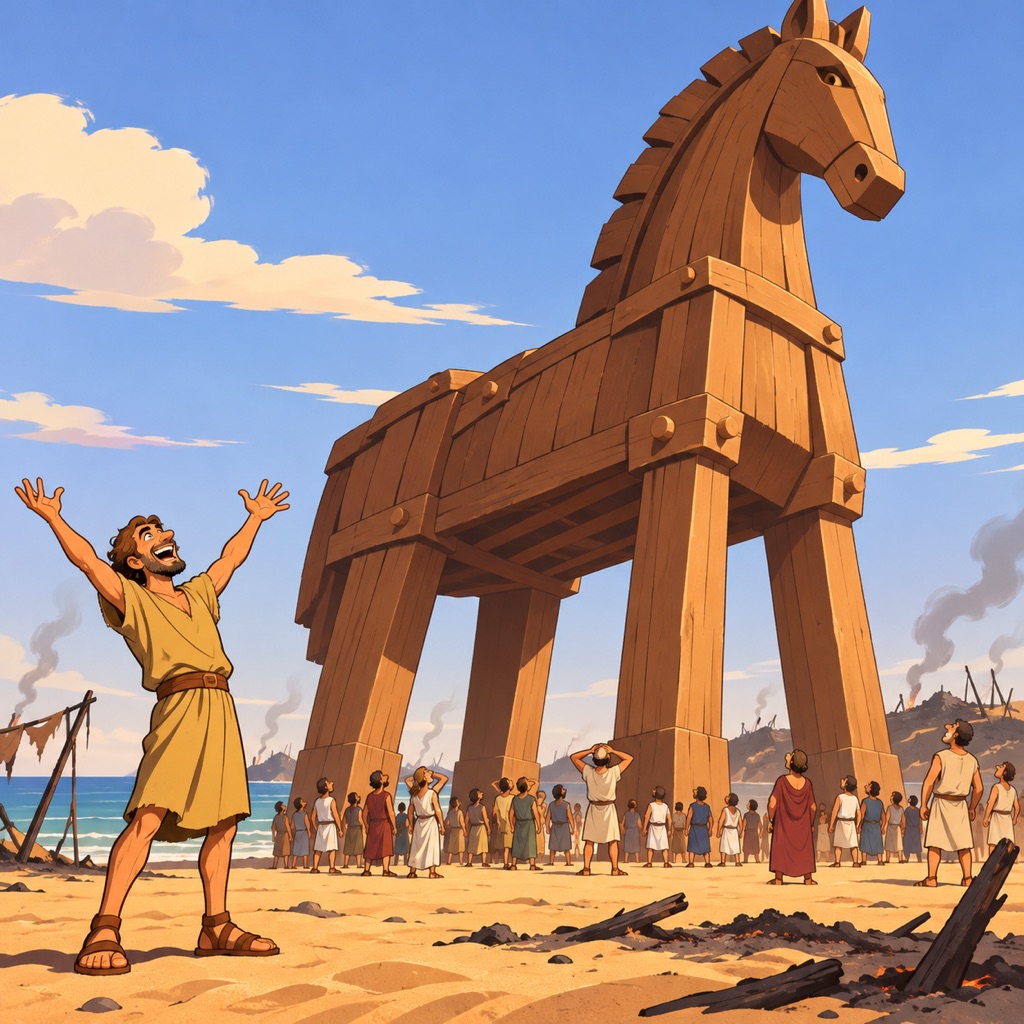
The Trojan Horse: The Real Story
The Trojan Horse real story, from Homer and the lost epics: who built it, who hid inside, Cassandra's warning, Helen's trick, and whether a horse ever existed.
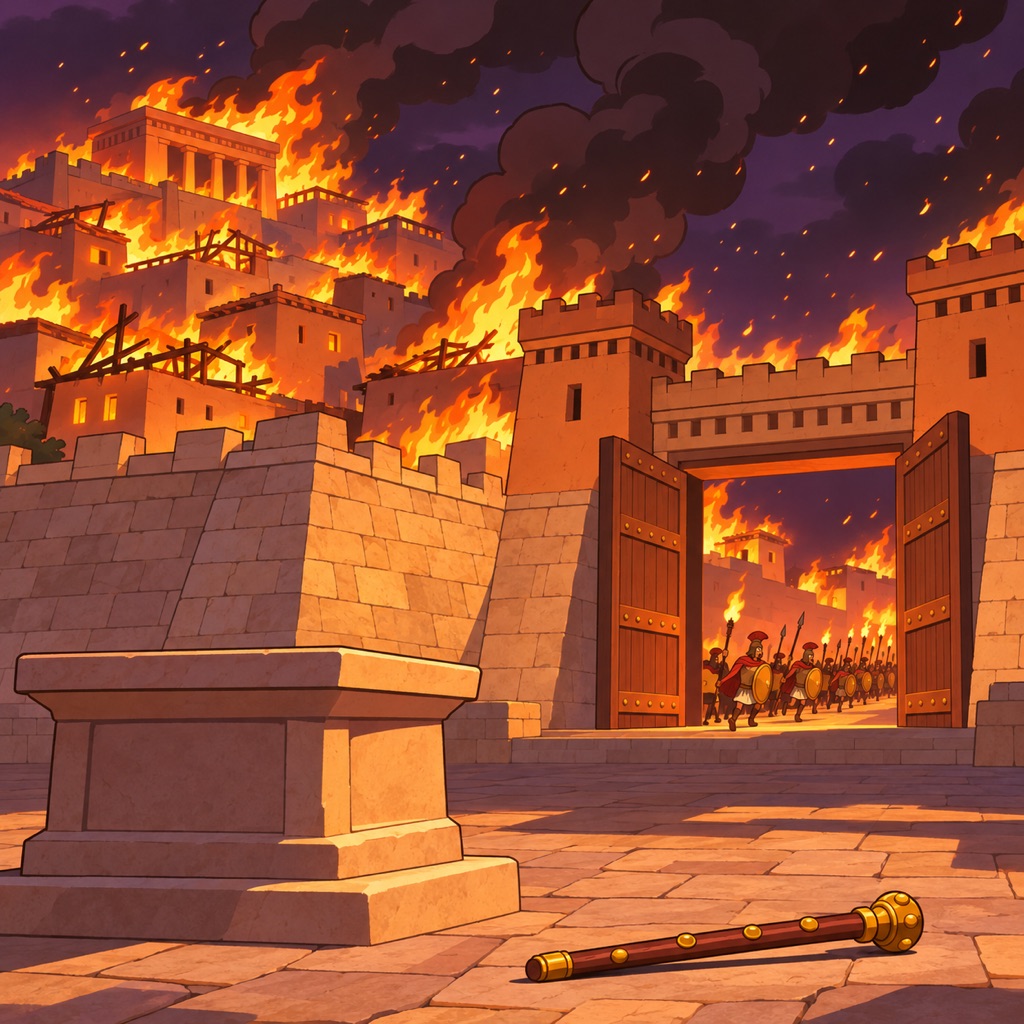
Trojan War Summary: The Whole Story
Trojan War summary in order: the golden apple, Helen and Paris, Achilles and Hector, the wooden horse and the fall of Troy, with a timeline and the archaeology.
Was Troy Real? What Archaeologists Found
Was Troy real? Yes: a Bronze Age city at Hisarlik in Turkey burned around 1180 BCE. Whether a Greek army burned it is still one of archaeology's big debates.
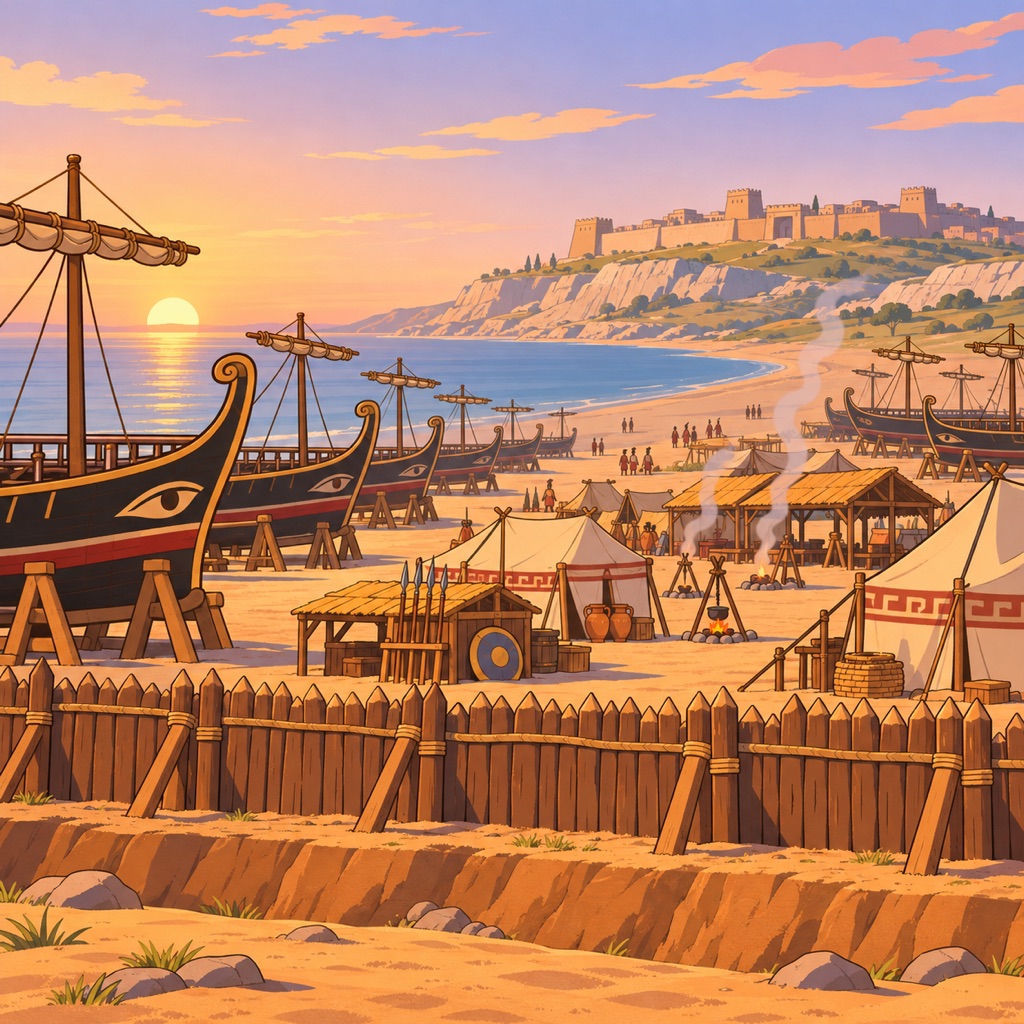
Iliad Summary: Achilles' Rage, Book by Book
Iliad summary, book by book: the quarrel, Patroclus, the death of Hector and Priam's ransom. Plus the main characters, the themes, and Iliad vs Odyssey.
Experience Ancient Greece Through Audio
Go beyond articles. Listen to dramatic stories from Ancient Greece narrated by Lumo, your immortal wolf guide.