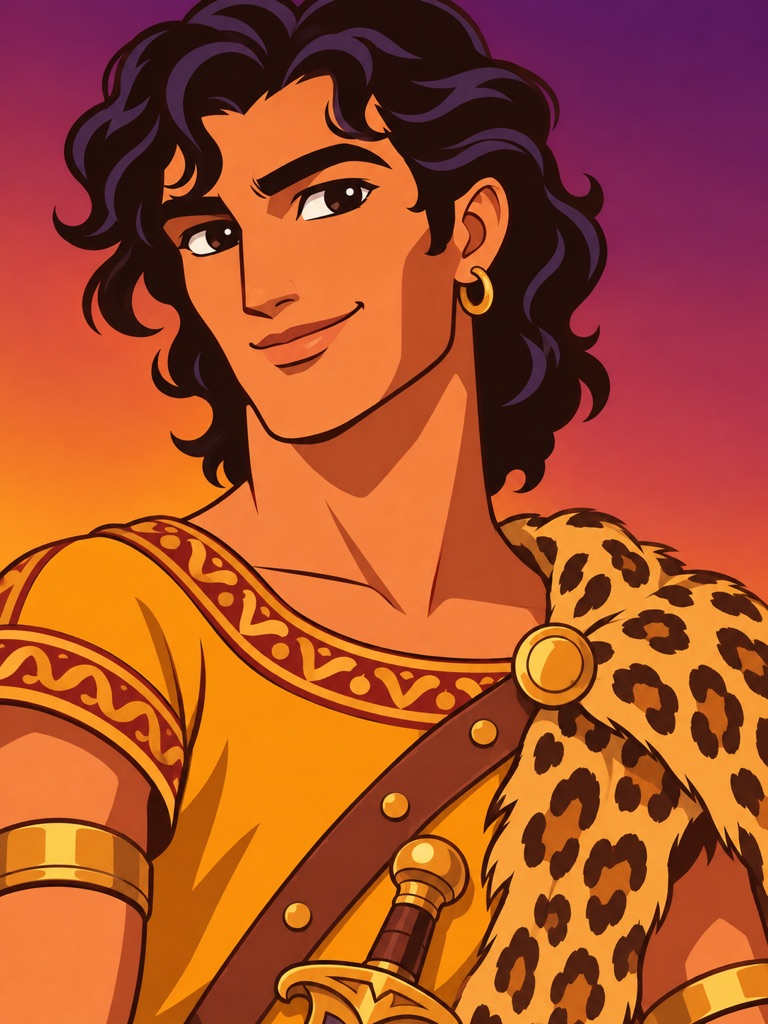
Who Was Paris of Troy?

Paris of Troy was a son of King Priam and Queen Hecuba in Greek myth. He judged three goddesses in a beauty contest, took Helen from her husband Menelaus in Sparta, and so started the Trojan War. Ten years later, with the god Apollo's help, he shot Achilles, and then he died himself from a poisoned arrow.
Homer usually calls him Alexandros, a Greek name that means something like "defender of men." The irony was not lost on anyone. He was the most beautiful man in Troy, a gifted archer, and to many of his own family a disgrace. His brother Hector told him to his face that the Trojans should have stoned him to death.
Was Paris of Troy a coward? Was he a villain, a victim of the gods, or just a spoiled prince? The ancient poets give us enough material to argue every side. Everything below comes from the ancient sources: Homer's Iliad, the lost epics summarised by Proclus, the mythographers Apollodorus and Hyginus, and the Athenian tragedians. These are myths and epic poetry, not history, and where the versions differ, we say so.
Hecuba's Dream and the Baby on Mount Ida
Paris's story begins with a nightmare. While Hecuba was pregnant with him, she dreamed that she gave birth to a burning torch, and that the fire spread through the whole city of Troy and burned it down (Apollodorus, Library 3.12.5). The dream appears in Pindar and in several tragedies, so it was well known by the fifth century BCE.
A seer explained it. In Apollodorus, this is Aesacus, Priam's son by an earlier wife, who said the child would be the ruin of the country and must be exposed. When the boy was born, Priam gave him to a herdsman named Agelaus to leave on Mount Ida, the wooded mountain range south of Troy.
The baby did not die. Apollodorus says a she-bear nursed him for five days. When Agelaus came back and found him alive, he took the child home, raised him as his own son, and named him Paris. When the young man grew up and fought off cattle thieves, people called him Alexandros, "defender of men."
Hyginus (Fabulae 91) tells how he came home. Priam held funeral games every year for the son he thought was dead, and the prize was a bull from the herds on Ida. Paris entered to win back his favourite bull, and beat everyone, including his own unknowing brothers. His brother Deiphobus drew a sword on him. Paris ran to the altar of Zeus, and his sister Cassandra, the prophetess no one believed, declared that he was their brother. Priam took him back into the palace. Euripides wrote a play about this, the Alexandros, which survives only in fragments.
So Troy had been warned. The family had tried to get rid of the firebrand, and the firebrand came home anyway.
The Nymph Oenone
While he was still a herdsman, Paris married a mountain nymph named Oenone, daughter of the river Cebren. Apollodorus (3.12.6) says she had learned the art of prophecy and medicine. She warned him not to sail to Greece for Helen, and when he went anyway, she told him one thing: if he was ever wounded, he should come back to her, because only she could heal him. Keep that in mind. It comes back at the end.
The Judgment of Paris
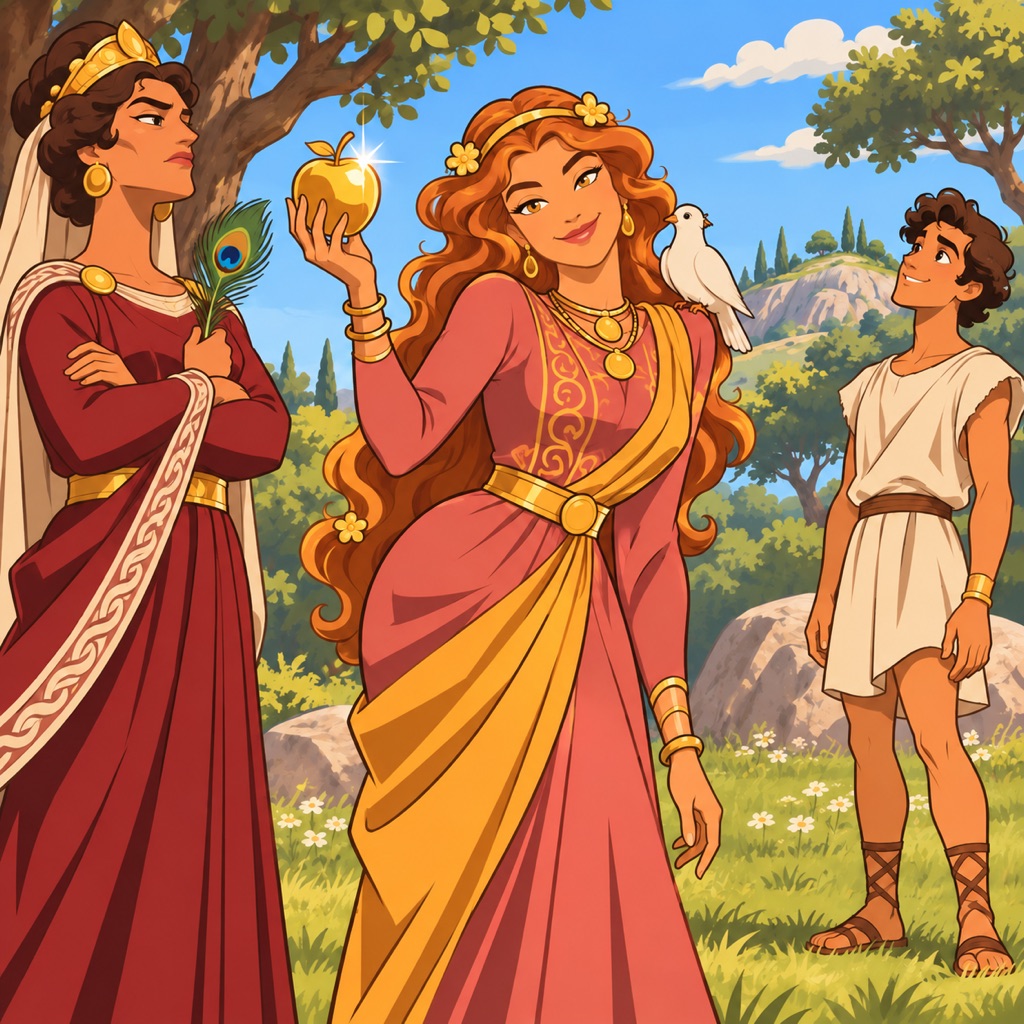
At the wedding of Peleus and Thetis, the parents of Achilles, the goddess Eris (Strife) threw a golden apple among the guests. Hera, Athena and Aphrodite each claimed it. Zeus refused to judge between his wife and his daughters, and sent Hermes to lead the three goddesses to Paris on Mount Ida.
Each goddess offered a bribe. In Apollodorus (Epitome 3.2), Hera offered him kingship over all men, Athena victory in war, and Aphrodite marriage to Helen. Paris chose Aphrodite. The full story is in The Judgment of Paris.
Homer barely mentions it. The only clear reference in the Iliad comes in the last book, where the poet explains why Hera and Athena hate Troy: Paris insulted them when they came to his farmstead, and praised the goddess who offered him painful lust (Iliad 24.25–30). The two losers never forgave him, his father, or his city.
Paris in Sparta: Breaking the Guest Law
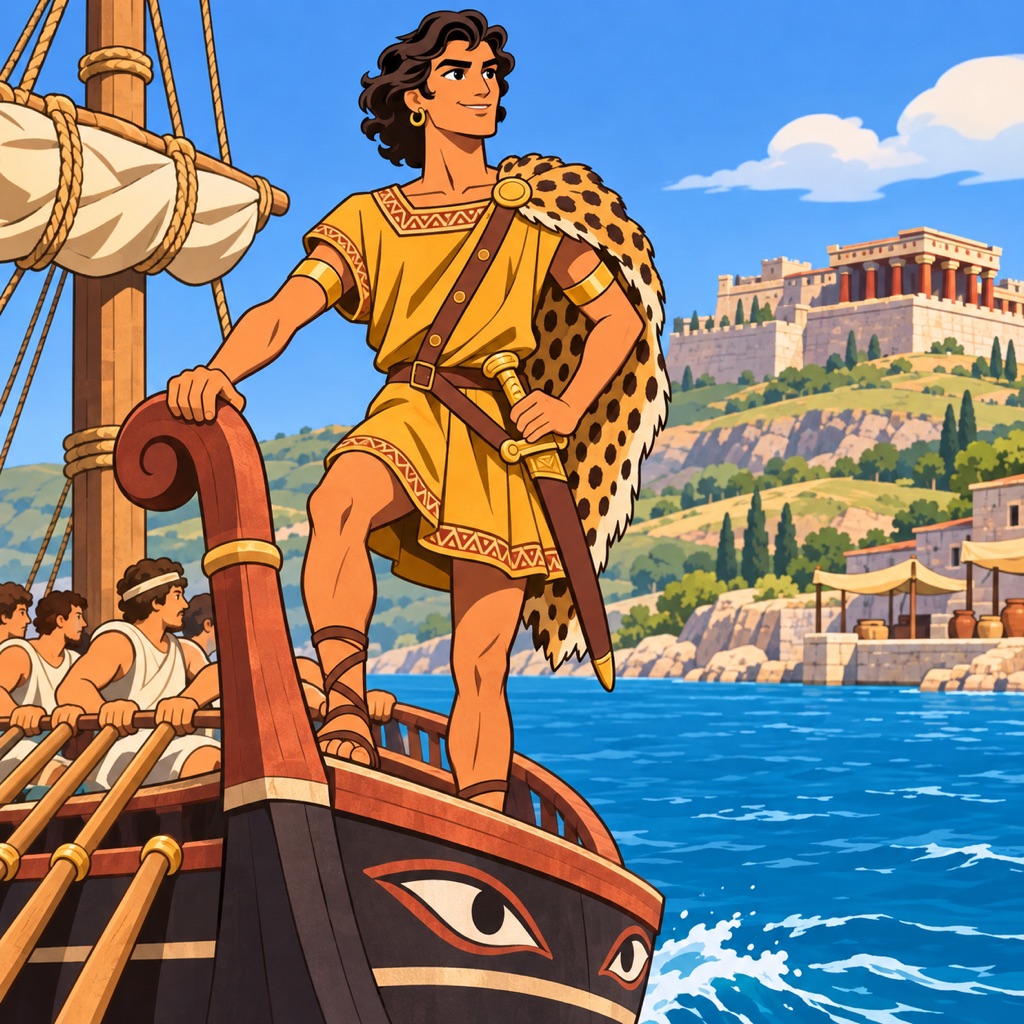
Paris did not simply wander into Greece. The Iliad names the craftsman who built his fleet, Phereclus, and calls those ships "the beginning of evils" (5.59–64). According to the Cypria, in Proclus's summary, Aphrodite told Paris to build them, and Aeneas sailed with him.
In Sparta, King Menelaus welcomed him as a guest. This mattered. The Greek law of guest-friendship, xenia, was sacred: a host fed and sheltered a stranger, and the guest never harmed his host. Zeus himself protected the rule. Apollodorus (Epitome 3.3) says Menelaus entertained Paris for nine days. On the tenth, Menelaus left for Crete to bury his grandfather Catreus and told his wife to give the guests everything they needed.
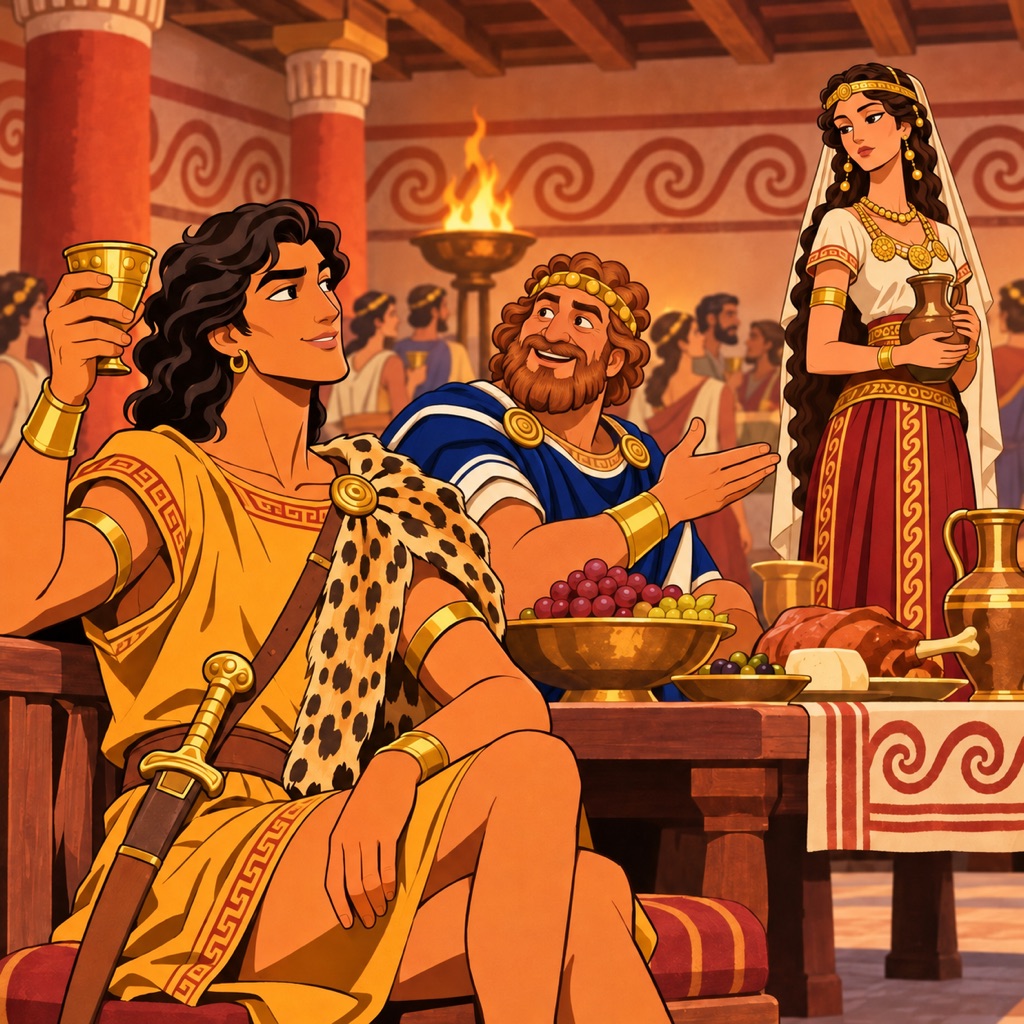
That was the end of the visit. Aphrodite brought Paris and Helen together, and the two sailed away by night with much of Menelaus's treasure.
The voyage home has two versions. The Cypria in Proclus says Hera sent a storm that drove them to Sidon in Phoenicia, and Paris sacked the city. The Iliad agrees they came by way of Sidon, where Paris collected fine embroidered robes (6.289–292). But Herodotus (2.117) says his copy of the Cypria had them reach Troy in three days with a fair wind, and he used the difference to argue that Homer did not write the Cypria.
Either way, Paris had done something no Greek could forgive. He hadn't just taken a woman. He had robbed the man who fed him. Every king who had once courted Helen was bound by an oath to defend her husband, and Menelaus's brother Agamemnon called them in. See Helen of Troy for that story.
Paris and Helen in Troy
The Trojans could have ended the war at any point by handing Helen back. In the Iliad, they keep trying. After a truce in Book 7, the Trojan elder Antenor proposes returning Helen and her treasure. Paris refuses flatly. He offers to give back the treasure and add some of his own, but he will not give up the woman (7.347–364). Later we learn that Paris had bribed a Trojan named Antimachus with gold to argue against returning Helen (11.123–125).
Paris and Helen's marriage in Homer is not a love story. Helen is frank about what she thinks of him. In Book 6 she tells Hector she wishes she were married to a better man, one who could feel shame. This one, she says, has no steady mind and never will, and he will reap the reward of it (6.350–353). And yet, after the duel in Book 3, she goes to bed with him. The Iliad lets both things be true.
The Duel with Menelaus: Iliad Book 3
This is the scene behind the search "Paris of Troy was a coward."
The Iliad opens its first battle with Paris strutting at the front of the Trojan line in a leopard skin, with a bow, a sword and two spears, challenging the best of the Greeks to fight him (3.16–20). Menelaus sees him and jumps down from his chariot, delighted, like a hungry lion that finds a stag. Paris sees Menelaus and shrinks back into the crowd "like a man who sees a snake in a mountain glen and jumps back, trembling, pale" (3.30–37).
Hector is disgusted. He calls him Dysparis, "evil Paris," "best in looks, woman-mad, seducer," and wishes he had never been born, or had died unmarried (3.39–40). The Trojans, he says, are too timid: otherwise they would long ago have "dressed you in a tunic of stone" (3.56–57), a grim way of saying stoned you to death.
Paris's answer is interesting. He does not argue. He says Hector's rebuke is fair, that Hector's heart is as hard as an axe, but that the gifts of golden Aphrodite are not to be scorned, because no one chooses the gifts of the gods (3.59–66). Then he offers to fight Menelaus alone, with Helen and her treasure as the prize, to settle the war.
The duel goes badly. Paris throws first, and his spear stops against Menelaus's shield. Menelaus's spear drives through Paris's shield and armour and would have killed him if he hadn't twisted away. Menelaus smashes his sword on Paris's helmet; the blade shatters. Then he grabs Paris by the horsehair crest and drags him toward the Greek lines, the chin strap choking him. Aphrodite snaps the strap, wraps Paris in mist, and sets him down in his own perfumed bedroom (3.340–382).
Helen is sent to him. She tells him she wishes he had died out there (3.428–436). Paris shrugs it off. Menelaus won with Athena's help, he says, and next time it will be his turn. Then he takes her to bed, saying he has never wanted her so much, not even on the island where they first slept together after leaving Sparta (3.438–447).
Hector's Scorn: Iliad Book 6
In Book 6, with the Trojans losing, Hector goes looking for Paris and finds him at home, polishing his armour and handling his curved bow while Helen sits among her maids (6.321–324). Hector tears into him: the men are dying at the walls because of you, and you would curse anyone else you saw hanging back (6.325–331). Again Paris agrees. He says he was sitting with his grief, Helen has been urging him back to battle, and he will come.
He does. Homer gives him one of the most glorious images in the poem: Paris running down from the citadel in shining bronze, laughing, like a stallion that breaks its halter and gallops to the river where it bathes (6.503–514). He catches up with Hector at the gate. Hector's last word on him is the fairest judgment of Paris in all of Greek literature: "No one who is fair would slight your work in battle, because you are strong. But you hang back on purpose and don't want to fight. And my heart aches when I hear the Trojans insult you" (6.521–525).
Was Paris of Troy a Coward?
Homer's answer is: not exactly. Paris is capable and he does fight, but he lacks the will to keep doing it, and everyone notices.
The evidence on the other side is real. In the Iliad, Paris accepts a duel to the death with the strongest man he has wronged. He leads one of the five Trojan divisions in the attack on the Greek wall (12.93). His arrows wound three of the leading Greeks in a single day: Diomedes in the foot (11.369–378), the healer Machaon in the shoulder (11.505–507), and Eurypylus in the thigh (11.581–583). He kills Menesthius (7.8–10), Euchenor (13.660–672) and Deiochus (15.341).
Part of his reputation comes from the weapon. Homer's heroes fight face to face with spear and sword. An archer shoots from cover. When Paris wounds Diomedes, Diomedes sneers at him: "Archer, braggart, proud of your bow, ogler of girls" (11.385). To Diomedes, an arrow from behind a gravestone was no victory at all.
So Paris is not a man who runs from every fight. He is a man who fights when he feels like it, and who was a skilled archer in a culture that looked down on archery. And he was the cause of the whole war, which made every one of his absences worse.
The Archer Who Killed Achilles
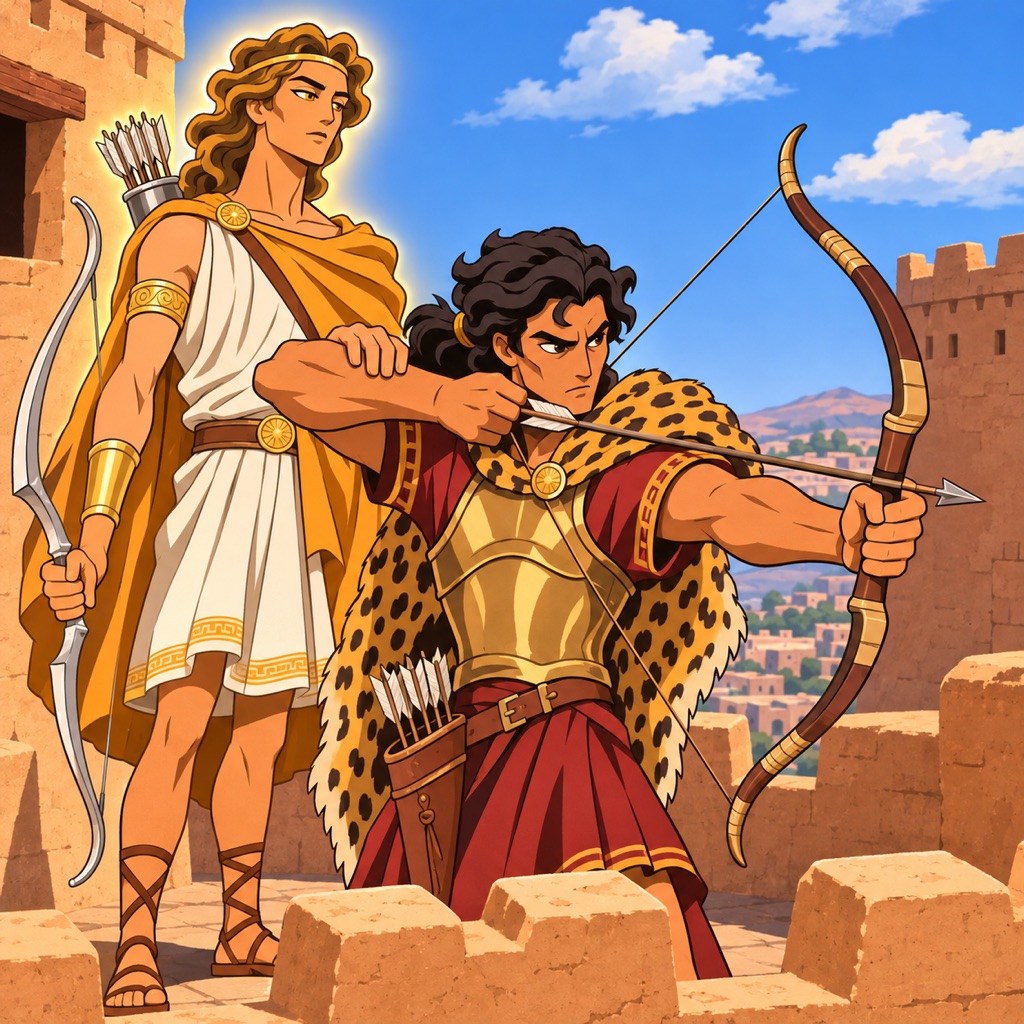
The Iliad ends before Achilles dies, but it tells us how he will. As Hector dies, he warns Achilles that "Paris and Phoebus Apollo" will kill him at the Scaean Gate, for all his strength (22.359–360). Earlier, Achilles himself remembers his mother telling him he would die under the walls of Troy by the swift arrows of Apollo (21.277–278).
The lost epic Aethiopis, in Proclus's summary, tells it: Achilles routed the Trojans and chased them into the city, and was killed by Paris and Apollo. Apollodorus (Epitome 5.3) adds where the arrow struck: Achilles was shot in the ankle at the Scaean Gate.
The more famous version, with baby Achilles dipped in the river Styx and held by one heel, is later. It appears in the Roman poet Statius in the first century CE. The Greek sources have the arrow and the ankle, and the god guiding it. For the man Paris killed, see Achilles, and for the war around them, Hector.
That makes Paris the man who killed the greatest warrior of the age, a fact that sits awkwardly next to his reputation. The poets never let him have the credit. In every version, Apollo is there.
Paris of Troy's Death: Philoctetes and the Bow of Heracles
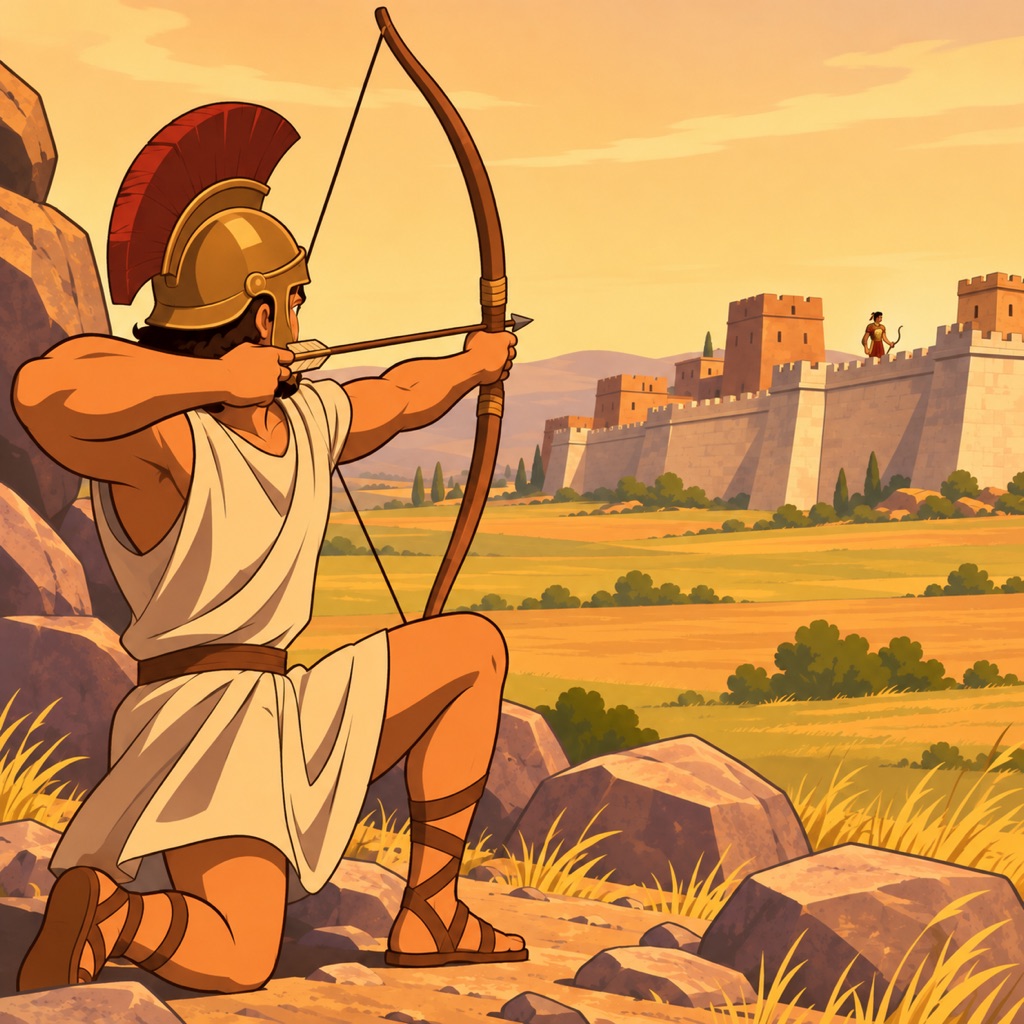
Paris of Troy's death came from another archer. Philoctetes had inherited the bow of Heracles, but on the way to Troy a snake bit him, and the wound smelled so foul that the Greeks left him behind on the island of Lemnos (Iliad 2.718–725). In the tenth year, a prophecy said Troy could not be taken without that bow. In the Little Iliad, Odysseus captures the Trojan seer Helenus, who reveals this, and Diomedes fetches Philoctetes from Lemnos. Sophocles' play Philoctetes sends Odysseus with Achilles' son Neoptolemus instead.
Proclus's summary of the Little Iliad is brief: Philoctetes, healed by Machaon, fights Alexandros in single combat and kills him. Menelaus mutilates the body, but the Trojans recover it and bury it. Apollodorus (Epitome 5.8) says Philoctetes was healed by Podalirius and then shot Paris.
Now Oenone returns. According to Apollodorus (3.12.6), the wounded Paris remembered her promise and went back to Mount Ida to be healed. She refused, out of bitterness over Helen. Paris was carried back toward Troy and died. Oenone changed her mind, hurried after him with her medicines, found him dead, and hanged herself. The love stories of Parthenius (no. 4) tell much the same tale, with Oenone mockingly telling Paris to ask Helen to heal him; in the later epic of Quintus of Smyrna she leaps onto his funeral pyre.
After his death, Helen was married to his brother Deiphobus. Paris did not live to see the Trojan Horse or the fire that Hecuba had dreamed of before he was born.
A Real Name in the Hittite Records?
There is no evidence that Paris existed. But one detail has fascinated historians. Hittite archives from what is now central Turkey preserve a treaty, from about 1280 BCE, between the Hittite king Muwatalli II and a ruler of Wilusa named Alaksandu. Most scholars identify Wilusa with Troy (the Greek name Ilios was once Wilios), and Alaksandu looks very like the Greek Alexandros, Paris's name in Homer.
That does not prove Paris was real. A name could have passed into legend from a real king without any of the story attached, and the resemblance may be a coincidence. But it is one of the few points where the legend touches a real document. For the full archaeological case, see Was Troy Real?. For the poem that made Paris famous, see the Iliad summary and the profile of Homer. For the wider world, see Ancient Greece.
Frequently Asked Questions
1Who was Paris of Troy?
In Greek myth, Paris (also called Alexandros) was a son of King Priam and Queen Hecuba of Troy. He judged the beauty contest of Hera, Athena and Aphrodite, took Helen from Menelaus of Sparta, and so caused the Trojan War. He later killed Achilles with an arrow, with Apollo's help.
2How did Paris of Troy die?
He was shot by the Greek archer Philoctetes, who used the bow of Heracles. This comes from the lost epic Little Iliad and from Apollodorus. In Apollodorus, the wounded Paris went to his first wife, the nymph Oenone, who alone could heal him; she refused, he died, and she then killed herself.
3Was Paris of Troy a coward?
Homer shows both sides. In Iliad Book 3 Paris shrinks from Menelaus and has to be rescued by Aphrodite, and Hector repeatedly scolds him for hanging back. But he also accepts a duel, leads troops, wounds Diomedes, Machaon and Eurypylus, and kills several Greeks. Hector himself says Paris is strong but unwilling.
4Did Paris and Helen love each other?
The Iliad never says so plainly. Paris refuses every offer to give Helen back and says he has never desired her more. Helen, though, tells Hector she wishes she had a better husband and tells Paris she wishes he had died in the duel.
5Did Paris really kill Achilles?
In the Greek sources, yes, with Apollo's help. Hector predicts it in Iliad 22.359–360, and the lost Aethiopis and Apollodorus describe it. Apollodorus says the arrow hit Achilles in the ankle. The vulnerable heel and the dip in the river Styx come from later Roman-era writers such as Statius.
6Why is Paris also called Alexander?
Homer usually calls him Alexandros. According to Apollodorus, he got the name, 'defender of men', as a young herdsman fighting off cattle thieves. A Hittite treaty of about 1280 BCE names a king of Wilusa, probably Troy, called Alaksandu.
Hear the Story of Paris
Three goddesses on a mountain, a guest who broke the oldest rule in Greece, and one arrow at the gates. Listen in Histolumo's Ancient Greece stories.


Hear Their Story
The Golden Apple
4 minThree goddesses, one golden apple, and a cattle herder on a mountain who had to pick the most beautiful.

Everything He Needs
4 minA king told his wife to give their Trojan guest everything he needed. The guest took her.
Who Gets the Armour?
4 minOne arrow from the walls of Troy, with a god's hand on the bow, and the greatest Greek warrior fell.
Related Articles
Iliad Summary: Achilles' Rage, Book by Book
Iliad summary, book by book: the quarrel, Patroclus, the death of Hector and Priam's ransom. Plus the main characters, the themes, and Iliad vs Odyssey.
Judgment of Paris: The Apple of Discord
The Judgment of Paris myth: Eris and the golden apple of discord at a gods' wedding, three goddesses, three bribes, and the choice that started the Trojan War.
Trojan War Summary: The Whole Story
Trojan War summary in order: the golden apple, Helen and Paris, Achilles and Hector, the wooden horse and the fall of Troy, with a timeline and the archaeology.
Was Troy Real? What Archaeologists Found
Was Troy real? Yes: a Bronze Age city at Hisarlik in Turkey burned around 1180 BCE. Whether a Greek army burned it is still one of archaeology's big debates.
Experience Paris of Troy's Story
Go beyond the biography. Hear Paris of Troy's story told by Lumo, your immortal wolf guide who witnessed these events firsthand.