Trojan War Summary in Brief
The Trojan War is the Greek legend of a ten-year war between the Greeks and the city of Troy, in what is now northwest Turkey. In short: the Trojan prince Paris carried off Helen, wife of King Menelaus of Sparta; the Greek kings, bound by an oath, sailed against Troy under Agamemnon; after the deaths of Hector and Achilles, the Greeks took the city by hiding soldiers inside a wooden horse. The story comes from Homer's Iliad and Odyssey and from lost epics summarized by later Greek scholars. It is myth and poetry, but there was a real Troy, and it burned around 1180 BCE.
That is the version that fits on a postcard. The full Trojan War story is stranger and much darker. It starts with Zeus deciding the earth has too many people, runs through a wedding, a beauty contest, a stolen queen, a sacrificed daughter, nine years of raiding, a quarrel over a captive woman, and one of the great revenge stories of world literature. It ends with a city on fire and a victory that ruins nearly everyone who wins it.
Here is the whole legend in order, with the ancient source named for each part.
Where the Trojan War Story Comes From
No single ancient text tells the whole war. Homer's Iliad, composed around 750–700 BCE, covers only a few weeks in the tenth year. His Odyssey looks back on the fall of Troy in flashbacks. Everything else came from a set of epics the Greeks called the Epic Cycle, composed in the seventh and sixth centuries BCE:
- the Cypria, from the origins of the war to the start of the Iliad
- the Aethiopis, from Hector's funeral to the death of Achilles
- the Little Iliad, from the contest over Achilles' armour to the wooden horse
- the Sack of Troy (Iliou Persis), the fall of the city
- the Returns (Nostoi), the voyages home
These poems are lost except for a few lines. What survives is a set of plot summaries by a scholar named Proclus, preserved in manuscripts of the Iliad. Later Greek writers fill the gaps: the mythographer Apollodorus (whose Library and Epitome are the closest thing to a complete handbook), the Latin compiler Hyginus, and the Athenian tragedians Aeschylus, Sophocles and Euripides, who staged episodes of the war in the fifth century BCE.
The sources often disagree, and the Greeks did not mind. This summary follows the Greek tradition and says when versions differ. It also flags the famous details that come from later Roman poets, Virgil above all, rather than from the Greeks.
Part 1: The Wedding and the Golden Apple
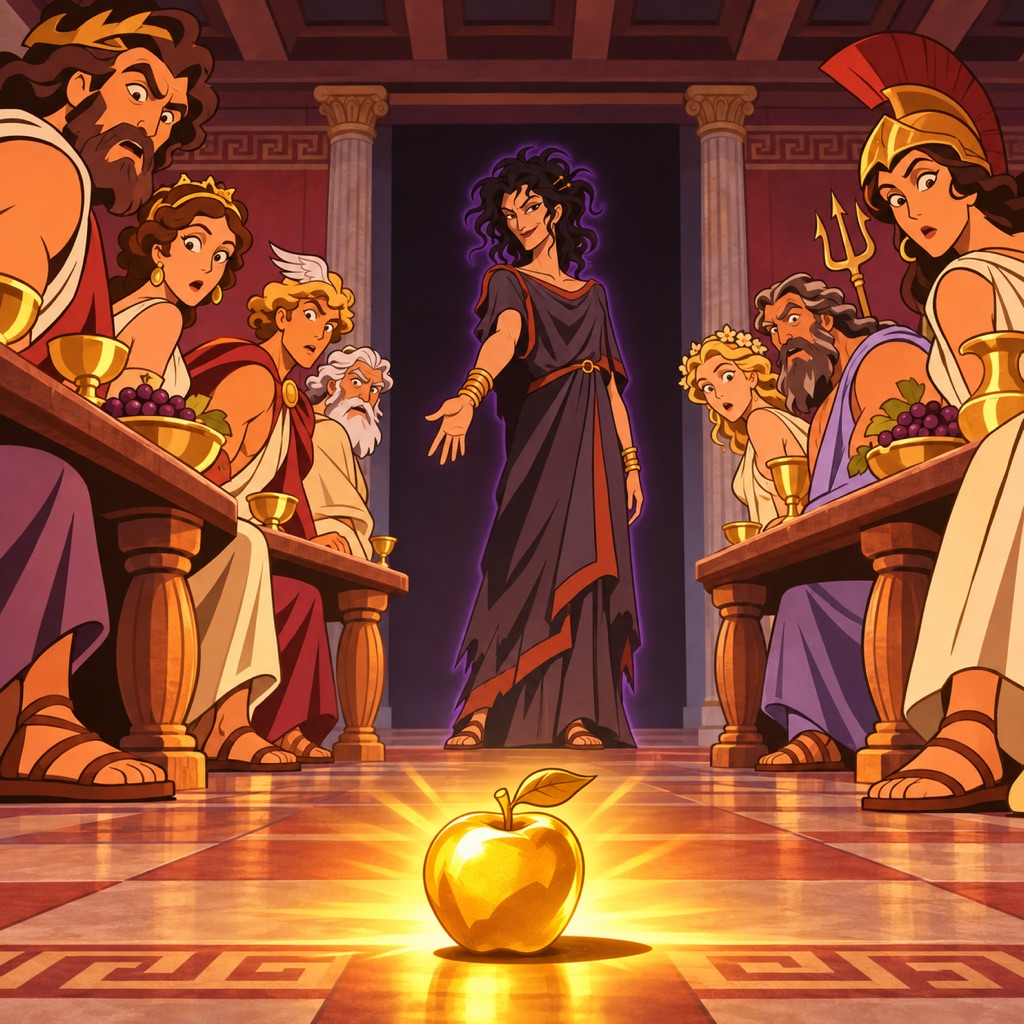
According to a fragment of the Cypria, the war began as a plan of Zeus. The earth was groaning under the weight of mankind, and Zeus, with the advice of Themis, resolved to lighten the load with a great war. The opening lines of the Iliad may echo this when they say that in all the slaughter "the plan of Zeus was being fulfilled."
The first step was a wedding. Thetis was a sea goddess, and both Zeus and Poseidon had wanted her until a prophecy warned that her son would be greater than his father (Pindar, Isthmian 8). So the gods married her off to a mortal, King Peleus. In the Iliad (24.59–63) Hera recalls that every god came to the feast, and Apollo played the lyre. Their son would be Achilles.
One goddess was left off the guest list: Eris, goddess of strife. Hyginus (Fabulae 92) says she came to the door anyway and threw in a golden apple, saying the most beautiful goddess should have it. The Cypria summary says only that Eris arrived during the feast and started a quarrel about beauty among Hera, Athena and Aphrodite. The inscription "to the fairest," which many retellings carve on the apple, is a later detail.
Zeus would not judge between his wife and two daughters. He sent Hermes to lead the three goddesses to Mount Ida near Troy, where a young prince named Paris (also called Alexandros) was herding cattle. Each goddess offered a bribe. Apollodorus (Epitome 3.2) gives the classic list: Hera offered rule over all men, Athena victory in war, and Aphrodite marriage to Helen. Paris chose Aphrodite.
Homer barely mentions this. His one clear reference, near the end of the Iliad (24.25–30), says Paris insulted Hera and Athena when they came to his farmyard and favored the goddess who offered him lust. Two goddesses walked away from that mountain as enemies of Troy, and they stayed enemies to the end. The full myth is on our Judgment of Paris page.
Part 2: Helen, the Oath and the Thousand Ships
Helen was the daughter of Zeus, either by the mortal queen Leda, who was visited by Zeus as a swan, or, in the Cypria, by the goddess Nemesis. She grew up in Sparta as the daughter of King Tyndareus, and every unmarried prince in Greece came to win her.
Tyndareus feared that whoever he chose, the losers would turn on the winner. Apollodorus (3.10.9) says it was Odysseus, a minor king from the rocky island of Ithaca, who suggested the fix: every suitor would swear to defend the chosen husband against anyone who wronged him over the marriage. In return, Tyndareus helped Odysseus win his niece Penelope. Helen married Menelaus, who became king of Sparta. His brother Agamemnon ruled Mycenae and was the most powerful king in Greece.
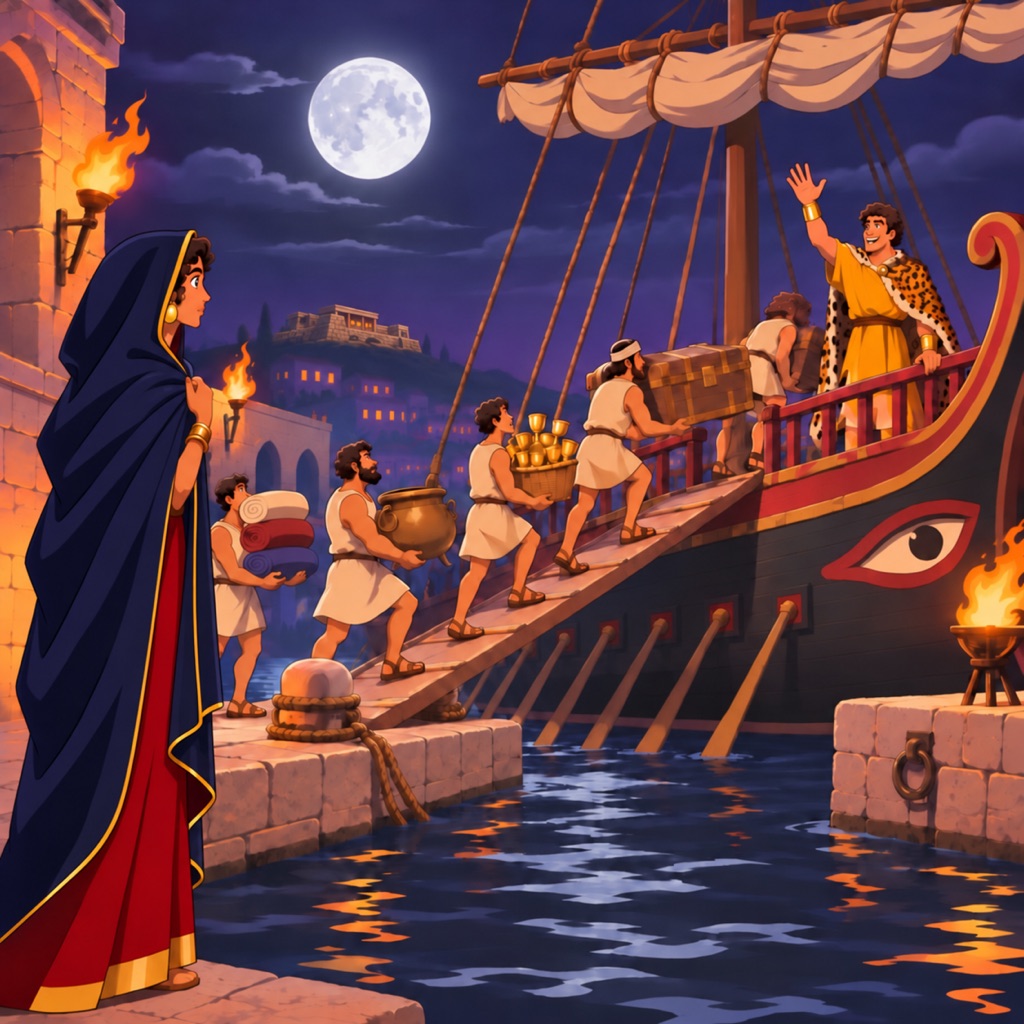
Years later Paris sailed to Sparta. Menelaus took him in as a guest, which in Greek terms was sacred. The law of xenia, guest-friendship, protected by Zeus himself, meant a host fed, bathed and sheltered a stranger, and a guest never harmed his host. Then, the Cypria summary says, Menelaus left for Crete and told Helen to give their guests everything they needed. Aphrodite brought Helen and Paris together, and they sailed by night with much of the palace treasure. In the Iliad, Helen later calls herself a "dog" and wishes she had died before she followed him (3.173–180, 6.344–348).
Not every Greek accepted this. The poet Stesichorus, around 600 BCE, wrote a famous "recantation" in which Helen never went to Troy at all: the gods sent a phantom in her place while the real Helen waited out the war elsewhere. Euripides built his play Helen on that version.
Menelaus called on the oath. His messengers went from kingdom to kingdom. Some heroes did not want to come. Odysseus, warned that if he went he would come home after twenty years alone and poor, pretended to be mad. In Hyginus's version (Fabulae 95) he yoked a horse and an ox to a plough and sowed his fields with salt, until a clever officer named Palamedes put his baby son Telemachus in front of the plough. Odysseus swerved, and his sanity was proved. Achilles' mother Thetis, who knew her son would die at Troy, hid him on the island of Skyros dressed as a girl among the king's daughters. Odysseus found him by bringing gifts with a spear and shield among them, then sounding a trumpet (Hyginus 96; Apollodorus 3.13.8).
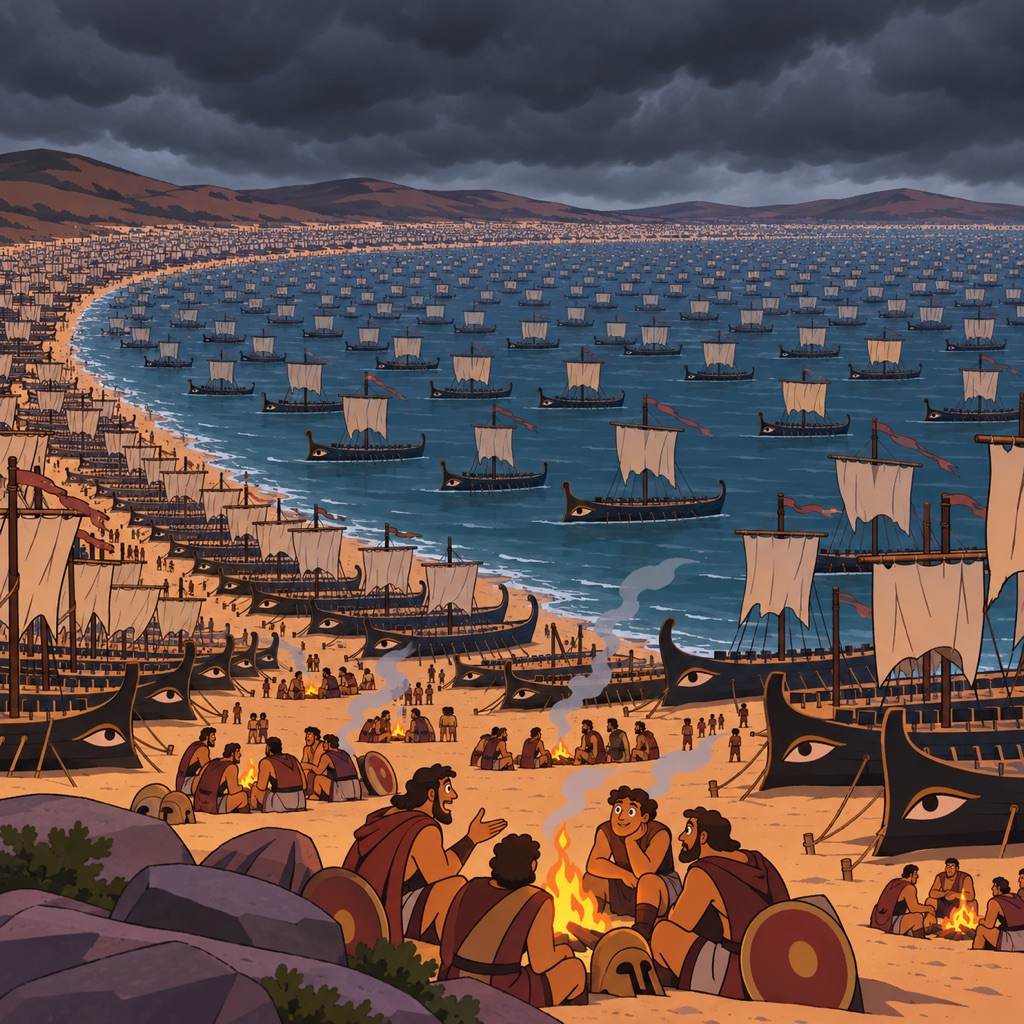
The fleet gathered at Aulis, on the east coast of Greece. Homer's Catalogue of Ships in Iliad Book 2 lists 1,186 of them, which is where Christopher Marlowe, two thousand years later, got "the face that launched a thousand ships." Then the winds stopped. According to the Cypria, Agamemnon had killed a deer and boasted that he hunted better than Artemis herself. The prophet Calchas told him the price: his daughter Iphigenia. Agamemnon sent Odysseus to fetch her from Mycenae with a lie, that she was to marry Achilles (Apollodorus, Epitome 3.22). At the altar, in the Cypria version, Artemis snatched the girl away and left a deer in her place. In Aeschylus's Agamemnon, there is no rescue. Either way, Agamemnon's wife Clytemnestra did not forgive him.
The Cypria adds misadventures on the way. The Greeks first landed in the wrong country, Mysia, and attacked it thinking it was Troy. The archer Philoctetes was bitten by a snake and abandoned on Lemnos because of the stench of his wound. When the fleet finally reached Troy, the first Greek ashore, Protesilaus, was killed at once by Hector. The Greeks sent envoys to demand Helen and the treasure back. Troy refused.
Part 3: Nine Years Outside the Walls
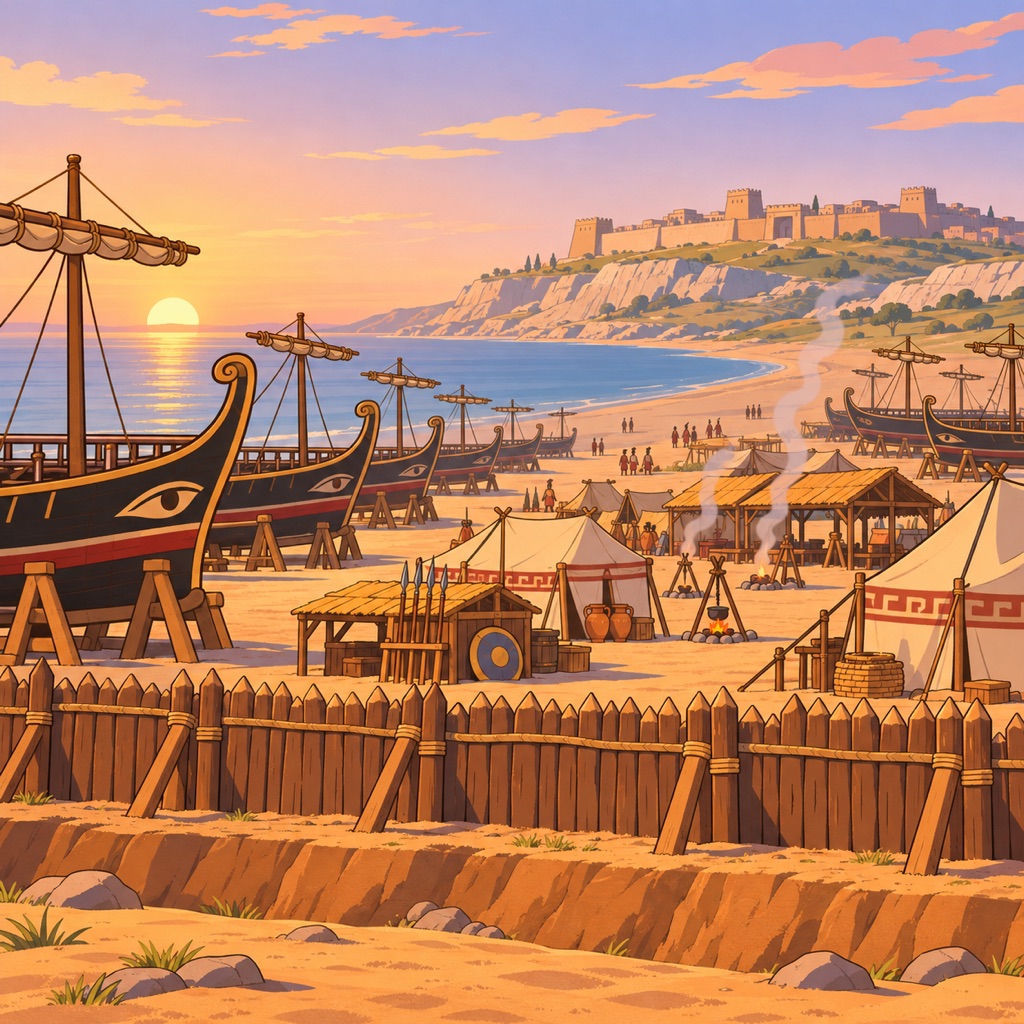
The legend's "siege" was not really a siege. Troy's walls were too strong to storm and the Greeks could not surround the city. They camped beside their beached ships and raided the countryside. In the Iliad (9.328–329) Achilles says he sacked twelve cities by sea and eleven by land. Homer says "nine years of great Zeus" had passed by the time his poem begins (2.134).
The Cypria summary lists the episodes of those years: Achilles ambushing and killing the young Trojan prince Troilus, the sack of Lyrnessus and Pedasus, and the division of the spoils. Captured women were shared out as prizes. Achilles received Briseis, and Agamemnon received Chryseis, the daughter of a priest of Apollo.
The years also saw the death of Palamedes, the man who had exposed Odysseus's madness. In the version told by Apollodorus (Epitome 3.8) and Hyginus (105), Odysseus took his revenge by burying gold under Palamedes' tent and forging a letter from the king of Troy. The army stoned Palamedes as a traitor. Pausanias (10.31.2) reports that the Cypria told it differently: Odysseus and Diomedes drowned him while he was fishing.
Part 4: The Iliad, the Rage of Achilles
Homer's Iliad opens in the tenth year. The priest Chryses comes to ransom his daughter, and Agamemnon throws him out. Apollo sends a plague on the camp for nine days. Forced to give the girl back, Agamemnon takes Briseis from Achilles instead. Achilles nearly draws his sword on him, until Athena, visible only to Achilles, grabs him by the hair (1.188–222). He calls Agamemnon a man with "the eyes of a dog and the heart of a deer" (1.225) and withdraws from the war. His mother persuades Zeus to let the Trojans win until the Greeks beg for her son.
They do. Hector drives the Greeks back to their ships. An embassy offers Achilles a fortune to return, and he refuses, telling them his mother gave him two fates: a short life with eternal glory, or a long life without it (9.410–416). Finally his closest friend Patroclus borrows Achilles' armour and leads his men out. The Trojans break, until Apollo strikes Patroclus from behind and Hector kills him (16.786–863).
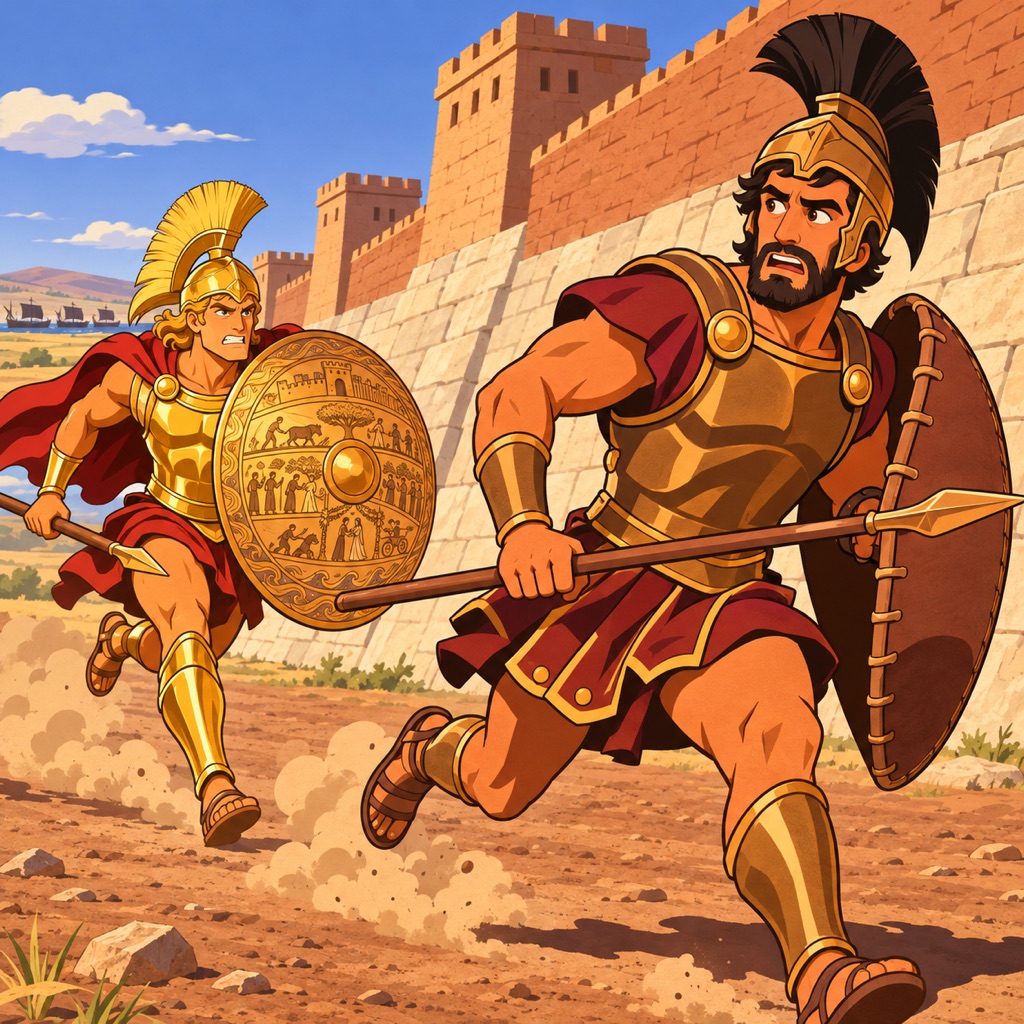
Achilles' grief turns to fury. The smith god Hephaestus forges him new armour and the great shield described in Book 18. He kills so many Trojans that the river god rises against him. Then he meets Hector outside the walls. Hector runs three times around the city, then stands and fights after Athena tricks him by appearing as his brother. Achilles kills him, refuses his dying plea to return his body, and drags the corpse behind his chariot. With his last breath Hector foretells that Paris and Apollo will kill Achilles at the gates (22.359–360).
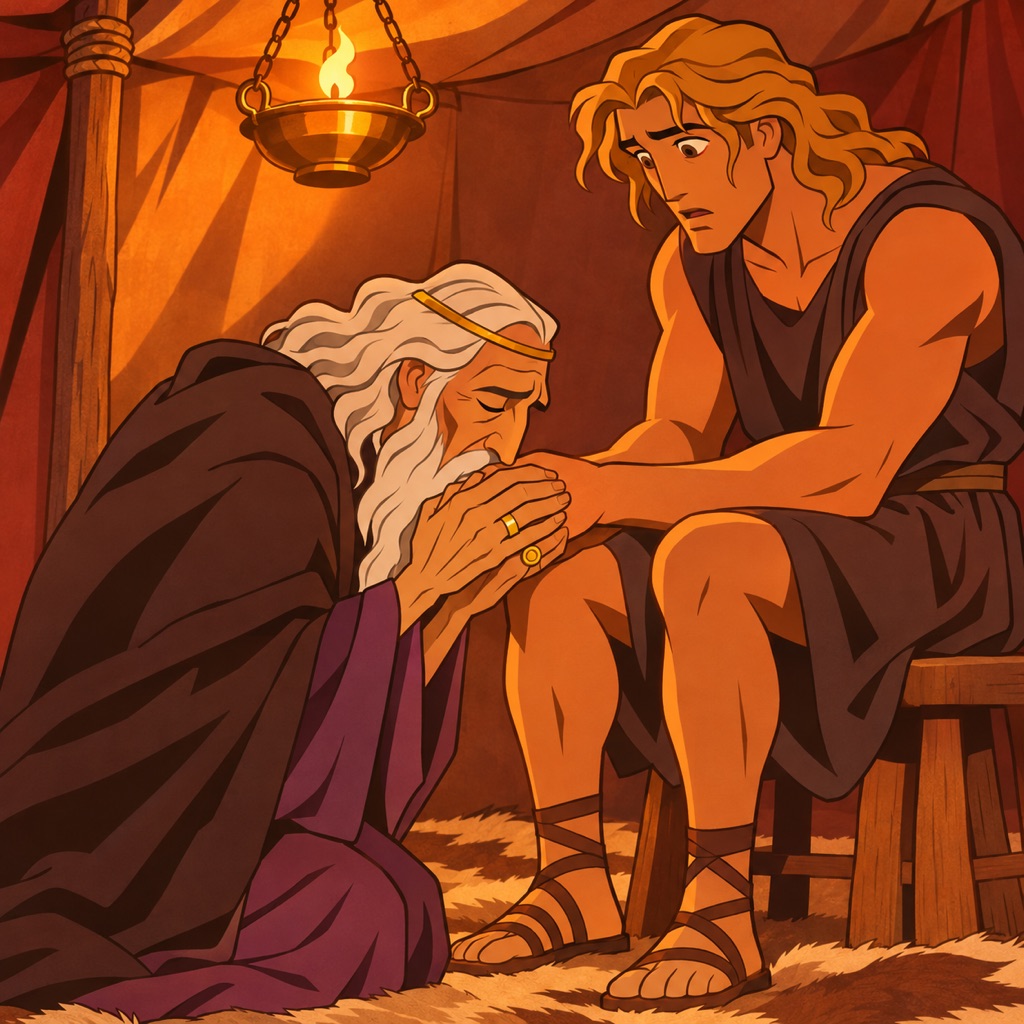
The poem ends with an old man. King Priam, guided by Hermes, crosses the Greek camp at night and kneels before Achilles. "I have done what no man on earth has done before," he says: "I have put to my lips the hands of the man who killed my son" (24.505–506). Achilles weeps for his own father, gives back the body, and grants a truce. The last line of the Iliad reads: "So they buried Hector, tamer of horses" (24.804). For the book-by-book plot, see our Iliad summary.
Part 5: The Death of Achilles and the Wooden Horse
The Aethiopis picked up where Homer stopped. Two new allies came to save Troy: Penthesilea, queen of the Amazons, and Memnon, king of the Ethiopians and son of the Dawn. Achilles killed both. Then he drove the Trojans back to their own gates, and there Paris, with Apollo's help, shot him. Apollodorus (Epitome 5.3) says the arrow hit him in the ankle.
That ankle matters. The well-known story that Thetis dipped baby Achilles in the river Styx, holding him by the heel and leaving that one spot vulnerable, is not in the early Greek sources. In surviving literature it first appears clearly in the Roman poet Statius in the first century CE. Greek writers told a different tale, that Thetis tried to burn away her baby's mortality in the fire at night until Peleus caught her (Apollonius of Rhodes 4.869–879; Apollodorus 3.13.6). In the Iliad, Achilles is not invulnerable at all: a spear grazes his forearm and draws blood (21.166–167).
Ajax carried Achilles' body out of the battle while Odysseus held off the Trojans. The Little Iliad tells what followed. The Greeks gave Achilles' god-made armour to Odysseus rather than Ajax. Ajax went mad with shame and killed himself, the subject of Sophocles' Ajax; in the Odyssey (11.543–551) his ghost still refuses to speak to Odysseus. A prophecy said Troy could not fall without the bow of Heracles, so the Greeks fetched Philoctetes from Lemnos, and he shot Paris dead. Helen was married to Paris's brother Deiphobus. Odysseus slipped into Troy disguised as a beggar, was recognized only by Helen, and came back with what he needed (Odyssey 4.240–264). He and Diomedes then stole the Palladium, a sacred image of Athena that protected the city.
Then came the trick. In the Odyssey (8.492–495) the horse was built by Epeius with Athena's help, and Odysseus led it into the citadel. Apollodorus (Epitome 5.14) says fifty of the best Greeks climbed inside, adding that the author of the Little Iliad made it three thousand. The rest burned their camp and sailed to hide behind the island of Tenedos. The Trojans broke down part of their own wall to pull the horse into the city.
The Trojans argued about what to do with it. In the Odyssey (8.505–510) they had three options: cut it open, throw it off the rocks, or keep it as an offering to the gods. Priam's daughter Cassandra, who could see the future but whom Apollo had cursed so that no one believed her, warned that it was full of soldiers (Apollodorus, Epitome 5.17). They kept it. The Sack of Troy summary says two serpents then came from the sea and killed the priest Laocoön and one of his sons. Virgil's Aeneid later made this scene famous, with Laocoön hurling a spear into the horse; the spear is Virgil's addition. In the Odyssey (4.271–289), Helen walked around the horse that night calling the hidden men by name in the voices of their wives, and Odysseus clamped his hand over one man's mouth to stop him answering. The full story is on our Trojan Horse page.
The Sack of Troy
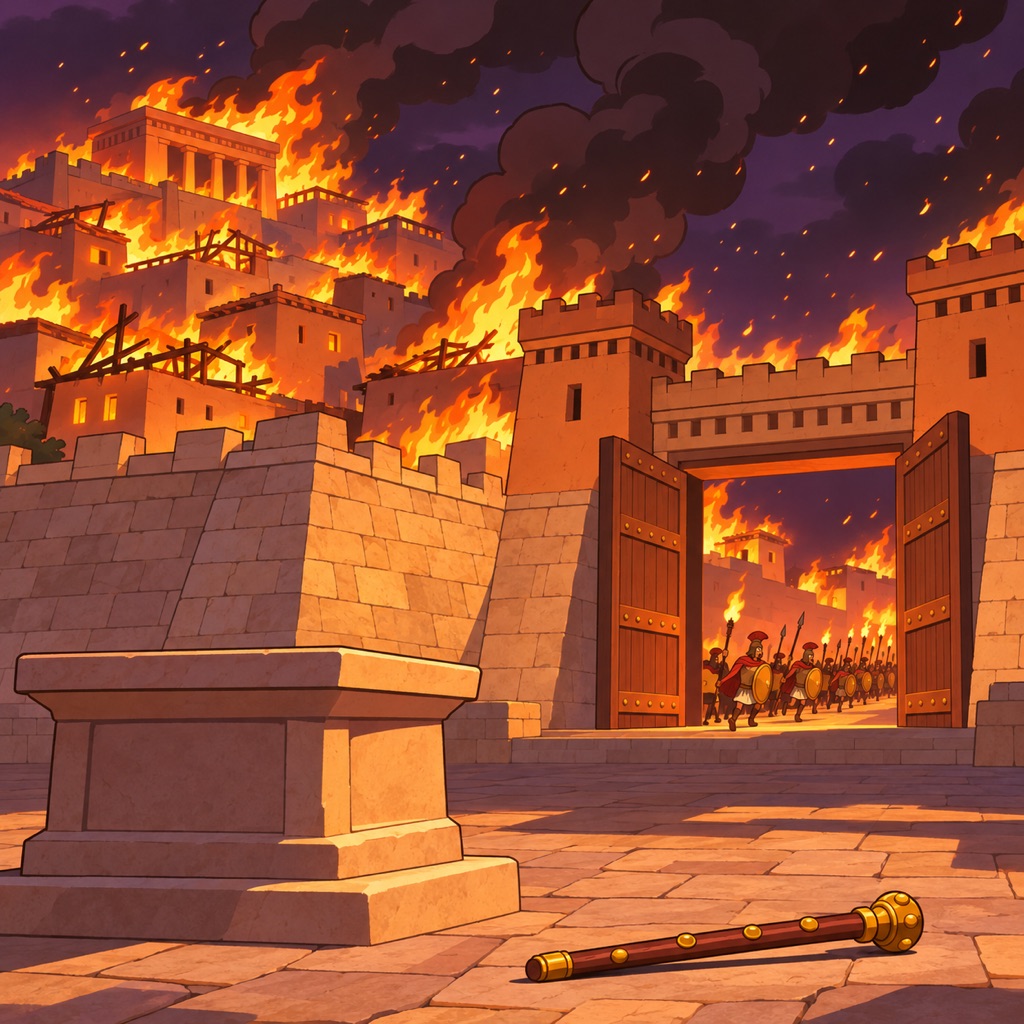
The Sack of Troy summary says a Greek named Sinon, who had got into the city by a ruse, lit the fire signal for the fleet. (The long lying speech that Sinon gives to talk the Trojans into accepting the horse is Virgil's.) The men climbed out of the horse, the fleet returned, and the city fell.
The Greek sources do not soften what happened next. Achilles' son Neoptolemus killed Priam at the altar of Zeus in his own courtyard. The lesser Ajax dragged Cassandra away from the statue of Athena, a sacrilege that would later cost the Greeks dearly at sea; she was given to Agamemnon as a prize. Hector's baby son Astyanax was thrown from the walls; in the Sack of Troy summary Odysseus kills him, and in Euripides' Trojan Women it is Odysseus's argument that decides it. Priam's daughter Polyxena was sacrificed at Achilles' tomb. Menelaus found Helen, raised his sword, and dropped it at the sight of her (Euripides, Andromache 627–631), and took her home.
The victory poisoned almost everyone who won it. The Returns and the Odyssey tell of storms, shipwrecks and murders. Agamemnon reached Mycenae and was killed by his wife Clytemnestra, the story of Aeschylus's Oresteia. Odysseus took ten more years to reach Ithaca, which is the story of the Odyssey.
Trojan War Timeline
The order of the legend:
- The wedding of Peleus and Thetis; Eris and the golden apple (Cypria; Hyginus 92)
- The judgment of Paris on Mount Ida (Cypria; Apollodorus, Epitome 3.2)
- Paris at Sparta; Helen leaves with him (Cypria)
- The oath is called in; Odysseus feigns madness; Achilles found on Skyros (Cypria; Hyginus 95–96)
- The fleet at Aulis; the sacrifice of Iphigenia (Cypria; Aeschylus, Agamemnon)
- Landing at Troy; nine years of raids; death of Palamedes (Cypria)
- Year ten: the quarrel, the death of Patroclus, the death of Hector, Priam's ransom (Iliad)
- Penthesilea, Memnon and the death of Achilles (Aethiopis)
- The contest of the armour; the death of Ajax; Paris killed by Philoctetes (Little Iliad)
- The wooden horse and the sack of Troy (Little Iliad; Sack of Troy; Odyssey 8)
- The returns of the Greeks; Odysseus reaches Ithaca ten years later (Returns; Odyssey)
The Trojan War date, ancient and modern. The Greeks themselves disagreed about when it happened. Herodotus (2.145) puts the war about 800 years before his own time, so around 1250 BCE. The Parian Marble, a chronicle carved in the third century BCE, dates the fall of Troy to 1209/8 BCE. The scholar Eratosthenes calculated 1184/3 BCE, and that became the standard ancient date. Archaeology dates the destruction of the city level known as Troy VIIa to about 1180 BCE, which is remarkably close to Eratosthenes. Counting the legend's ten years back from that gives a war of roughly 1190 to 1180 BCE. Homer composed the Iliad about five hundred years later.
Was the Trojan War Real?
Was the Trojan War real? The legend as told, with gods, a golden apple and a wooden horse, is myth. But the city was real. At Hisarlik in northwest Turkey, excavations since the 1870s have uncovered a large fortified Bronze Age city, and the level called Troy VIIa ended in fire around 1180 BCE, with arrowheads and human remains in the debris. Hittite texts of the thirteenth century BCE refer to a kingdom called Wilusa, which most scholars identify with Troy (Greek Ilios), and to a sea power called Ahhiyawa, which most scholars take to be the Mycenaean Greeks. One Hittite king writes to the king of Ahhiyawa about "the matter of Wilusa, over which we were hostile."
That points to real conflict in the right place at roughly the right time. It does not prove a ten-year war over a queen. Many historians suspect the legend grew from memories of several raids and wars, folded together by singers over five centuries. Our page Was Troy Real? goes through the evidence in detail, from Schliemann's trench to the Hittite archives. For the wider story of the Bronze Age palaces, the collapse and the world that sang about them, see Ancient Greece.
Frequently Asked Questions
1What is the Trojan War story in short?
Paris, prince of Troy, was promised the most beautiful woman alive by Aphrodite and carried off Helen, wife of King Menelaus of Sparta. The Greek kings, bound by an oath, sailed against Troy under Agamemnon. After ten years and the deaths of Hector, Achilles and Paris, the Greeks hid soldiers inside a wooden horse, the Trojans brought it into the city, and Troy was sacked.
2Was the Trojan War real?
The legend is myth, but Troy was a real city at Hisarlik in northwest Turkey. A level called Troy VIIa was destroyed by fire around 1180 BCE, and Hittite texts mention a kingdom called Wilusa, most likely Troy, and hostility over it with a power most scholars identify as the Greeks. A real conflict may lie behind the story.
3When did the Trojan War happen?
Ancient Greek scholars disagreed: Herodotus implies about 1250 BCE, the Parian Marble gives 1209/8 BCE, and Eratosthenes 1184/3 BCE. Archaeologists date the burning of Troy VIIa to about 1180 BCE, so the legend's war is usually placed around 1190 to 1180 BCE.
4How long did the Trojan War last?
In the legend, ten years. The Greeks spent nine years raiding the land around Troy, and the city fell in the tenth. Homer's Iliad covers only a few weeks of that final year.
5How did the Trojan War start?
In Greek mythology it began at the wedding of Peleus and Thetis, when Eris threw in a golden apple for the most beautiful goddess. Paris judged the contest and chose Aphrodite, who gave him Helen. When Paris took Helen from Sparta, he broke the sacred law of guest-friendship, and the Greek kings went to war.
6Who won the Trojan War?
The Greeks won. They took Troy with the wooden horse and destroyed the city. But many of the victors died on the way home or soon after: Agamemnon was murdered by his wife, and Odysseus needed ten more years to reach Ithaca.
Hear the Trojan War From the Beginning
The Histolumo app tells the whole legend as an audio story: the golden apple, the thousand ships, Achilles and Hector, and the night of the horse. The first chapter is free.


Listen to Related Stories
The Golden Apple
4 minNobody invited the goddess of strife to the wedding, so she sent a gift.

Everything He Needs
4 minA king leaves his guest with his wife, and the guest sails off with both her and the treasure.
Which One Is Achilles?
5 minThe fleet needs a wind, and the goddess wants the king's daughter in return.
The Eyes of a Dog
4 minNine years into the war, the best of the Greeks puts down his spear.
The Hands He Kissed
4 minAn old king crosses the enemy camp at night to beg for his son's body.
Voices in the Horse
5 minOne morning the Greek camp is ash, and a wooden horse stands on the sand.
Key Figures

Listen to the Full Story
Experience history through immersive audio lessons narrated by Lumo, your immortal wolf guide.