The Judgment of Paris Myth in Brief
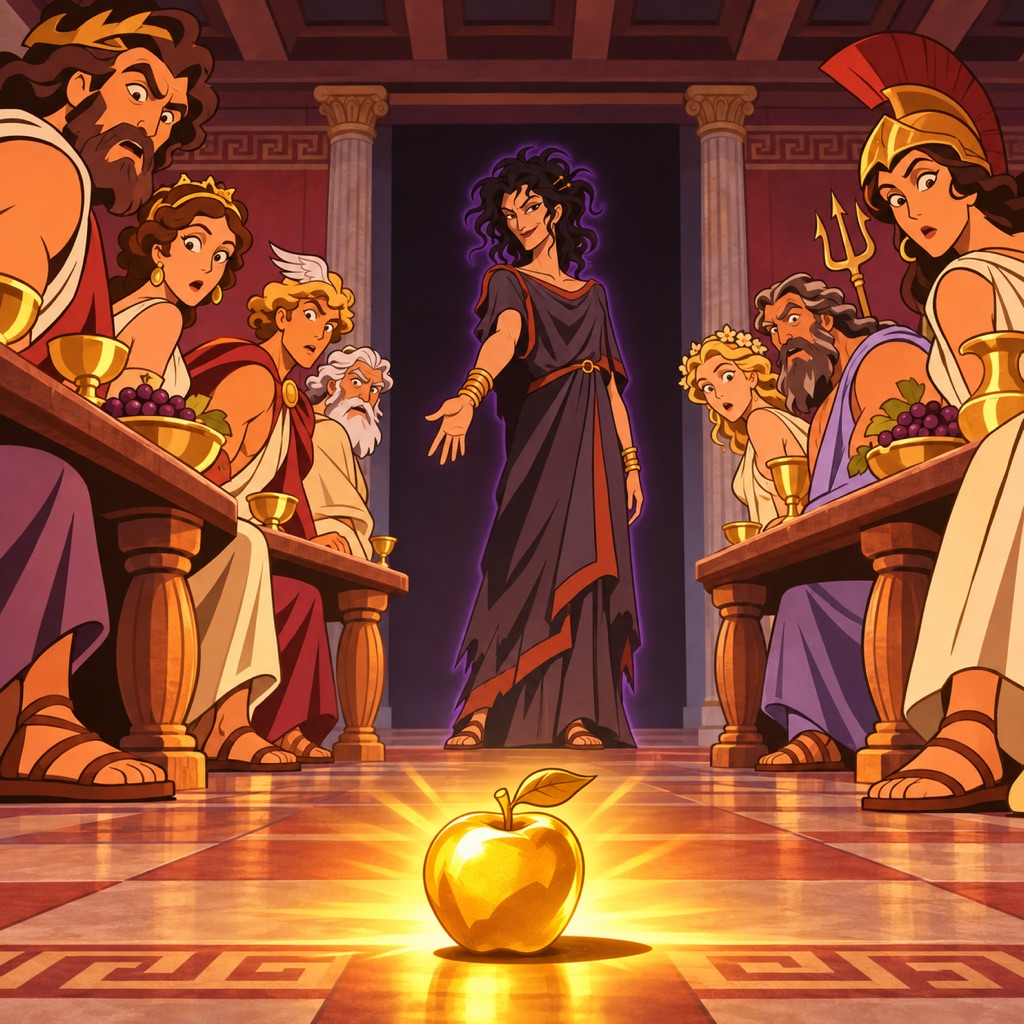
The Judgment of Paris myth is the Greek story of how the Trojan War began. At the wedding of the sea goddess Thetis and the mortal king Peleus, Eris, the goddess of strife, threw a golden apple among the guests as a prize for the most beautiful goddess. Hera, Athena and Aphrodite each claimed it. Zeus refused to choose, and Hermes led the three goddesses to a young Trojan prince, Paris, herding cattle on Mount Ida. Each offered him a bribe. Paris chose Aphrodite, who had promised him the most beautiful woman in the world: Helen, the wife of King Menelaus of Sparta.
That choice cost Paris his city. Two goddesses walked away from Mount Ida hating Troy, and Helen's abduction brought a thousand Greek ships to its shore.
The "apple of discord" story has been retold for nearly three thousand years, so the details shift from source to source. Some of what people now take for granted, such as the words "to the fairest" carved on the apple, are later additions. This page tells the story as the Greek sources give it and names the source for each part.
Where the Story Comes From
Homer knew the myth but barely touched it. In the whole of the Iliad there is one mention, near the end (Iliad 24.25–30): Hera, Poseidon and Athena keep their hatred of Troy "because of the blindness of Paris, who insulted the goddesses when they came to his farmyard, and praised the one who gave him painful lust". Some ancient scholars, including Aristarchus of Samothrace, suspected even these lines were added later.
The full story was told in the Cypria, a lost epic of the Trojan cycle, probably composed in the 7th or 6th century BCE. It survives mainly as a prose summary by a scholar named Proclus and a few quotations. Proclus's summary is short: Zeus plans the Trojan War with the goddess Themis; Eris arrives while the gods are feasting at the wedding of Peleus and starts a quarrel among Hera, Athena and Aphrodite about their beauty; Hermes, on Zeus's orders, leads them to Alexandros (Paris) on Mount Ida to be judged; and Paris, excited by the promise of marriage to Helen, decides for Aphrodite.
Notice what is missing. Proclus's summary mentions no apple. The apple appears clearly in later writers, especially the mythographer Apollodorus (Epitome 3.2, 1st or 2nd century CE) and the Latin handbook of Hyginus (Fabulae 92). The tragedians of Athens, writing in the 5th century BCE, return to the judgment again and again, usually through the bitter eyes of Trojan women.
The Wedding of Peleus and Thetis
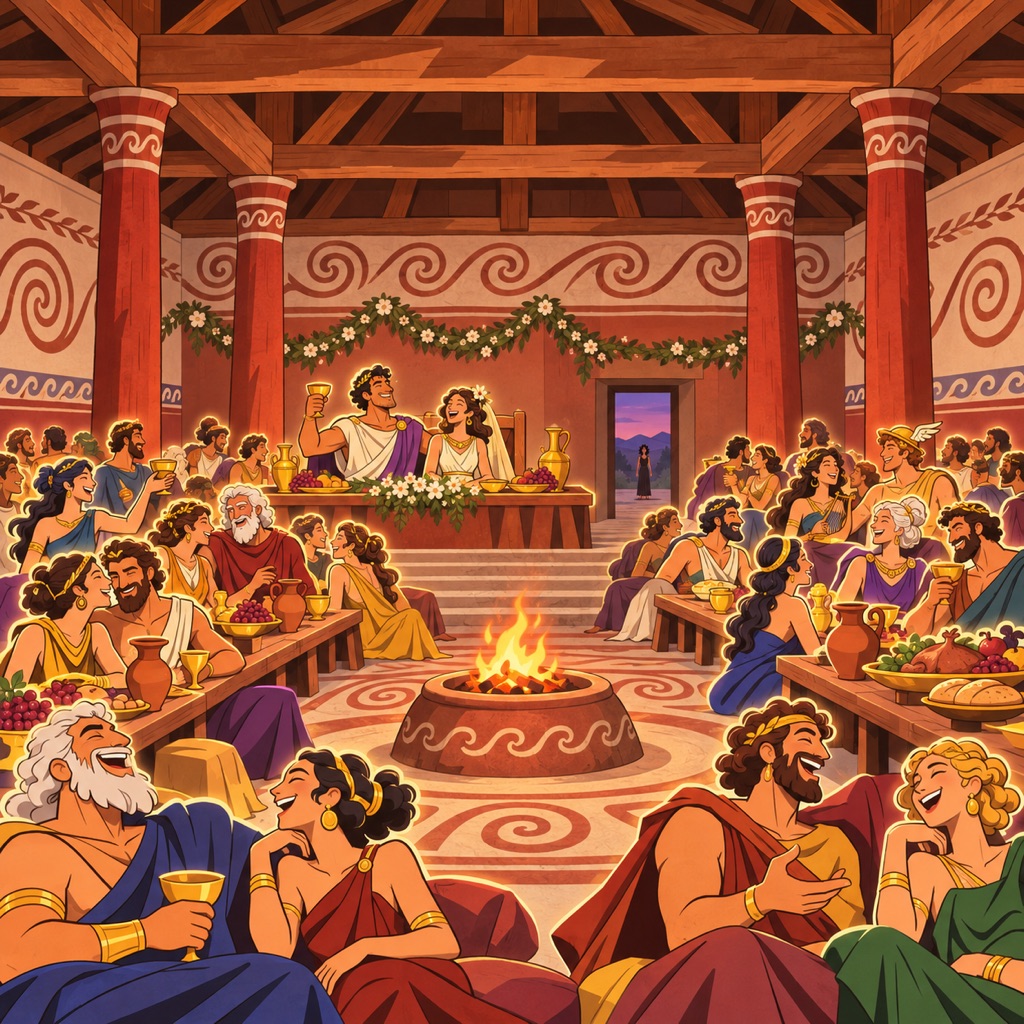
The wedding itself has a dark backstory. Thetis was a Nereid, one of the daughters of the old sea god Nereus. According to Pindar (Isthmian 8) and other sources, both Zeus and Poseidon wanted her, until a prophecy warned that her son would be greater than his father. Neither god wanted to be overthrown by his own child. So the gods married her off to a mortal: Peleus, king of the Myrmidons in Thessaly. Some versions say Thetis resisted, changing into fire, water and wild beasts as Peleus held on.
The son she bore him would be Achilles, the greatest warrior of the Trojan War. The prophecy held true: Achilles was greater than his mortal father, and his death at Troy is one of the war's central tragedies.
The wedding was held on Mount Pelion in Thessaly, near the cave of the wise centaur Chiron, and the gods came in a body. In the Iliad (24.62–63), Hera reminds Apollo that all the gods attended, and that Apollo himself played the lyre at the feast. The gods brought gifts that turn up later in the war. Chiron gave Peleus an ash spear from Pelion that only Achilles could wield (Iliad 16.140–144), and Poseidon gave him the immortal horses Xanthus and Balius, who would one day pull Achilles' chariot (Iliad 23.277–278).
Eris and the Golden Apple

Not every god was welcome. Eris was the goddess of strife, quarrels and rivalry; Hesiod lists among her children Toil, Famine, Battles and Lies (Theogony 226–232). Hyginus says she was not invited to the wedding. She came anyway, stood at the door, and threw an apple into the middle of the feast, saying that the most beautiful should take it (Fabulae 92). Apollodorus says Eris threw the apple as a prize of beauty, to be contended for by Hera, Athena and Aphrodite.
What about "to the fairest"?
Many modern retellings say the apple was inscribed tēi kallistēi, "to the fairest" or "for the most beautiful". That inscription is not in the early Greek sources. In Hyginus, Eris speaks the challenge aloud. The idea of words written on the apple appears in later writers, such as the satirist Lucian in the 2nd century CE, whose dialogues about the judgment have the apple carry a message for "the beautiful one". The familiar form "to the fairest" belongs to later tradition. It is a good detail, but not an ancient Greek one.
Was it really an apple?
The Greek word in these stories is mēlon, which usually means apple but could also be used for other tree fruit, such as quinces. Golden mēla turn up in several Greek myths, which can confuse anyone searching "golden apple Greek mythology":
- The apple of discord, Eris's apple, thrown at the wedding of Peleus and Thetis.
- The golden apples of the Hesperides, which Gaia gave Hera as a wedding gift and which grew in a garden at the western edge of the world. Fetching them was one of the labors of Heracles.
- Atalanta's race, in which a suitor slowed the swift huntress by dropping golden apples that she stopped to pick up.
Apples were also a lover's gift in Greek culture, and throwing one at someone could be a proposal. A golden apple thrown among three goddesses was a joke with teeth.
Paris on Mount Ida
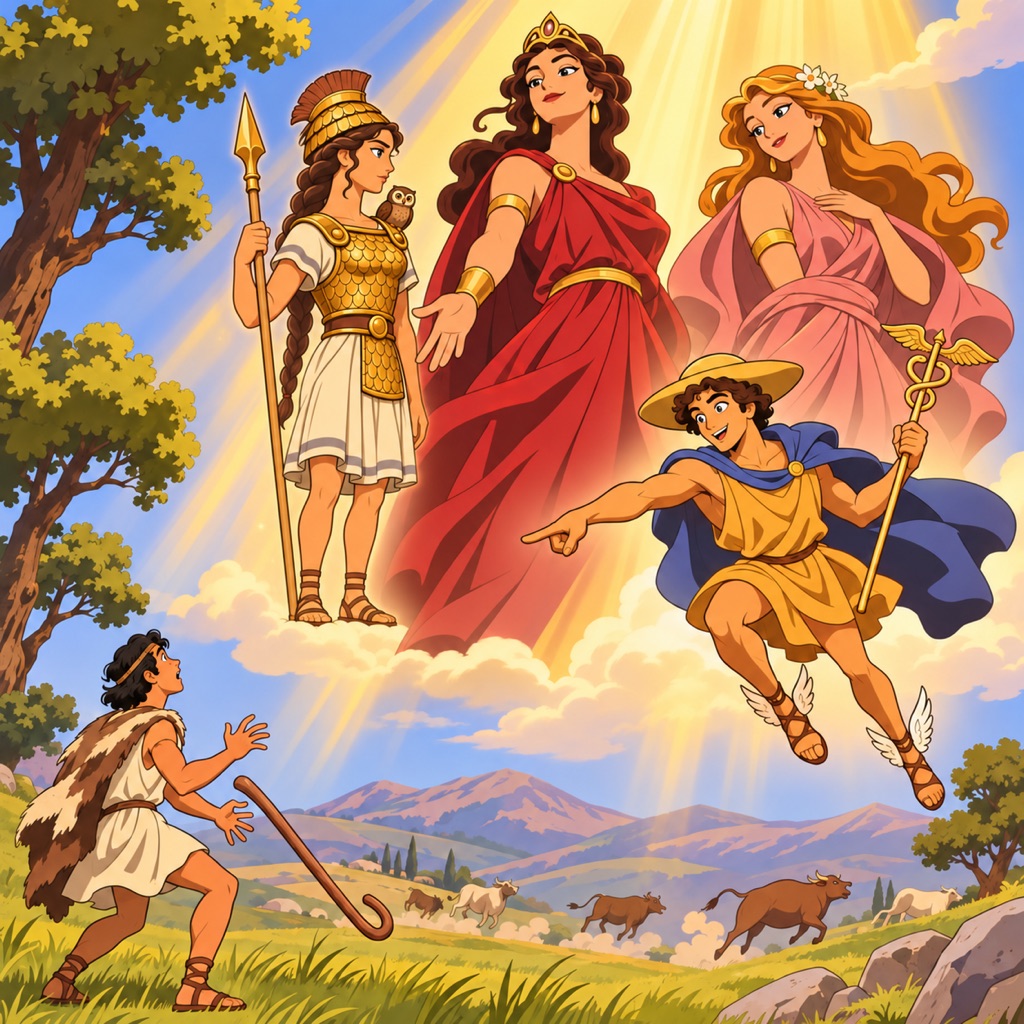
Zeus had no intention of choosing. One of the three was his wife, the other two his daughters. In the Cypria and Apollodorus, he orders Hermes, his messenger, to take the goddesses to Paris on Mount Ida, the mountain range above the plain of Troy.
Why was a prince of Troy herding cattle? Apollodorus (3.12.5) explains. Before Paris was born, his mother Hecuba dreamed that she gave birth to a burning torch, and the fire spread through the whole city. A seer warned that the child would destroy Troy. King Priam had the baby left on Mount Ida to die. A she-bear nursed him for five days, and the herdsman who had exposed him, Agelaus, found him still alive and raised him as his own. Paris grew up a herdsman, unaware of his royal birth, until he later came down to the city, won games at Troy, and was recognized by his family. Ancient writers disagree on whether the judgment happened before or after that homecoming.
Paris was also known as Alexandros, the name the Iliad uses most often. On Ida he married a mountain nymph, Oenone, whom he would later abandon for Helen.
Three Goddesses, Three Bribes
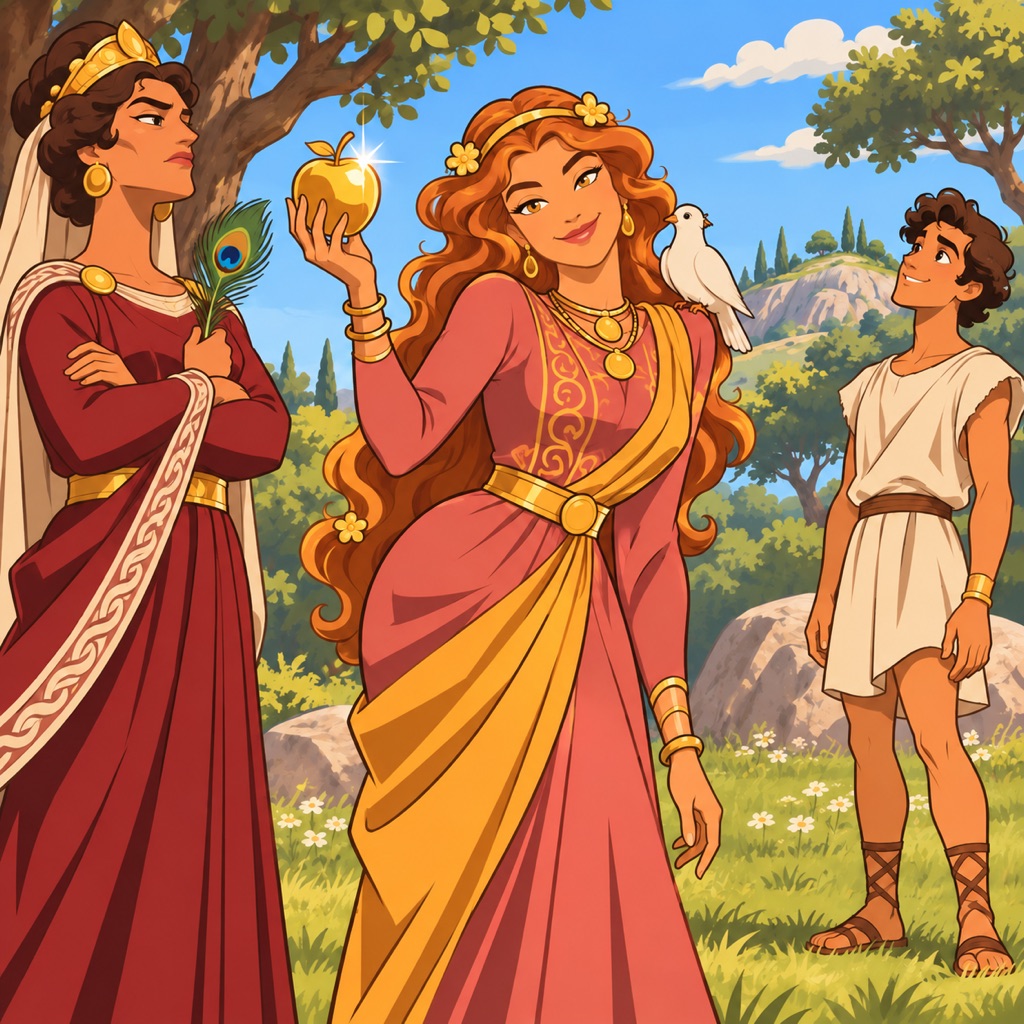
None of the goddesses trusted her looks alone. Apollodorus (Epitome 3.2) gives the bribes in their simplest form:
- Hera, queen of the gods, promised Paris kingship over all men.
- Athena, goddess of wisdom and war, promised him victory in war.
- Aphrodite, goddess of love, promised him marriage to Helen.
Euripides gives slightly different offers. In The Trojan Women (lines 924–932), Helen, defending herself before Menelaus, says Athena offered Paris command of a Trojan army to conquer Greece, Hera offered rule over Asia and the edges of Europe, and Aphrodite offered Helen herself. Helen's point is that by choosing Aphrodite, Paris saved Greece from Trojan conquest. Hecuba, listening, is not impressed.
Paris chose Aphrodite. The Cypria says he was "excited by the promise of marriage to Helen". In the Iliad's one mention, the word Homer uses for what Aphrodite gave him is machlosynē, lust, and it is not a compliment.
Later writers enjoyed the scene too much to leave it alone. In Lucian's comic dialogue The Judgment of the Goddesses, Paris asks the goddesses to undress so he can judge properly, and each tries to bribe him privately. That is satire from the Roman imperial era, not early myth, but it shaped how painters showed the scene for centuries.
The Consequences

The judgment set the whole Trojan War in motion. According to the Cypria, Aphrodite told Paris to build ships, and he sailed for Sparta with Aeneas. The Iliad (5.59–64) names the shipbuilder, Phereclus, whose ships were "the beginning of evils" for the Trojans.
In Sparta, King Menelaus welcomed Paris as a guest, then left for Crete to bury his grandfather. While he was gone, Paris carried off Helen and a great deal of the palace treasure. That broke xenia, the sacred law between host and guest that Zeus himself protected. Every Greek king who had once courted Helen had sworn to defend her husband, and Agamemnon, Menelaus's brother, called them to war. The story continues in our Trojan War page and in the profiles of Paris of Troy and Helen of Troy.
The goddesses never forgot. Throughout the Iliad, Hera and Athena fight for the Greeks with a fury that even Zeus finds exhausting. Aphrodite protects Paris; in Iliad 3, when Menelaus is about to kill him in single combat, she snatches him away in a mist and sets him down in his own bedroom. In the end, Athena helps the Greeks build the Trojan Horse.
The Cypria also gave the war a colder cause. A quoted fragment says that the earth was overburdened by the numbers of mankind, and Zeus, pitying her, decided to lighten the load through the war at Troy. By that reading, Eris and her apple were tools in a plan already made. The judgment was the spark Zeus needed.
The Judgment of Paris in Art
Few myths have been painted as often. Greek vase painters were drawing the scene by the 7th and 6th centuries BCE, usually as a procession: Hermes leading the three goddesses toward Paris, who sometimes looks as if he wants to run away. The famous François Vase, an Athenian mixing bowl from around 570 BCE now in Florence, shows the gods arriving in procession at the wedding of Peleus and Thetis. The apple itself shows up in art mostly later.
In the Renaissance and after, the judgment became an excuse to paint three nude goddesses, very much in the spirit of Lucian. Lucas Cranach the Elder painted it many times in the 16th century. An engraving by Marcantonio Raimondi after a design by Raphael, around 1510 to 1520, was copied across Europe, and Édouard Manet borrowed its group of river gods for his Déjeuner sur l'herbe (1863). Peter Paul Rubens painted several versions in the 1630s, including one in the National Gallery in London and one in the Prado in Madrid. Later artists from Watteau to Renoir took it up again.
The phrase "apple of discord" survives in many European languages as a name for anything that sets people fighting. For more on the poems that preserved this story, see our Iliad summary and the profile of Homer. For the archaeology behind Troy itself, read Was Troy Real?, or explore all of Ancient Greece.
Frequently Asked Questions
1What is the Judgment of Paris myth?
At the wedding of Peleus and Thetis, Eris, goddess of strife, threw a golden apple among the guests as a prize for the most beautiful goddess. Hera, Athena and Aphrodite each claimed it. Zeus sent them with Hermes to the Trojan prince Paris on Mount Ida. Hera offered him power, Athena victory in war, and Aphrodite the most beautiful woman in the world. Paris chose Aphrodite, and his abduction of Helen started the Trojan War.
2What is the apple of discord?
It is the golden apple Eris threw at the wedding of Peleus and Thetis, which started the quarrel among Hera, Athena and Aphrodite. It led to the Judgment of Paris and, in the myth, to the Trojan War. Today 'apple of discord' means anything that causes a dispute.
3Was 'to the fairest' written on the golden apple?
Not in the early Greek sources. The lost Cypria, as summarized by Proclus, does not even mention an apple. Hyginus has Eris say aloud that the most beautiful should take it. The idea of a written message on the apple appears in later writers such as Lucian, and the familiar 'to the fairest' (tēi kallistēi) belongs to later tradition.
4Why was Eris not invited to the wedding?
The sources do not give a detailed reason. Hyginus simply says she was not invited. As the goddess of strife, quarrels and rivalry, she was an obvious guest to leave off the list at a wedding.
5What did each goddess offer Paris?
According to Apollodorus, Hera offered kingship over all men, Athena victory in war, and Aphrodite marriage to Helen. Euripides gives a variant in which Hera offers rule over Asia and Europe and Athena offers Paris command of a Trojan conquest of Greece.
6What are the golden apples in Greek mythology?
There are three famous ones. Eris's apple of discord started the Judgment of Paris. The golden apples of the Hesperides, a wedding gift from Gaia to Hera, grew in a garden at the edge of the world and were fetched by Heracles. And Atalanta lost a footrace when her suitor dropped golden apples for her to pick up.
Hear Where the War Began
The Golden Apple is free in the app: a wedding of the gods, an uninvited guest, and a shepherd prince with a terrible choice.


Listen to Related Stories
The Golden Apple
4 minNobody invited Strife to the wedding of the gods, so she sent a gift instead.

Everything He Needs
4 minThe king of Sparta sailed off to a funeral and left his guest from Troy alone with his wife.
Key Figures



Listen to the Full Story
Experience history through immersive audio lessons narrated by Lumo, your immortal wolf guide.