
The Helen of Troy Story in Brief
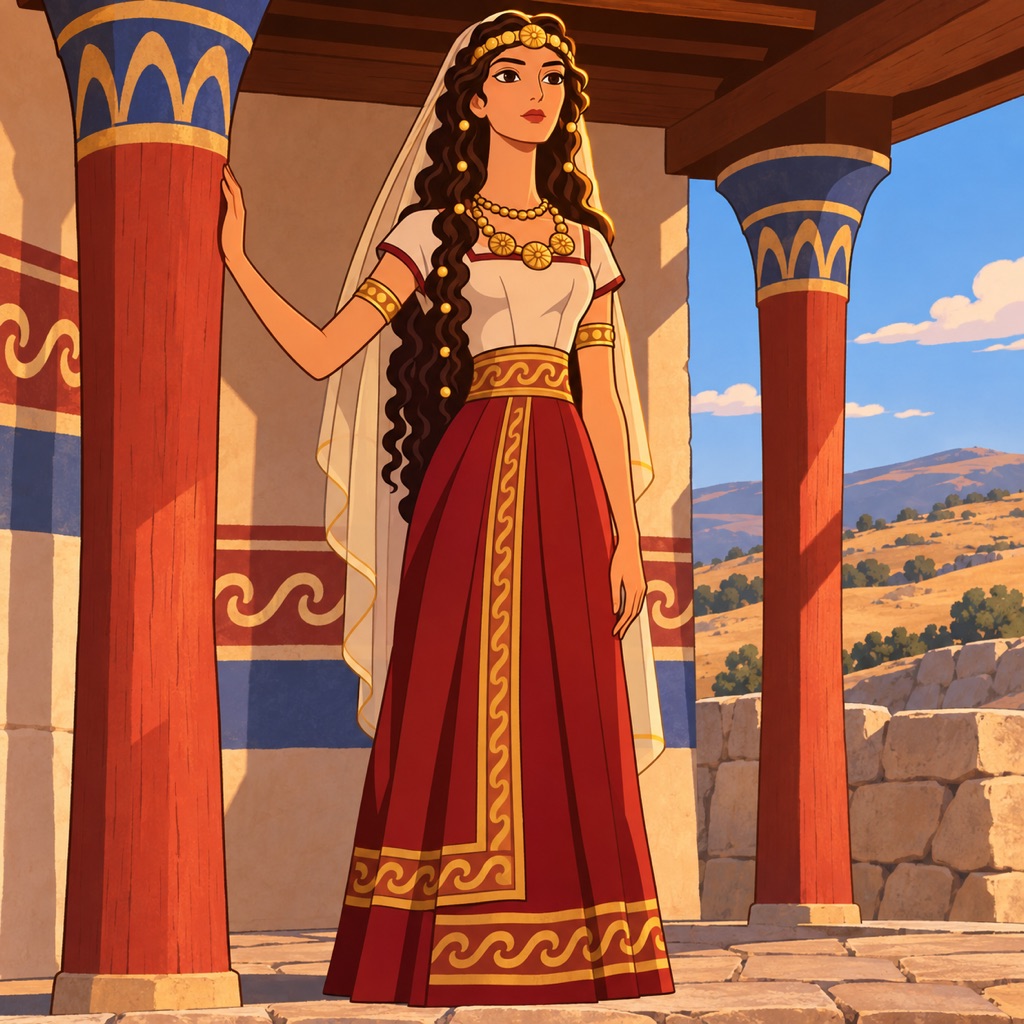
The Helen of Troy story is simple to state and hard to judge. In Greek myth, Helen was a daughter of Zeus, the most beautiful woman in the world, and the wife of Menelaus, king of Sparta. When the Trojan prince Paris carried her off to Troy, the kings of Greece sailed after her, and the Trojan War began.
That is the outline. The poems that tell it are stranger. Homer's Helen is no trophy waiting to be rescued. She is the sharpest person in every room she enters. She weaves the war into a tapestry while it happens outside her window. She calls herself a "dog." She spots a disguised spy that nobody else in Troy can see. She walks around the wooden horse at night and almost gets the Greeks inside it killed. And when the war is over, she goes home to Sparta and serves drugged wine to her guests as if nothing happened.
She was also a real cult figure. Spartans worshipped Helen as a goddess at a shrine outside their city, which tells you something: the ancient Greeks never quite decided whether she was a woman, a goddess, or a curse.
Everything below comes from the ancient sources: Homer's Iliad and Odyssey, the lost epics summarised by the late writer Proclus, the mythographers Apollodorus and Hyginus, and the Athenian tragedians. Where they disagree, and they often do, we say so.
Daughter of Zeus and Leda
Helen's mother was Leda, wife of Tyndareus, king of Sparta. Her father, in the most famous version, was Zeus, who came to Leda in the shape of a swan. Because of that, Helen was said to have hatched from an egg. Apollodorus (Library 3.10.7) gives both stories side by side: the swan and Leda, and an older one in which Zeus chased the goddess Nemesis, who turned into a goose, and the egg she laid was found and given to Leda to raise. The lost epic Cypria also made Nemesis her mother.
Her family was loaded with trouble. Her sister Clytemnestra married Agamemnon, the high king of Mycenae, and later murdered him in his bath. Her brothers were the twins Castor and Polydeuces, the Dioscuri. Tyndareus was her father on paper; Zeus was the one who mattered.
Helen's trouble started young. According to Apollodorus and later writers, the Athenian hero Theseus kidnapped her when she was still a girl, and her brothers marched on Attica to get her back. So Paris was not even the first man to carry her off.
The Suitors and the Oath of Tyndareus
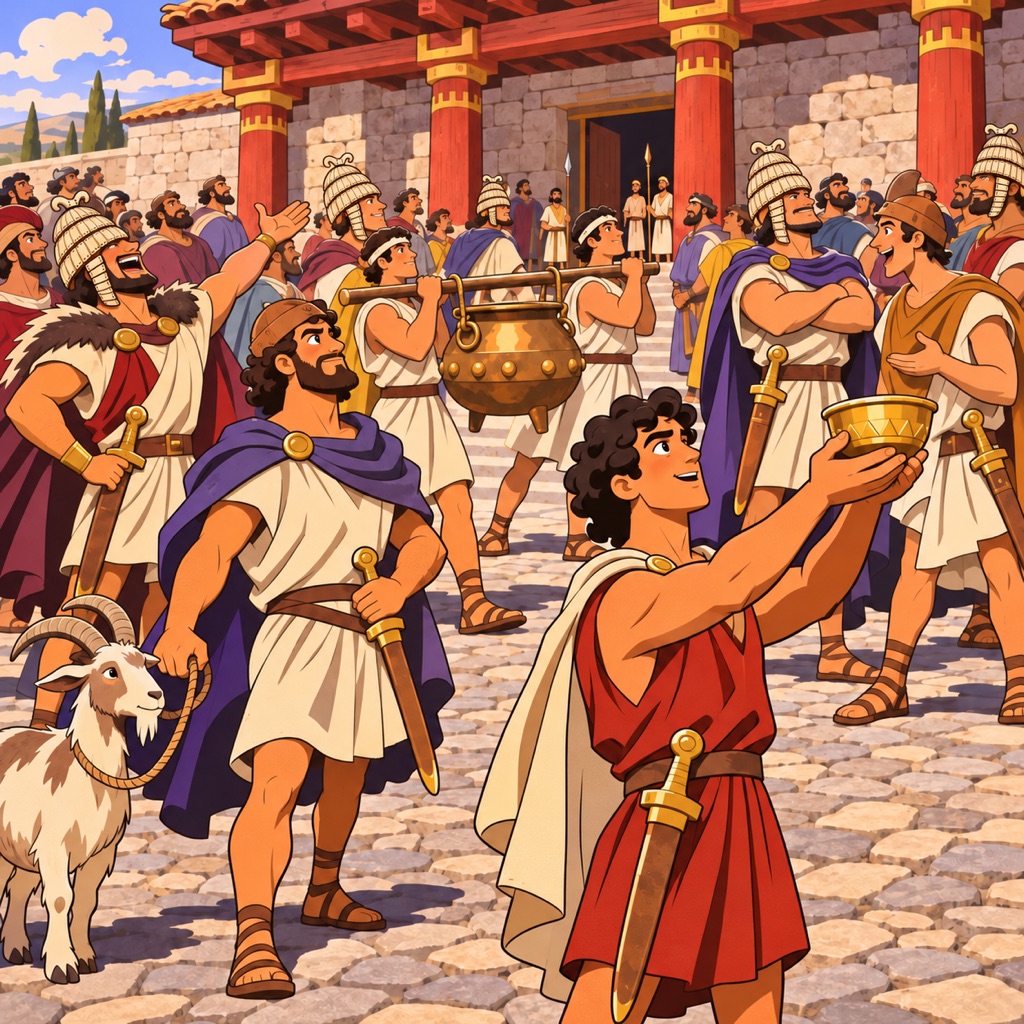
When Helen came of age, every unmarried king and prince in Greece came to Sparta to court her. The lists differ. Apollodorus (Library 3.10.8) names more than thirty suitors, among them Odysseus, Diomedes, Ajax, Philoctetes, Patroclus and Menelaus. The fragments of the Catalogue of Women, a poem attributed to Hesiod, describe the suitors sending gifts of cauldrons, tripods and gold.
Tyndareus had a problem. He could only choose one man, and every loser was armed and proud. A wrong choice meant a feud, possibly a war, against the winner.
The fix came from the least important man in the courtyard. Odysseus, king of the small rocky island of Ithaca, knew he had no real chance with Helen. So he made Tyndareus a deal. If the king helped him marry Penelope, the daughter of Tyndareus's brother Icarius, Odysseus would solve the suitor problem. His solution: make every suitor swear an oath to defend the chosen husband against anyone who wronged him in his marriage (Apollodorus 3.10.9; Hyginus, Fabulae 78). This is the Oath of Tyndareus. Pausanias, writing much later, even points out the place near Sparta where he says the oath was sworn over the cut pieces of a horse.
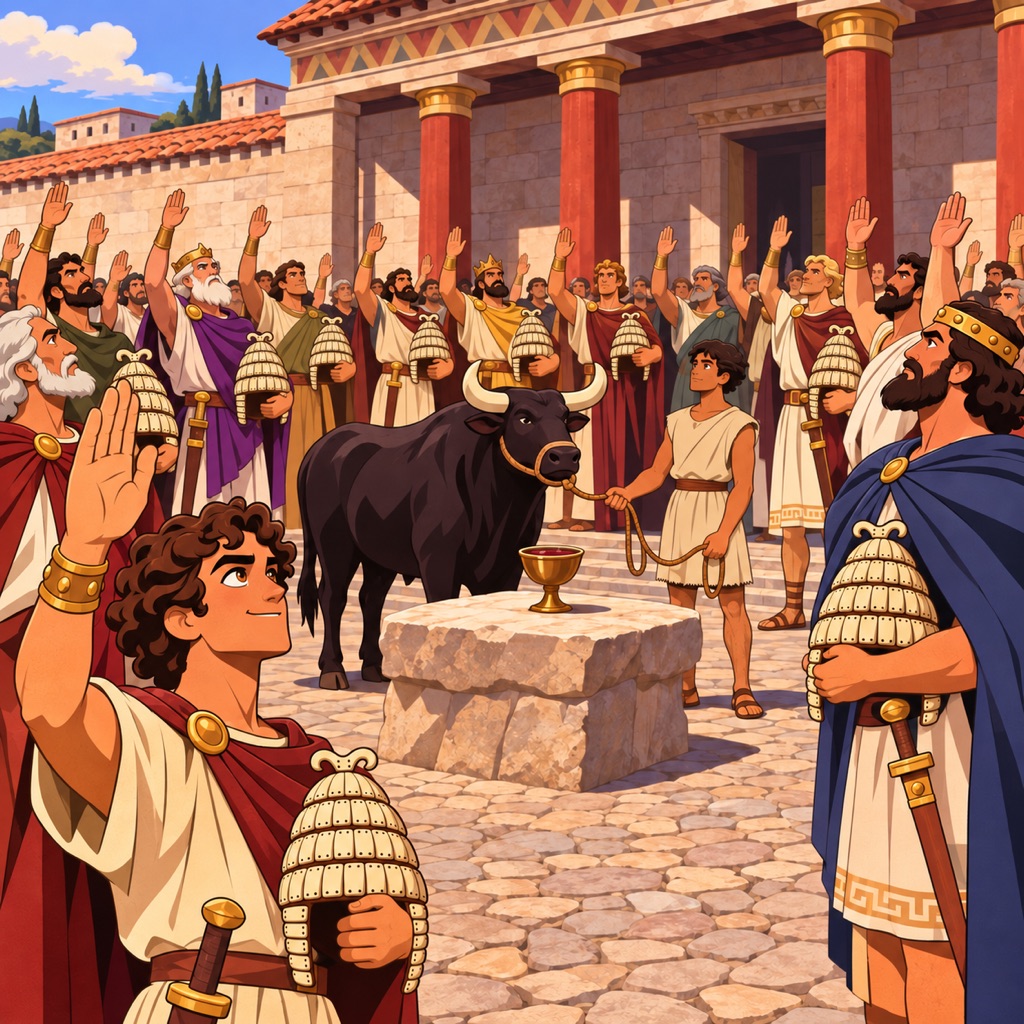
Every suitor swore. Menelaus got Helen. Odysseus got Penelope. And without knowing it, the clever king of Ithaca had just written the legal basis for the Trojan War, which would keep him away from Penelope for twenty years.
Helen of Troy's Husband: Menelaus, Then Paris, Then Deiphobus
If you search for "Helen of Troy husband," the short answer is Menelaus. He was the husband she was born to marry, the husband the Greeks went to war for, and the husband she went home with. But the full answer is longer.
Menelaus was the younger brother of Agamemnon and became king of Sparta through his marriage to Helen. Homer gives them one daughter, Hermione. In the Iliad, Menelaus is brave, decent and a little second-rate: a good fighter who is never quite the best.
Paris (also called Alexandros) was the son of King Priam of Troy. Whether Helen counted as his wife or his captive is a question the Greeks themselves argued over for a thousand years. The Trojans treated the marriage as real. Helen lived as Paris's wife in Troy for the whole ten-year war, nearly twenty years if you count the Homeric hint at Iliad 24.765, where she says it has been twenty years since she left home.
Deiphobus, another son of Priam, married Helen after Paris was killed. The lost epic Little Iliad, in Proclus's summary, records the marriage. The Odyssey has Deiphobus walking beside her on the night of the wooden horse (4.276), and has Odysseus and Menelaus heading straight for "the house of Deiphobus" when the city falls (8.517–518).
A later tradition even gave her a fourth husband. Pausanias reports a story that after death Helen married Achilles on the White Island in the Black Sea. That one is very late and very strange, and it is not in Homer.
Paris and the Guest Law
The war had a mythical cause, the golden apple and the Judgment of Paris, in which Aphrodite promised Paris the most beautiful woman alive. But in Greek eyes, the crime that started the war was something more ordinary and more serious: Paris broke the law of guest-friendship.
The Greeks called it xenia. A host gave a stranger a bath, food, wine and a bed, often before asking his name. In return, the guest never harmed the host. Zeus himself, under the title Zeus Xenios, guarded the rule. To abuse a host's house was to insult the king of the gods.
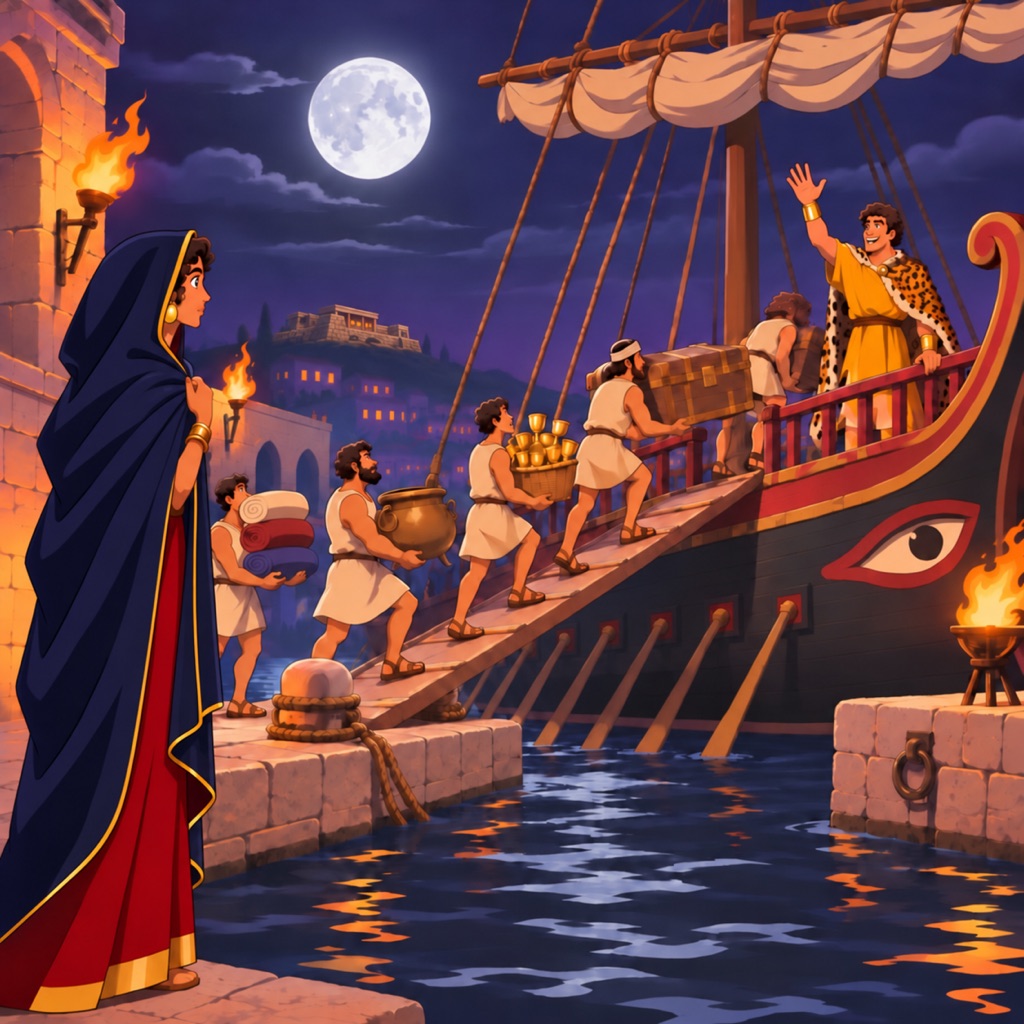
According to the Cypria (in Proclus) and Apollodorus (Epitome 3.3), Menelaus welcomed Paris and feasted him for nine days. On the tenth day, Menelaus sailed to Crete for the funeral of his grandfather Catreus, and told Helen to give their guests everything they needed. Aphrodite brought Helen and Paris together. They left by night with a large part of the palace treasure.
That treasure matters. In the Iliad, when the Greeks and Trojans agree to settle the war by a duel, the stakes are "Helen and all her possessions" (3.70). The Greeks did not just want the woman back. They wanted their gold.
Did Helen go willingly? The ancient sources can't agree, and they argue about it openly. In Homer, she blames Aphrodite and herself. In Euripides' Trojan Women, Helen argues that the goddess forced her, and Paris's mother Hecuba replies that Helen simply saw a handsome rich foreigner and wanted him. The orator Gorgias wrote a whole speech, the Encomium of Helen, arguing that she was innocent whether she was moved by gods, force, words or love. The debate was already an old one in the fifth century BCE.
Helen on the Walls: Iliad Book 3
Helen's best scene in all of Greek literature is in Iliad Book 3, in the passage scholars call the Teichoskopia, "the view from the wall."
The poem finds her in her room weaving a great purple cloth, and on it she is weaving the battles that the Greeks and Trojans are fighting for her sake (3.125–128). The goddess Iris calls her to the walls to watch the duel between Paris and Menelaus. At the Scaean Gate, the old men of Troy watch her walk past. They say it is no shame that two armies should suffer so long for a woman like that: she looks terribly like an immortal goddess. Then they add that she should still go home in the ships, before she ruins them all (3.156–160).
King Priam calls her to sit beside him. "You are not to blame in my eyes," he says. "The gods are to blame" (3.164). Then he asks her to name the Greek heroes on the plain below. She points out Agamemnon, Odysseus and Ajax. She looks for her own brothers, Castor and Polydeuces, and can't find them. She guesses they stayed home out of shame because of her. Homer tells us the truth she can't know: they were already dead and buried in Sparta (3.236–244).
What makes the scene famous is Helen's self-blame. She tells Priam she wishes she had died before she followed his son to Troy (3.173–175), and she calls herself "dog-faced" (3.180). In Book 6 she goes further, telling Hector she is a "dog, a schemer of evil" and that she wishes a storm had swept her away on the day she was born (6.344–348). Then she says something chilling: Zeus gave her and Paris an evil fate so that they would be the subject of songs for people in the future (6.357–358). Homer's Helen knows she is inside a story.
After the duel, Aphrodite rescues Paris and orders Helen to go to his bed. Helen refuses at first and tells the goddess to go and sit by Paris herself. Aphrodite threatens her, and Helen obeys in silence (3.390–420). It is one of the few moments in Homer where a mortal tells a god, to her face, exactly what she thinks.
At the very end of the Iliad, Helen is the last of three women to mourn Hector. She says he was the only Trojan who never said a harsh word to her (24.762–775). Everyone else in Troy, she says, shudders at her.
Helen and the Beggar: Odyssey Book 4
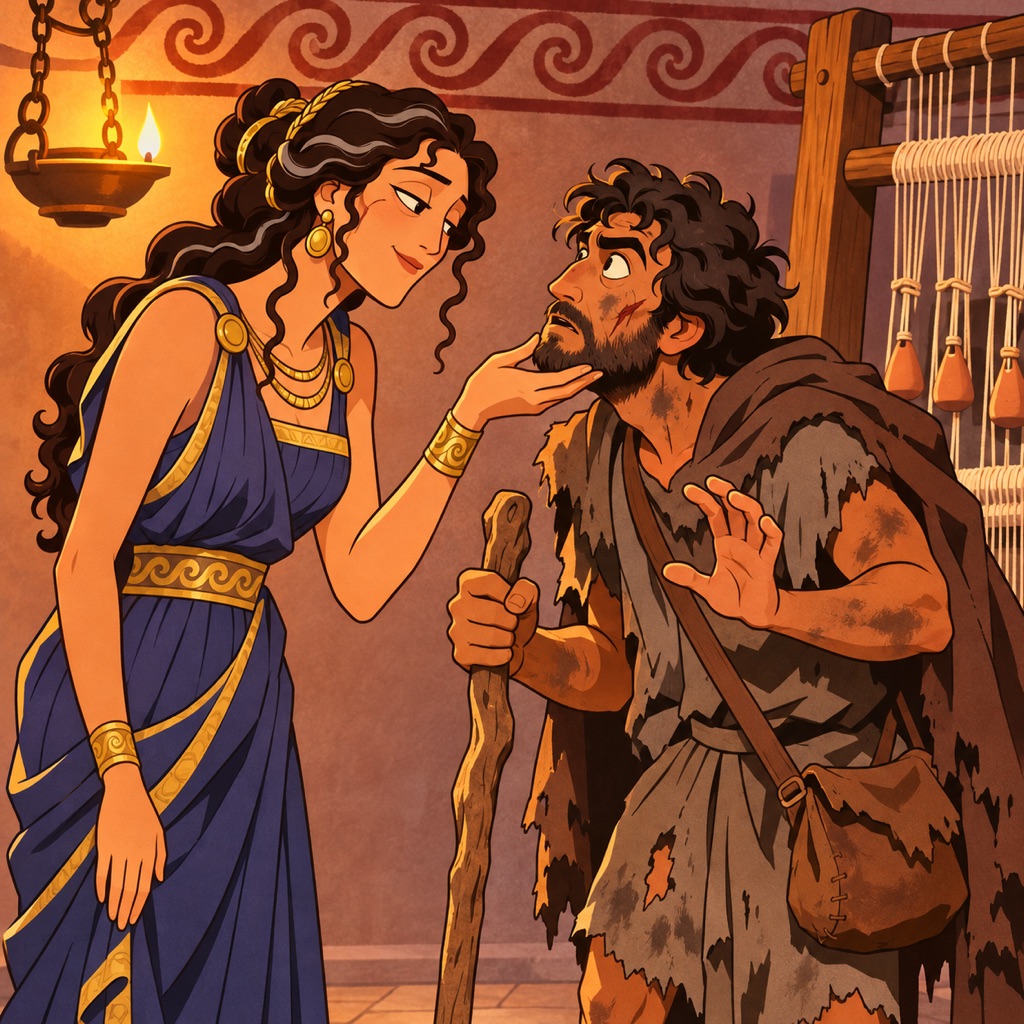
Some of the best Helen material comes after the war, from Helen herself. In Odyssey Book 4, Odysseus's son Telemachus visits Sparta looking for news of his father. Helen, back home with Menelaus, tells a story about the war.
Odysseus, she says, once beat his own body with blows, dressed in rags like a slave, and slipped into Troy as a beggar. Nobody recognised him. Helen did. She questioned him, and he tried to dodge her. She bathed him, rubbed him with oil, gave him clothes, and swore a great oath not to reveal him until he was back at the ships. Then he told her the Greek plans, killed a number of Trojans on his way out, and returned to camp. The Trojan women wailed, Helen says, but her heart was glad, because by then she longed to go home and regretted the madness Aphrodite had put on her (4.240–264).
It is a flattering story, and Homer seems to know it. The very next speaker is Menelaus, and his story is not flattering at all.
The Voices at the Horse
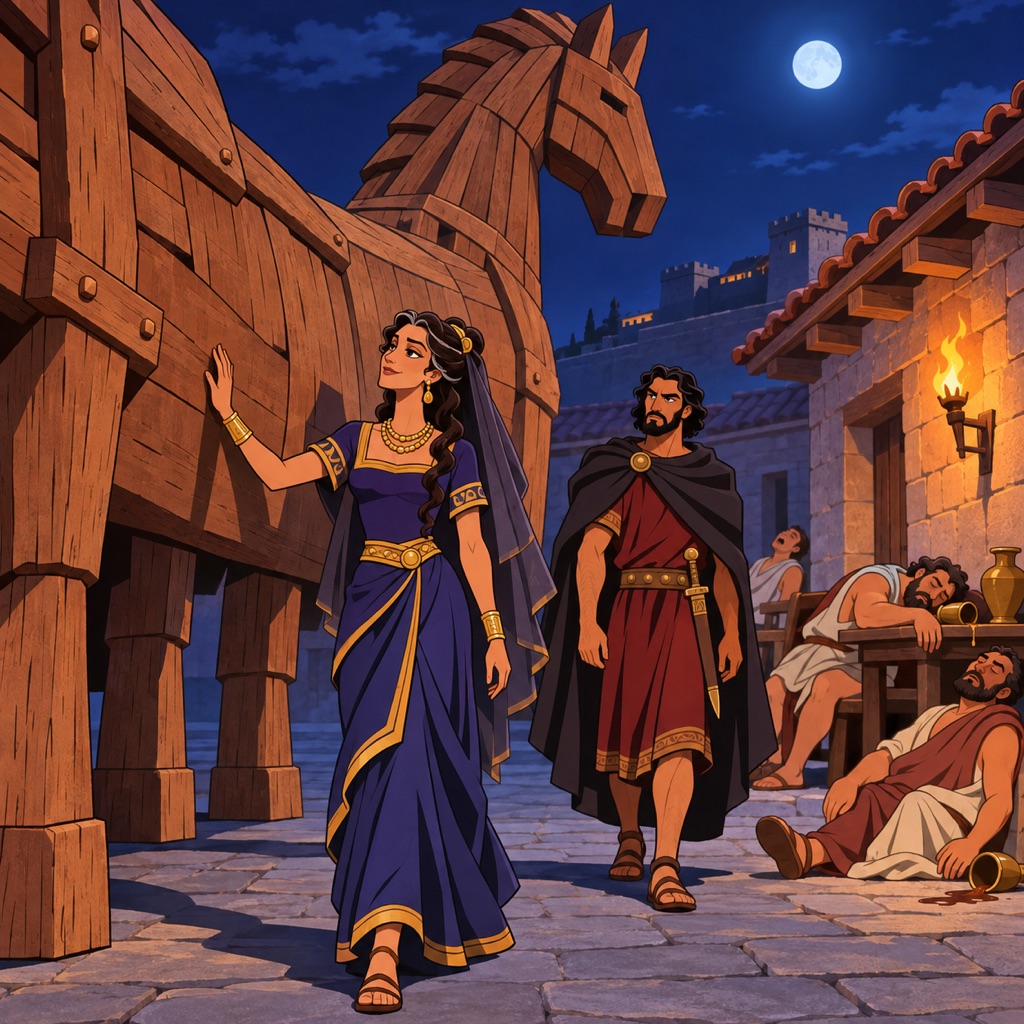
Menelaus tells Telemachus about the night of the Trojan Horse. He and the best of the Greeks were hidden inside it. Helen came to the horse, with Deiphobus following her. Some god who favoured the Trojans had put the idea in her head, Menelaus says politely. She walked around the hollow horse three times, touching it, and called out to the Greek leaders by name, imitating the voice of each man's wife (4.274–279).
Menelaus and Diomedes nearly jumped up to answer. One man, Anticlus, was about to call out. Odysseus clamped his hands over the man's mouth and held them there until Athena led Helen away (4.280–289). In Menelaus's version, Helen almost got them all killed.
So which Helen was she: the secret friend of the Greeks, or the woman testing the horse for the Trojans? Homer gives us both stories, one after the other, from husband and wife at the same dinner table, and does not tell us which to believe. It is one of the most deliberate silences in ancient literature.
The scene is worth knowing because Virgil's Aeneid leaves it out entirely. Most modern retellings follow Virgil, so most people have never heard that Helen walked around the horse at all.
Menelaus Lowers His Sword
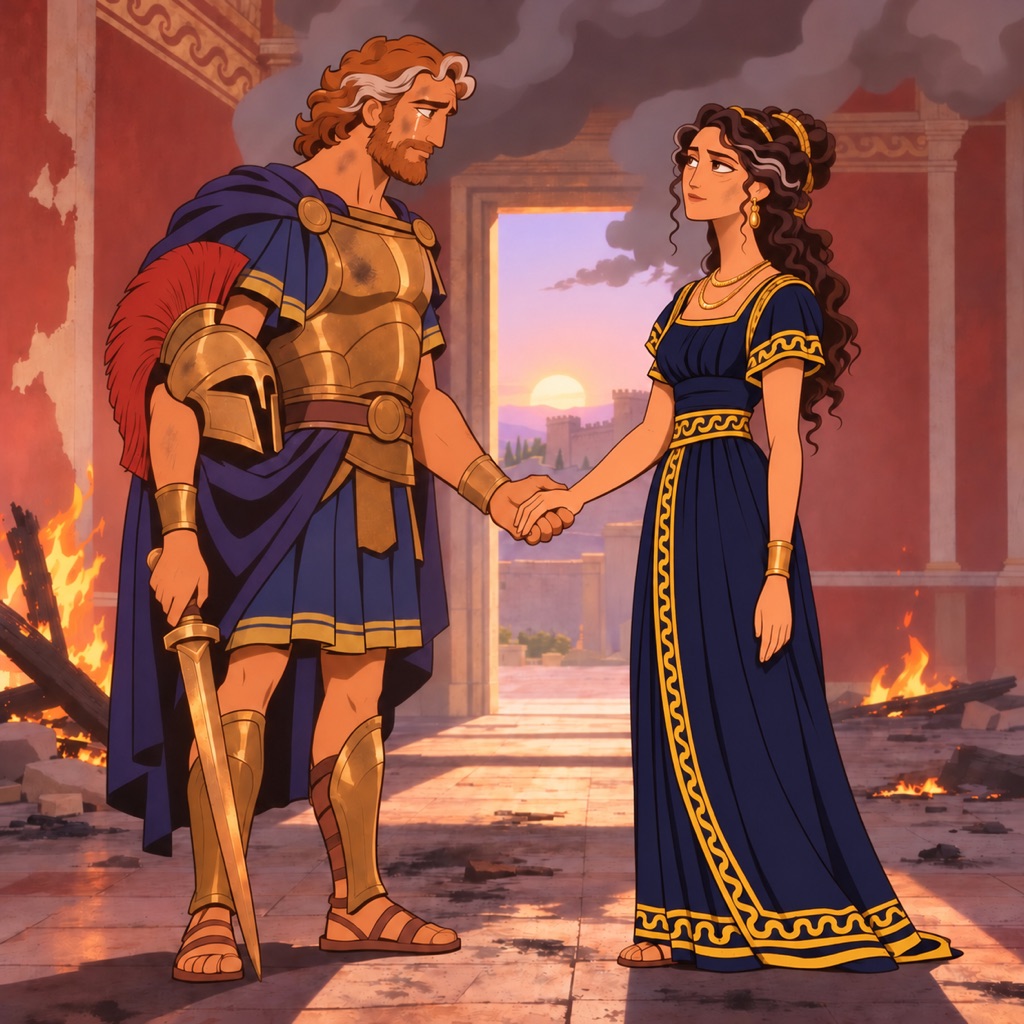
When Troy fell, Menelaus went looking for Helen. Homer only says that he and Odysseus went to Deiphobus's house and fought there (Odyssey 8.517–520). Later sources supply the most famous moment. Menelaus found Helen and raised his sword to kill her. Then he saw her and could not do it.
The version in Euripides' Andromache (627–631) is blunt: when he saw her breast, he threw away his sword and took her back. Aristophanes makes a joke of the same scene in Lysistrata (155–156), which shows the story was well known in fifth-century Athens. Ancient commentators traced it to the lost early epics. In Euripides' Trojan Women, Menelaus announces he will kill her once they reach Greece, and Hecuba warns him not to let her board his ship. Everyone in the audience knew how that would end.
Back in Sparta: Odyssey Book 4
The journey home took years. According to the Odyssey, Menelaus wandered for eight years, as far as Cyprus, Phoenicia and Egypt, collecting treasure as he went (3.299–312, 4.81–85). By the time Telemachus arrives, the couple are back in their palace, celebrating a double wedding.
Helen enters "like Artemis of the golden distaff" (4.121–122), and she is the first to guess that the young stranger is Odysseus's son (4.138–146). When the men grow tearful remembering the war, she slips a drug from Egypt into the wine. The drug, Homer says, makes a man forget grief for a whole day, even if he saw his own brother or son killed in front of him (4.219–232).
The prophet Proteus tells Menelaus that he will not die at all. Because he is married to Helen, and so is the son-in-law of Zeus, the gods will send him to the Elysian Fields at the end of the world (4.561–569). In Homer, the husband who was wronged gets paradise, and he gets it because of her.
The Other Story: Helen Never Went to Troy
Some ancient writers rejected the whole thing. The lyric poet Stesichorus, in the sixth century BCE, is said to have written a poem blaming Helen and then gone blind. He wrote a retraction, the Palinode, which Plato quotes in the Phaedrus (243a): "That story is not true. You did not sail in the well-benched ships, nor go to the towers of Troy." His sight, the story goes, came back.
The historian Herodotus (2.112–120) reports what he says Egyptian priests told him: Paris and Helen were blown off course to Egypt, the Egyptian king kept Helen safe, and the Greeks besieged Troy for ten years over a woman who was not there. Herodotus thought Homer had heard this version too but chose the better story.
Euripides took it further in his play Helen (412 BCE). Hera, furious at losing the beauty contest, made a phantom Helen out of cloud and sent it to Troy with Paris. The real Helen spent the war in Egypt, faithful to Menelaus, while Greeks and Trojans died for a ghost. It is a play about a war fought for nothing, staged while Athens was losing a war of its own.
"The Face That Launched a Thousand Ships"
The most famous line about Helen is not ancient. "Was this the face that launched a thousand ships, / And burnt the topless towers of Ilium?" comes from Christopher Marlowe's play Doctor Faustus, written around 1592. In the play, Faustus has sold his soul to the devil, who summons the spirit of Helen for him. The next line is just as famous: "Sweet Helen, make me immortal with a kiss."
The number has a real root. In Iliad Book 2, Homer's Catalogue of Ships lists the Greek contingents that sailed for Troy, and the total comes to 1,186 ships. Marlowe rounded down.
Was Helen of Troy Real?
There is no evidence that a real Helen ever lived. No Bronze Age text names her. But the world around her story was real. Troy was a real city in northwest Turkey, and the layer archaeologists call Troy VIIa was destroyed by fire around 1180 BCE. Hittite records mention a kingdom called Wilusa, which most scholars identify with Troy, and a people called the Ahhiyawa, which most scholars take to be Mycenaean Greeks. One Hittite letter, the Tawagalawa letter, refers to a past quarrel between the two powers over Wilusa. See Was Troy Real? for the full evidence.
Helen's worship is also real history. At Therapne, just outside Sparta, archaeologists have excavated the Menelaion, a shrine to Helen and Menelaus with offerings going back to around 700 BCE. Herodotus (6.61) tells of an ugly Spartan baby whose nurse carried her to Helen's shrine every day, until a mysterious woman touched the child's head; she grew up the most beautiful woman in Sparta. To the Spartans, Helen was not a scandal. She was a goddess who could make you beautiful.
For the poems that made her famous, see the Iliad summary, the profile of Homer, and the overview of Ancient Greece. For the woman who warned Troy and was not believed, see Cassandra.
Frequently Asked Questions
1What is the Helen of Troy story in short?
In Greek myth, Helen was the daughter of Zeus and Leda and the wife of Menelaus, king of Sparta. The Trojan prince Paris took her from Sparta while he was Menelaus's guest. Because all of Helen's former suitors had sworn to defend her husband, the Greek kings sailed to Troy and fought for ten years to get her back. After Troy fell, Menelaus took her home to Sparta.
2Who was Helen of Troy's husband?
Her first husband was Menelaus, king of Sparta, and she returned to him after the war. In Troy she lived as the wife of Paris. After Paris was killed, she was married to his brother Deiphobus, according to the lost epic Little Iliad and Homer's Odyssey.
3Who said 'the face that launched a thousand ships'?
Christopher Marlowe, in his play Doctor Faustus, written around 1592. It is not an ancient quotation. The number echoes Homer's Catalogue of Ships in Iliad Book 2, which lists 1,186 Greek ships.
4Did Helen go with Paris willingly?
The ancient sources disagree. The Cypria says Aphrodite brought them together. In the Iliad, Helen blames both Aphrodite and herself. Euripides' Trojan Women stages a debate in which Helen blames the goddess and Hecuba blames Helen. Gorgias wrote a speech arguing she was blameless either way.
5Did Helen ever go to Troy at all?
In Homer she did. But the poet Stesichorus wrote a retraction saying she never sailed to Troy, Herodotus reports an Egyptian tradition that she spent the war in Egypt, and Euripides' play Helen has the gods send a phantom made of cloud to Troy in her place.
6Was Helen of Troy a real person?
There is no evidence that she was. Troy itself was real, and a city layer there burned around 1180 BCE, but no Bronze Age text names Helen. She was, however, really worshipped as a goddess at Therapne near Sparta from about 700 BCE.
Hear Helen's Story
Follow Helen from the palace at Sparta to the night of the wooden horse in Histolumo's Ancient Greece stories. The first chapter is free.


Hear Their Story
Everything He Needs
4 minA king left his guest everything he needed and sailed to a funeral. He came home to an empty hall and a missing wife.

Who Gets the Armour?
4 minA filthy beggar walked into Troy. Out of the whole city, only one woman knew who he really was.
Voices in the Horse
5 minAt midnight, Helen walked around the wooden horse and called the men inside by name, in the voices of their wives.
Related Articles
Iliad Summary: Achilles' Rage, Book by Book
Iliad summary, book by book: the quarrel, Patroclus, the death of Hector and Priam's ransom. Plus the main characters, the themes, and Iliad vs Odyssey.
Judgment of Paris: The Apple of Discord
The Judgment of Paris myth: Eris and the golden apple of discord at a gods' wedding, three goddesses, three bribes, and the choice that started the Trojan War.
The Trojan Horse: The Real Story
The Trojan Horse real story, from Homer and the lost epics: who built it, who hid inside, Cassandra's warning, Helen's trick, and whether a horse ever existed.
Trojan War Summary: The Whole Story
Trojan War summary in order: the golden apple, Helen and Paris, Achilles and Hector, the wooden horse and the fall of Troy, with a timeline and the archaeology.
Was Troy Real? What Archaeologists Found
Was Troy real? Yes: a Bronze Age city at Hisarlik in Turkey burned around 1180 BCE. Whether a Greek army burned it is still one of archaeology's big debates.
Experience Helen of Troy's Story
Go beyond the biography. Hear Helen of Troy's story told by Lumo, your immortal wolf guide who witnessed these events firsthand.