Was Troy Real? The Short Answer
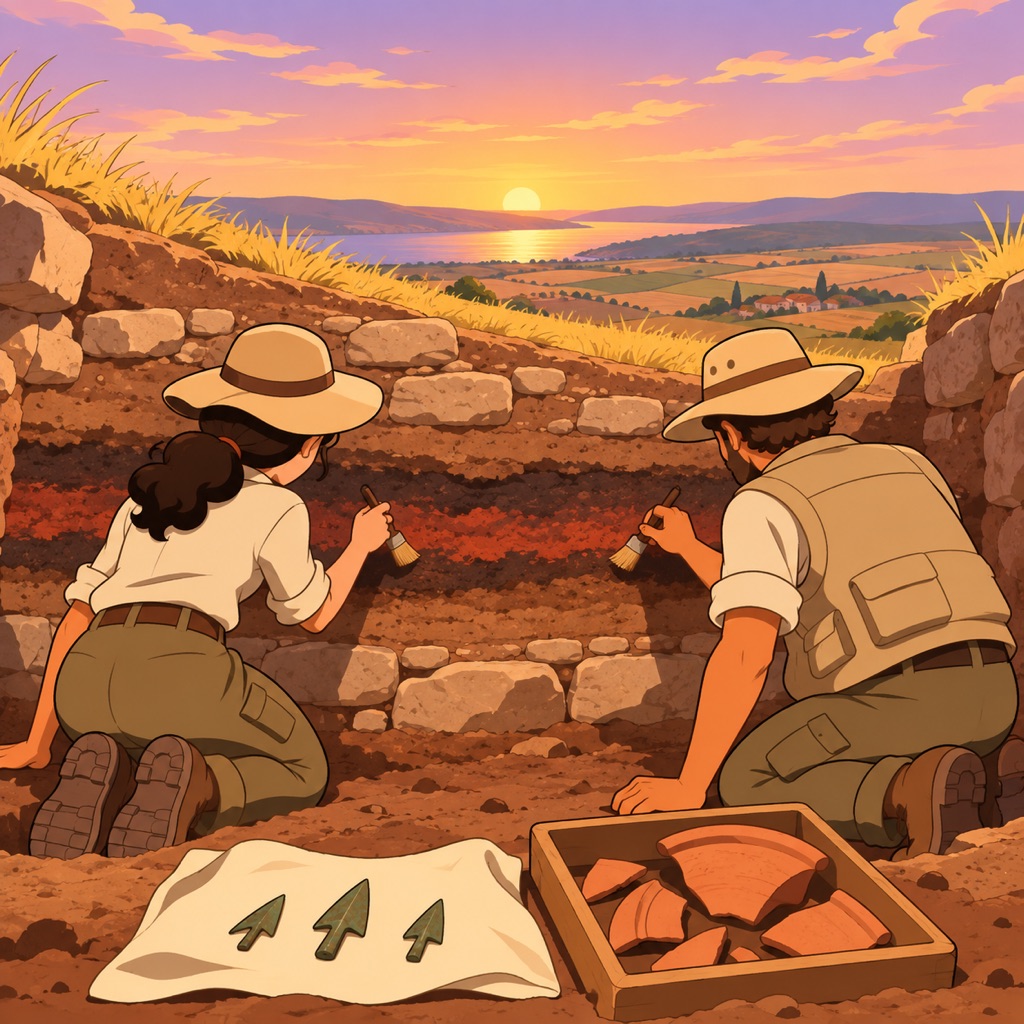
Was Troy real? Yes. A city stood on the mound of Hisarlik, in northwest Turkey, for more than three thousand years, and most archaeologists accept it as the Troy of Greek legend. Whether that city was ever besieged by a Greek army, as Homer's Iliad tells it, is a different question, and it has no settled answer.
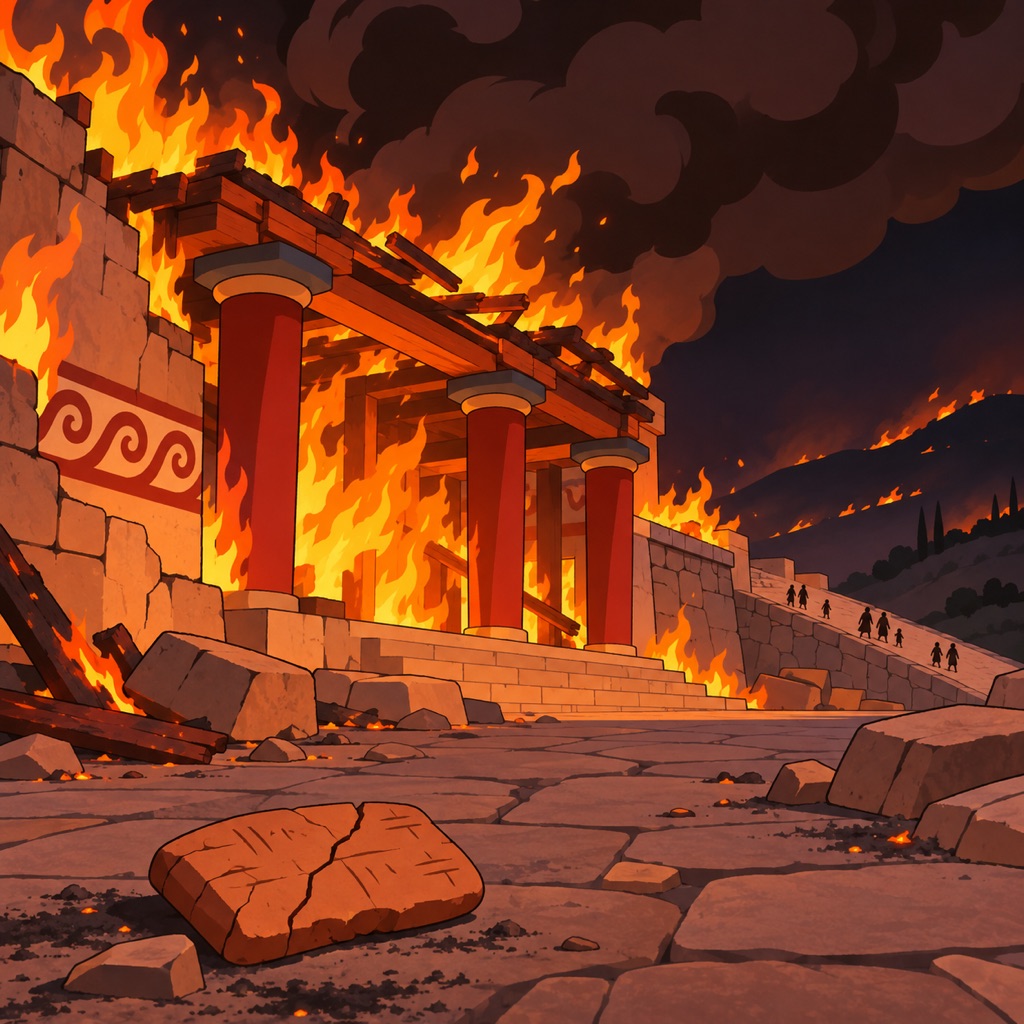
What the ground does show is this. Around 1180 BCE, a fortified Bronze Age town on that hill burned. Excavators found collapsed houses, scorched walls, scattered human bones and bronze arrowheads in the destruction layer. Hittite archives from the same centuries name a kingdom called Wilusa in the same corner of Anatolia, and they record quarrels over it with a sea-going power called Ahhiyawa. Most scholars read Wilusa as Troy (the Greek Ilios) and Ahhiyawa as Mycenaean Greeks. Not all of them agree.
So the honest answer to "was Troy real or myth" is: the place was real, the fire was real, and the political trouble in the region was real. The wooden horse, the golden apple and the ten-year siege belong to poetry. The fight is over how much of the poetry grew from a real war.
This page walks through the evidence in the order it was found: the hunt for the site, the men who dug it, the layers they named, the Hittite letters, and the arguments that are still running.
The Legend Comes First
Greeks of the classical age never doubted that Troy had existed. To them the war was history, the deepest layer of their own past. The Iliad and the Odyssey, composed around 700 BCE and credited to Homer, told of a rich walled city near the sea in Asia Minor, ruled by King Priam. The Greeks called the city both Ilios and Troia.
According to the legend, a Trojan prince, Paris, carried off Helen, wife of King Menelaus of Sparta. Menelaus's brother Agamemnon gathered the kings of Greece, and the fleet besieged Troy for ten years until the trick of the Trojan Horse ended it. The whole cycle of stories, from the Judgment of Paris to the burning of the city, is summarized on our Trojan War page.
Ancient writers also tried to date the war. The scholar Eratosthenes, working in the third century BCE, placed the fall of Troy in a year we would call 1184/1183 BCE. Herodotus put it some 800 years before his own time, which lands in the 13th century BCE. These were calculations from royal family trees, not from evidence in the ground, but they put the war in the Late Bronze Age, which turns out to be close to where the archaeology points.
There was also an actual town on the spot in classical times. A Greek settlement called Ilion stood on the hill, and visitors treated it as a shrine. Xerxes of Persia sacrificed a thousand cattle to Athena of Ilion in 480 BCE on his way to invade Greece. Alexander the Great stopped there in 334 BCE and, according to his ancient biographers, ran naked around the tomb said to be Achilles'. The Romans, who claimed descent from the Trojan prince Aeneas, rebuilt it.
Then the town faded. By the Middle Ages its location was forgotten, and by the 18th century many scholars thought Troy had never existed at all.
The Hunt for the Hill: Calvert and Schliemann
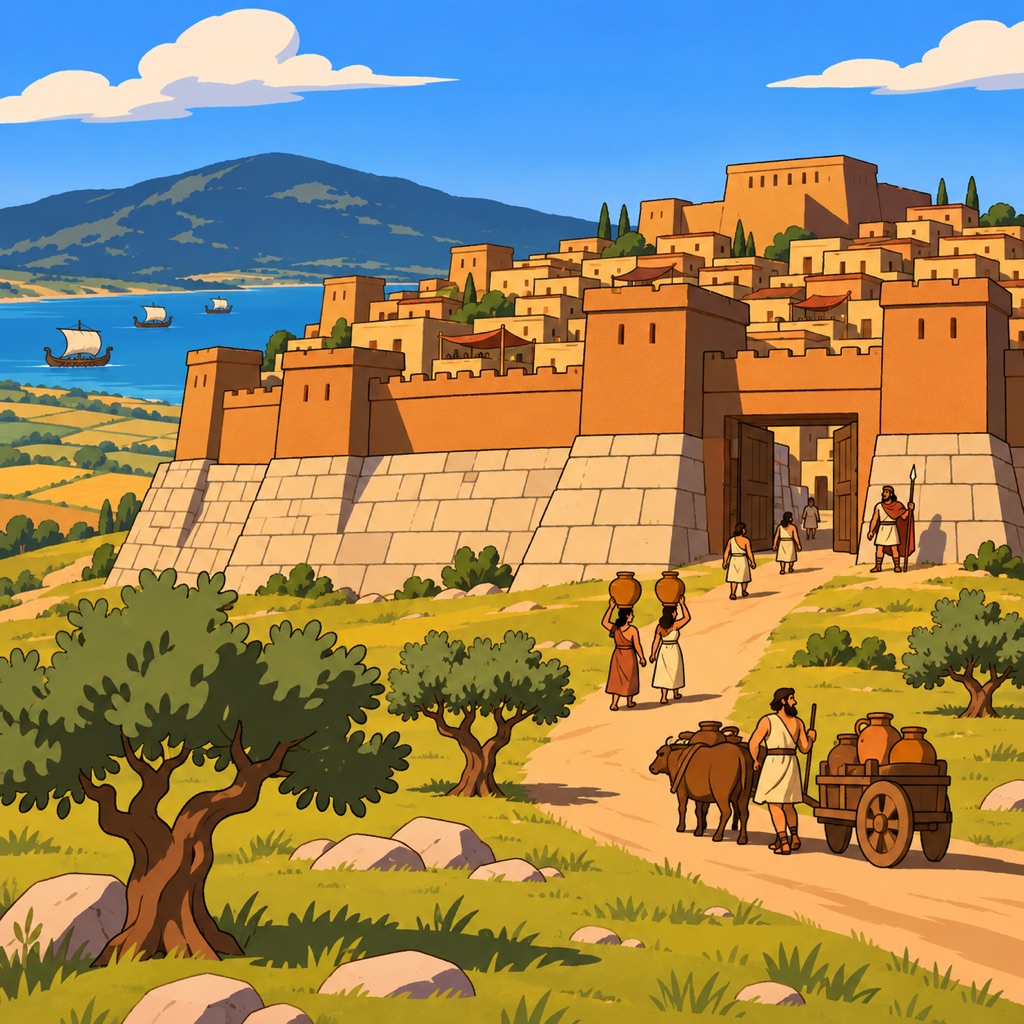
In the early 19th century, most travelers who went looking for Troy favored a hill called Pınarbaşı, a few miles inland. A Scottish journalist, Charles Maclaren, argued in 1822 that the real site was a low mound closer to the sea called Hisarlik ("place of the fortress" in Turkish). Classical coins and inscriptions from Ilion had turned up there.
The man who tested the idea was Frank Calvert, a British expatriate whose family lived in the Dardanelles and served as consuls there. Calvert owned part of the Hisarlik mound. In the 1860s he dug trial trenches and found walls and debris that convinced him the mound held more than one ancient city. He lacked the money to dig at scale.
In 1868, a wealthy German businessman named Heinrich Schliemann arrived in the Troad with a copy of Homer and a fortune made in trade. Calvert showed him Hisarlik and persuaded him that it was the place. Schliemann began digging in 1870, at first without a proper permit, and ran large campaigns from 1871 to 1873.
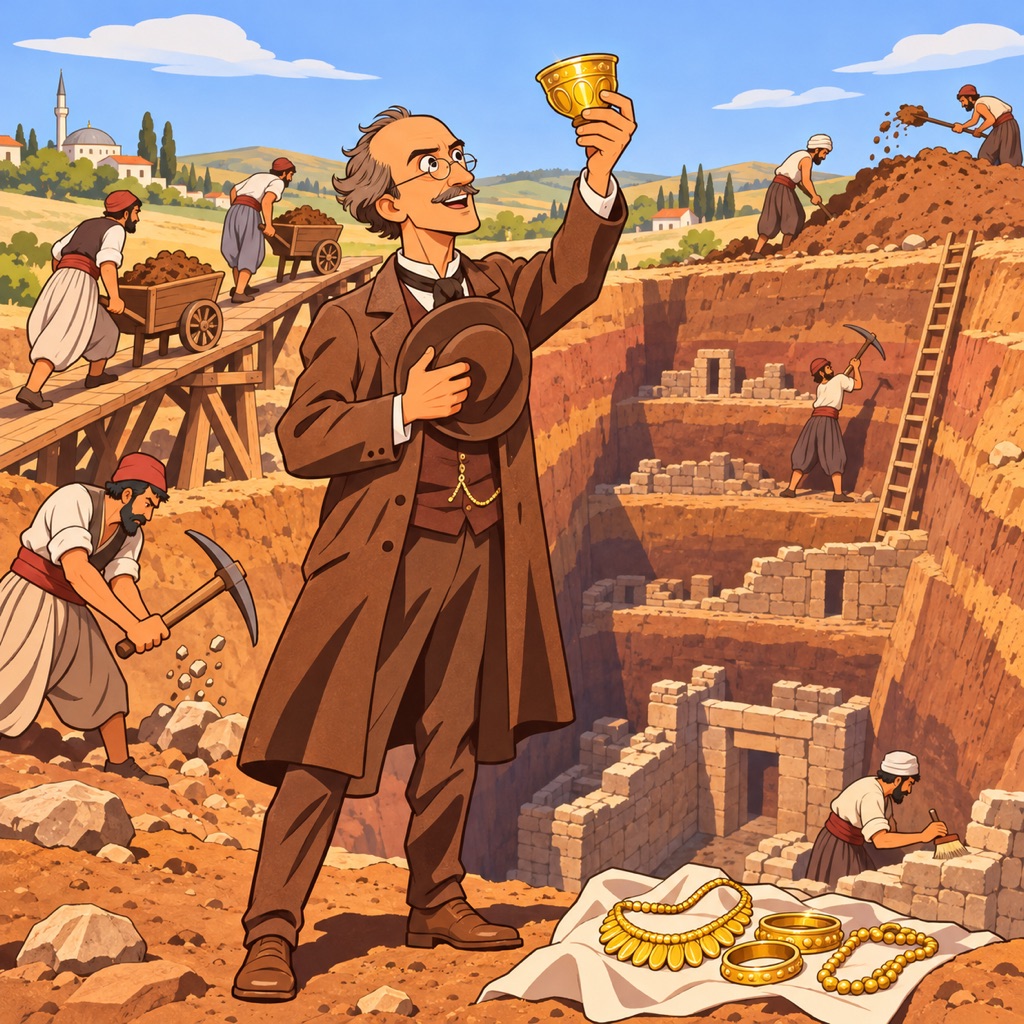
His method was brutal even by the standards of his day. Convinced that Homer's Troy must be at the bottom, the oldest layer, he cut a vast trench straight through the mound from north to south. Workers removed layer after layer of later walls to get there. In doing so they destroyed a good part of the very Late Bronze Age levels that later archaeologists would link to the legend.
In 1873, near the bottom of the mound, Schliemann found a cache of gold and silver: diadems, earrings, cups, thousands of small gold beads. He called it "Priam's Treasure" and announced that he had found the Troy of Homer. He photographed his wife Sophia wearing one of the gold headdresses and called it the jewels of Helen. His story that Sophia helped carry the treasure out in her shawl is very likely untrue: other evidence suggests she was in Athens at the time.
The treasure was real, but it was not Priam's. It came from the level now called Troy II, dated to about 2400 BCE, more than a thousand years before any possible Trojan War. Schliemann smuggled it out of the Ottoman Empire. It ended up in Berlin, vanished at the end of the Second World War, and resurfaced in Moscow's Pushkin Museum in the 1990s, where most of it remains.
Schliemann did not discover Troy alone, and Calvert's role was played down for a century. But Schliemann proved, with spades and publicity, that the hill held a great Bronze Age city, and he turned the question "was Troy real?" from a scholars' parlor game into a field of archaeology.
Nine Cities on One Hill: Dörpfeld, Blegen and the Layers
Hisarlik is a tell: a mound made of one settlement built on the ruins of the last. Archaeologists divide it into nine main layers, Troy I (from about 3000 BCE) to Troy IX (the Roman city), with many sub-phases.
Schliemann's architect, Wilhelm Dörpfeld, took over after Schliemann's death in 1890. In 1893 and 1894 he exposed the walls of Troy VI, a much grander city than the levels Schliemann had chased. Its fortification walls of fitted limestone, with a slight inward slope and great towers, still stand several meters high. Dörpfeld argued that Troy VI was Homer's Troy, and its walls do recall the Iliad's "well-built walls" of Ilios.
From 1932 to 1938, an American team from the University of Cincinnati under Carl Blegen re-examined the stratigraphy with far more care. Blegen concluded that Troy VI ended around 1300 BCE in an earthquake: cracked walls and toppled masonry, with no clear sign of an enemy. The settlement that followed, which he called Troy VIIa, was built inside the same walls by the same people. Its houses were small and crowded together. Large storage jars were sunk into the floors, as if the town were stocking food for a siege.
Troy VIIa ended in fire. Blegen found burned debris, human remains in the streets and houses, and arrowheads. He identified this level as the Troy of the Trojan War. He dated its destruction to around 1250 BCE; later study of the pottery moved that date down to around 1190 to 1180 BCE.
That is the core of the archaeological case. Was Troy really destroyed by fire? Yes, more than once. Troy II burned around 2300 BCE, which is why Schliemann thought he had found the flames of Homer's city. Troy VIIa burned around 1180 BCE, with signs of violence. That second fire is the one that matters for the legend.
Korfmann and the Lower Town
For decades, one objection hung over Hisarlik: the citadel was small. The fortified hilltop of Troy VI covers only about two hectares, hardly the capital of a powerful kingdom. Could this really be the city that held off a Greek coalition for ten years?
From 1988 until his death in 2005, a German-American team led by Manfred Korfmann of the University of Tübingen went back to the site with new tools. Magnetometry, which maps buried features by tiny changes in the earth's magnetic field, revealed a lower town spreading south of the citadel. The team found a defensive ditch cut into bedrock, enclosing an area many times larger than the citadel. Korfmann estimated the Late Bronze Age city at around 30 hectares and several thousand inhabitants, possibly 5,000 to 10,000.
Korfmann read the ditch as a barrier against chariots and argued that Troy was a major trading city controlling the approach to the Dardanelles, with ties both to the Aegean and to Anatolia. In 1995 the excavators found a small bronze seal with an inscription in Luwian hieroglyphs, a script used in western Anatolia, in a layer just after Troy VIIa. It is the only piece of writing yet found at Bronze Age Troy.
Not everyone accepted the picture. In 2001 the Tübingen historian Frank Kolb accused Korfmann of inflating thin evidence into a grand city to suit the Homeric story, and the two sides fought it out at a public symposium in 2002. Critics argued that the lower town was sparsely built and that the ditch might have served other purposes. Later work under Ernst Pernicka (2006 to 2012) and the Turkish team led by Rüstem Aslan (from 2013) continued to find Late Bronze Age houses in the lower town. Today most archaeologists accept that Troy VI and VIIa were a substantial regional city, larger than the citadel alone, though estimates of its size and wealth still vary.
Wilusa and Ahhiyawa: Troy in the Hittite Archives
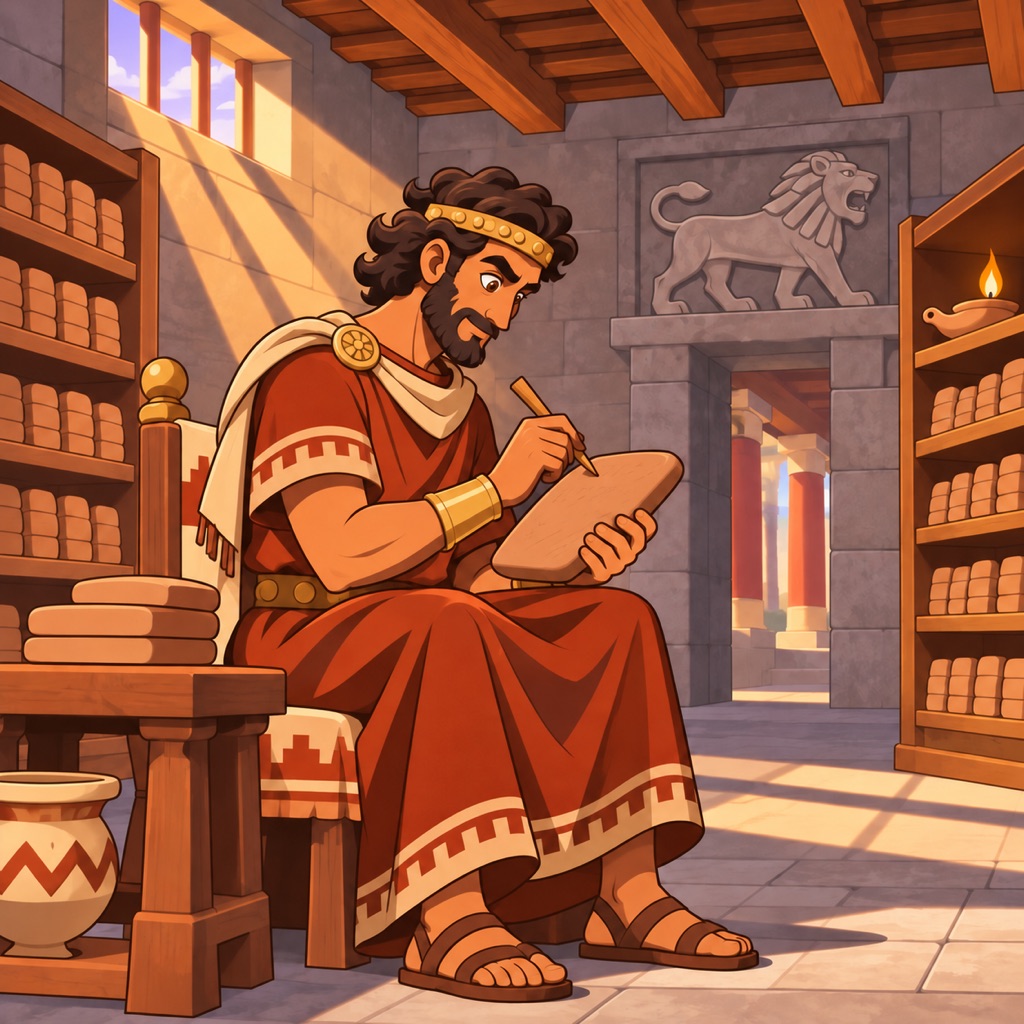
The strongest written evidence for a historical Troy does not come from Greece at all. It comes from the Hittites, the great Bronze Age empire of central Anatolia, whose capital Hattusa yielded thousands of clay tablets in cuneiform.
Several Hittite texts mention a kingdom in western Anatolia called Wilusa. In early Greek, Ilios was pronounced Wilios: the "w" sound dropped out of Greek later, but traces of it survive in Homer's verse. A second name, Taruisa, appears in a Hittite list of rebel lands, and it sounds much like Troia. The geography of Hittite texts, firmed up after the scholar David Hawkins re-read a rock inscription at Karabel in 1998, places Wilusa in the northwest, the region of Hisarlik.
The key documents:
- The Alaksandu treaty, around 1280 BCE, is a treaty between the Hittite king Muwatalli II and a vassal ruler of Wilusa named Alaksandu. The name looks a lot like Alexandros, which is Paris's other name in the Iliad. Among the gods called to witness the treaty is one written Appaliunas, which some scholars connect with Apollo, the god who fights for Troy in Homer.
- The Tawagalawa letter, usually dated to around 1250 BCE and probably written by King Hattusili III, is addressed to the king of Ahhiyawa, whom the Hittite king calls "my brother", a title reserved for great kings. Most of it concerns a troublemaker named Piyamaradu. In one passage the Hittite king refers to "the matter of Wilusa, over which we were hostile". Then they made peace.
- The Milawata letter, from a later Hittite king, mentions Walmu, a deposed king of Wilusa whom the Hittites wanted to restore to his throne.
Ahhiyawa appears in about two dozen Hittite texts as a power across the sea to the west, with a foothold on the Anatolian coast at Millawanda (Miletus). Most scholars now identify it with the Mycenaean Greeks, or with one of their kingdoms. The name recalls Homer's word for the Greeks, Achaioi (Achaeans). The identification is the majority view, not a proven fact; a minority have placed Ahhiyawa elsewhere, and nobody knows which Greek kingdom, if any single one, it meant.
Put together, the letters show a western Anatolian kingdom called Wilusa, a Hittite vassal, caught up in disputes in the 13th century BCE in which Greeks from across the Aegean were involved. That is not the Trojan War of the Iliad. There is no Helen in the tablets, no ten-year siege, no Achilles. But it is a plausible historical setting from which a legend could grow.
So Was There a Trojan War? The Debate
Scholars fall roughly into three camps.
A real war behind the poem. Some, such as the German classicist Joachim Latacz in his book Troy and Homer, argue that the Hittite evidence, the archaeology and the poems fit together well enough to say that the Iliad preserves a memory of real conflicts over Wilusa, passed down orally for five centuries. Homer's poems do keep genuine Bronze Age details. The boar's-tusk helmet described in Iliad 10 went out of use centuries before Homer, yet archaeologists have found examples in Mycenaean graves. Several places in the Catalogue of Ships in Iliad 2 were inhabited in the Bronze Age and barely, or not at all, later.
A real setting, no single war. Many historians, including the Hittite specialist Trevor Bryce, accept Wilusa as Troy and Ahhiyawa as Greeks, but think the legend probably merges several raids, disputes and destructions over a long period into one great war. Oral poetry compresses history and adds to it. The poems also contain much from Homer's own era, around 700 BCE: iron tools, cremation practices and fighting customs that do not belong to the Bronze Age.
Mostly myth. The historian Moses Finley argued in the 1950s and after that the Trojan War, as told, should be removed from history altogether: the world of the Odyssey reflected Homer's own time, and the war was a story. Some archaeologists also point out that the fire of Troy VIIa proves nothing about who lit it. Around 1200 BCE, the whole eastern Mediterranean was in crisis. The Mycenaean palaces in Greece burned. The Hittite Empire collapsed. Ugarit in Syria was destroyed. Egypt fought off the raiders it called the Sea Peoples. An attack by Greeks is only one possibility for Troy's destruction; raiders, internal revolt, or a fire after an earthquake are others. If Greeks did it, they did it at the very moment their own kingdoms were falling apart.
What would settle the question? A Bronze Age text found at Troy naming its kings, or a Mycenaean tablet mentioning an expedition to Wilusa. Neither has turned up. Until one does, the answer stays where it is.
Troy Today
Since 1998, the site of Troy has been a UNESCO World Heritage Site, and it lies inside a historical national park in Çanakkale province. Visitors can walk past Schliemann's great trench, the sloping walls of Troy VI, and the ramp of Troy II. A replica wooden horse built for tourists stands near the entrance, and the prop horse from the 2004 film Troy stands on the waterfront in Çanakkale. A new Troy Museum opened near the site in 2018. Some pieces of the gold that Schliemann carried off are still argued over by Russia, Germany and Turkey.
For the ancient Greeks, none of this would have been news. They knew Troy was real. They also knew that Achilles had a goddess for a mother and that Cassandra had her visions from Apollo. Archaeology cannot test those parts of the story. What it can say is that there was a city, it was rich, it had walls, and one night around 1180 BCE it burned.
To read what Homer made of all this, see our Iliad summary, or go back to the start with Ancient Greece.
Frequently Asked Questions
1Was Troy real or myth?
The city was real. Most archaeologists identify Troy with the mound of Hisarlik in northwest Turkey, where nine main settlements were built on top of one another from about 3000 BCE to Roman times. Whether the Trojan War of Homer happened is unproven. Hittite texts show disputes over the region in the 13th century BCE, but no source names Helen, Achilles or a ten-year siege.
2Was Troy really destroyed by fire?
Yes. The layer called Troy VIIa ended in a fire around 1180 BCE, with burned houses, human remains and bronze arrowheads. An earlier level, Troy II, also burned around 2300 BCE. Who set the later fire is unknown: Greek attackers are one possibility, alongside raiders, revolt, or an accident during the wider collapse around 1200 BCE.
3Who found Troy?
Frank Calvert, a British expatriate who owned part of the Hisarlik mound, dug test trenches there in the 1860s and convinced Heinrich Schliemann it was Troy. Schliemann dug from 1870 to 1890 and got most of the credit. Wilhelm Dörpfeld, Carl Blegen and Manfred Korfmann later did much of the careful work.
4Is Priam's Treasure really from Priam's Troy?
No. Schliemann found it in 1873 and named it after King Priam, but it comes from Troy II, about 2400 BCE, over a thousand years before any possible Trojan War. Most of it is now in the Pushkin Museum in Moscow.
5What is Wilusa?
Wilusa is a kingdom in western Anatolia named in Hittite texts of the 14th and 13th centuries BCE. Most scholars identify it with Troy, because the Greek name Ilios was once pronounced Wilios. The Tawagalawa letter mentions 'the matter of Wilusa, over which we were hostile' in a letter to the king of Ahhiyawa, probably a Greek kingdom.
6Where is Troy today?
Troy is at Hisarlik, near the town of Tevfikiye in Çanakkale province, Turkey, about 5 km from the Aegean coast and near the entrance to the Dardanelles. It is a UNESCO World Heritage Site and open to visitors.
Hear the Fall of Troy
The Golden Apple and The Walls of Troy tell the legend the way the Greeks told it, from the wedding of the gods to the night the city burned.


Listen to Related Stories
Voices in the Horse
5 minThe Greeks were gone, and a wooden horse stood on the empty beach.

The Singer Who Killed Me
6 minA blind singer in a smoky hall sang of a war five hundred years gone, and men wept into their wine.
Key Figures

Listen to the Full Story
Experience history through immersive audio lessons narrated by Lumo, your immortal wolf guide.