
Cassandra of Troy: Who Was She?
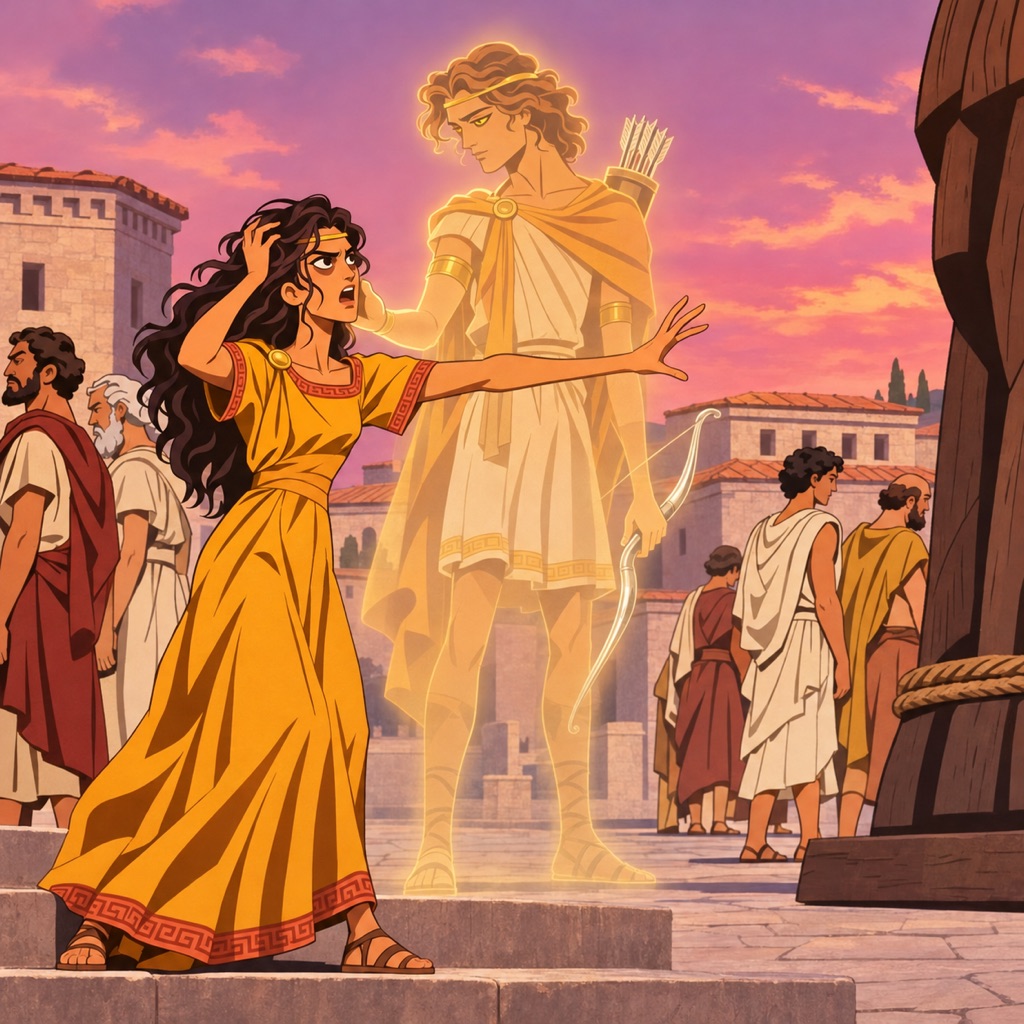
Cassandra of Troy is a princess in Greek mythology, a daughter of King Priam and Queen Hecuba, who could see the future but was cursed so that no one ever believed her. The god Apollo gave her the gift of prophecy. When she refused him, he added the curse. She warned the Trojans that the wooden horse was full of soldiers, and they ignored her. After the city fell she was dragged from the statue of Athena, taken to Greece as a prize by King Agamemnon, and killed with him at Mycenae.
That is the Cassandra most people know, and her name has become a word. A "Cassandra" today is someone who gives a true warning that nobody heeds.
The legend took centuries to build. Homer mentions her only briefly, and never as a prophet. The prophecy, the curse and her death at Mycenae come from the lost epics of the Trojan cycle, the Athenian playwright Aeschylus, and later mythographers such as Apollodorus and Hyginus. This page follows those sources in order and says which one tells what. Like everything about the Trojan War, it is legend, not history: for the archaeology of the real city, see Was Troy Real?
Cassandra in Homer
Homer's Cassandra is a beautiful princess, not a prophet. In the Iliad she is "the loveliest of Priam's daughters" (13.365). A Thracian ally named Othryoneus comes to Troy to marry her without paying a bride price, promising instead to drive the Greeks away. Priam agrees. Othryoneus is killed in battle by the Cretan king Idomeneus, who mocks him for the bargain (13.363–382).
Her one great moment in the Iliad comes at the very end. When Priam brings home the body of Hector from the Greek camp, Cassandra, "like golden Aphrodite", is the first to see the cart from the citadel. She cries out and calls all of Troy to come and look (24.699–706). It is an image of someone who sees first and calls out to people. But Homer does not say she can see the future.
In the Odyssey, Agamemnon's ghost tells Odysseus how he died. His wife Clytemnestra killed him at a feast on his return home, and as he lay dying he heard "the most pitiful voice" of Cassandra, whom Clytemnestra was killing beside him (11.421–423). So the end of her story is already in Homer, even if the prophecy is not.
Cassandra's Curse: Apollo's Gift
The fullest early account of Cassandra's curse is in Aeschylus' tragedy Agamemnon, first staged in Athens in 458 BCE. Cassandra arrives at Mycenae as Agamemnon's captive, and the chorus of old men asks her how she came to be a prophet. She tells them, in a short, painful exchange (lines 1202–1212). Apollo desired her. She agreed to give herself to him, and he gave her the gift of prophecy. Then she broke her promise. Apollo could not take back a gift from a god, so he made sure that no one would ever believe what she foretold. "Since I did that wrong," she says, "I have persuaded no one of anything."
The mythographer Apollodorus (Library 3.12.5) gives the same story in plain prose. Apollo wanted to sleep with her and promised to teach her prophecy. She learned the art and then refused him, so Apollo "deprived her prophecy of the power to persuade." Some later writers add that Apollo spat in her mouth, so the gift stayed but the persuasion was gone. That detail appears in the commentator Servius, writing in Latin centuries later.
There was another version. Ancient commentators tell of Cassandra and her twin brother Helenus being left as children in Apollo's temple overnight. In the morning their parents found sacred snakes licking their ears, and from then on both could hear the future. In that version there is no curse at all. Helenus became a seer whom people did believe, and he plays a part in the fall of Troy: in the Little Iliad he is captured by Odysseus and reveals what the Greeks must do to take the city.
The cruelty of the Aeschylus version is what made Cassandra famous. Other prophets in Greek myth are ignored because they are inconvenient. Cassandra is ignored because a god made it impossible for anyone to believe her.
The Warnings About the Horse
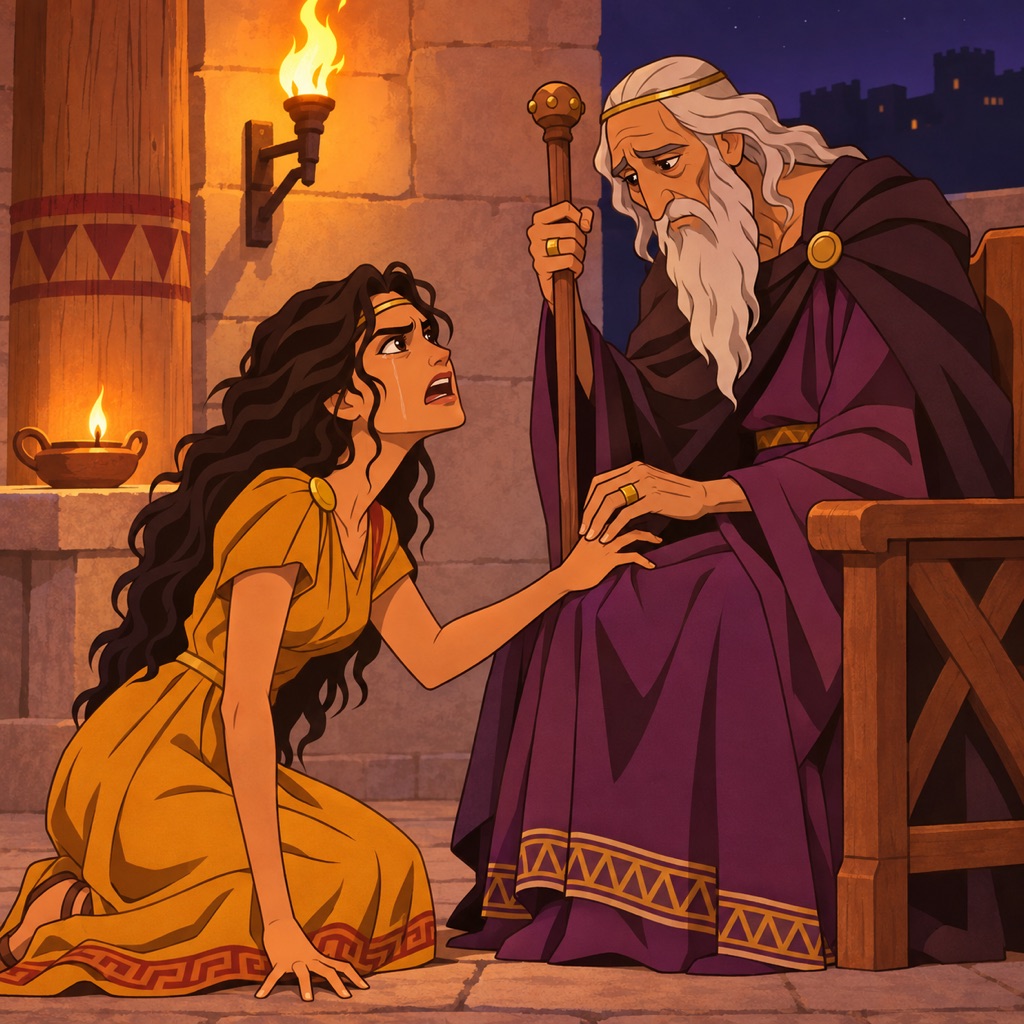
According to the lost epic Cypria, as summarized by the later scholar Proclus, Cassandra was already foretelling disaster at the very start of the story, when her brother Paris built his ships to sail to Sparta. Nobody listened then either. For how Paris came to sail, see the Judgment of Paris and Paris of Troy.
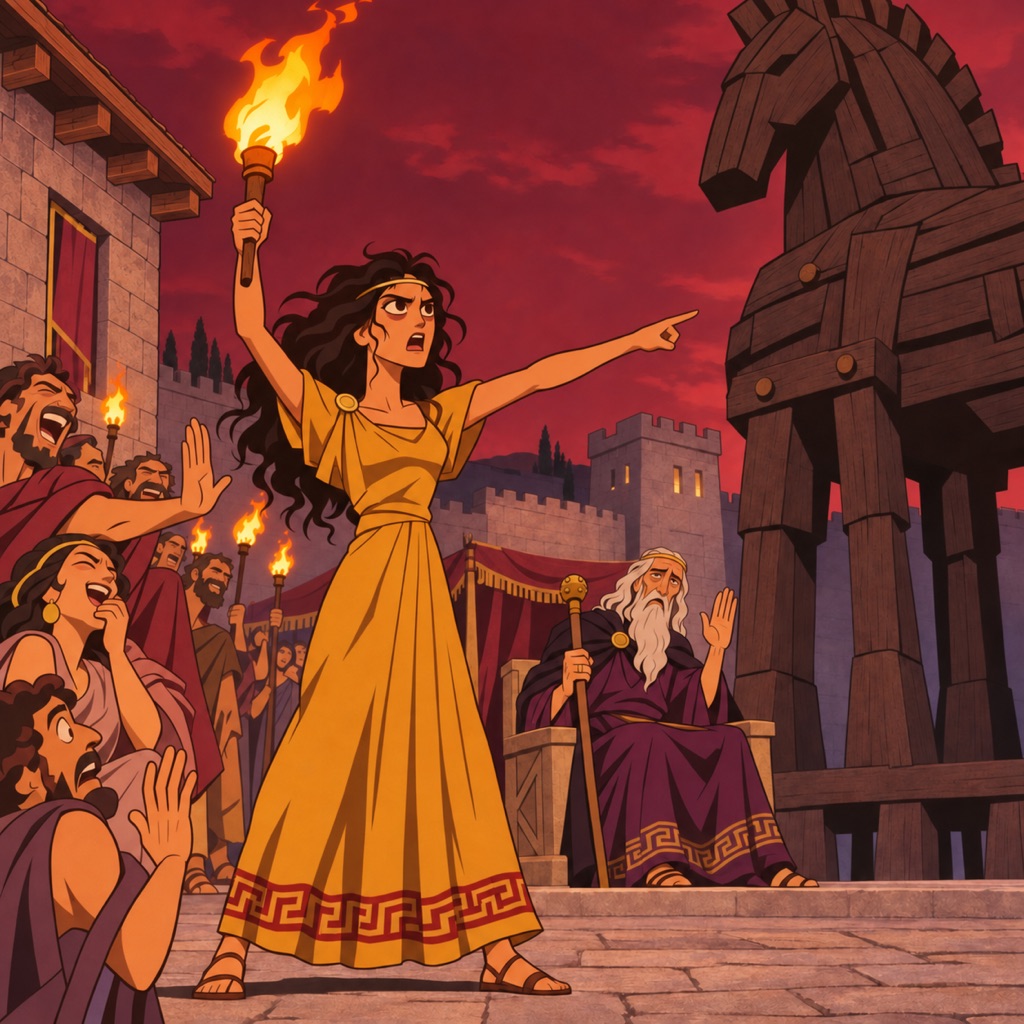
Her most famous warning came ten years later. The Greeks burned their camp, sailed out of sight and left a giant wooden horse on the beach. The Trojans dragged it up to their citadel and argued about what to do with it. In the Odyssey (8.505–510) there are three views: cut it open, throw it off the rocks, or keep it as an offering to the gods. Apollodorus (Epitome 5.17) adds Cassandra. She told them that there was an armed force inside it, and the seer Laocoön agreed with her. They kept it, and they feasted.
The Trojan Horse story most people know, with Laocoön throwing his spear into the horse's side and a Greek named Sinon lying to the Trojans, comes from the Roman poet Virgil (Aeneid Book 2), written in the 20s BCE. Virgil also has Cassandra warn the Trojans, and he says they did not believe her "by the god's command" (2.246–247). The Greek sources have a simpler story. The full version, and the differences between them, are on our Trojan Horse page.
The Night Troy Fell: Ajax at Athena's Statue
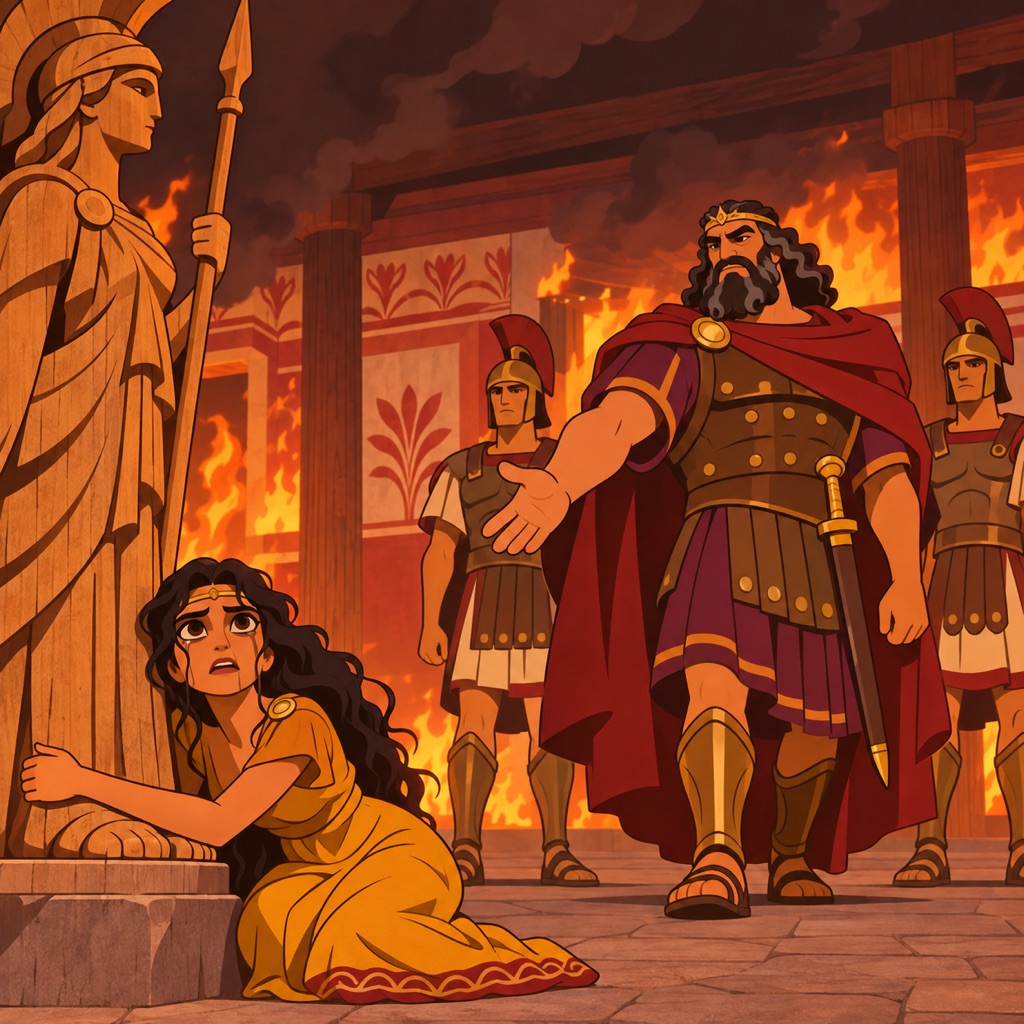
When Troy burned, Cassandra ran to the temple of Athena and held on to the goddess's wooden statue. To a Greek, anyone holding an altar or a god's image was a suppliant under the god's protection. Harming a suppliant was sacrilege.
The lost epic Sack of Troy (in Proclus) says that a Greek warrior, Ajax son of Oileus, dragged her away by force, and pulled the statue over with her. This Ajax is often called Ajax the Lesser, to tell him apart from the giant Ajax who carried the body of Achilles off the battlefield. The scene horrified the Greeks themselves. According to Proclus, the other Greeks wanted to stone Ajax for it, and he saved himself only by taking refuge at Athena's own altar.
Athena did not forgive. The gods' anger over that night falls on the whole Greek fleet on the voyage home. Apollodorus (Epitome 6.6) says Athena struck Ajax's ship with a thunderbolt. In the Odyssey (4.499–511) Ajax survives the wreck and boasts that he escaped in spite of the gods, and Poseidon splits the rock he is clinging to. For a long time afterwards, the legend says, the people of Locris, Ajax's homeland, paid for his crime by sending two girls every year to serve in Athena's temple at Troy (Apollodorus, Epitome 6.20–22). The custom is mentioned by historians, which suggests that some real ritual lay behind the story.
Greek painters loved the scene. A famous Athenian water jar by the so-called Kleophrades Painter, now in Naples, shows Cassandra clinging to Athena's statue in the middle of the sack. The painter Polygnotus put Ajax and Cassandra in his great painting of fallen Troy at Delphi, which Pausanias described (10.26.3).
Some later writers make the crime at the statue worse than an act of dragging. The early Greek sources tell it as sacrilege against Athena, and that is what the Greeks punished.
Taken by Agamemnon
When the captives were shared out, Cassandra went to Agamemnon, the high king of the Greeks, as his prize. In Euripides' Trojan Women (415 BCE), the herald brings the news to her mother Hecuba. Cassandra appears with a torch, half mad, singing a wedding song for herself. Then she makes her prophecies. She says her "marriage" to Agamemnon will destroy him and his house. She also foresees that Odysseus will suffer ten more years before he gets home (lines 431–443). Hecuba's women do not believe a word of it.
The scene makes the curse visible. Everything Cassandra says in Trojan Women comes true later in the legend: Agamemnon dies at home, and Odysseus wanders for ten years.
The Death of Cassandra at Mycenae
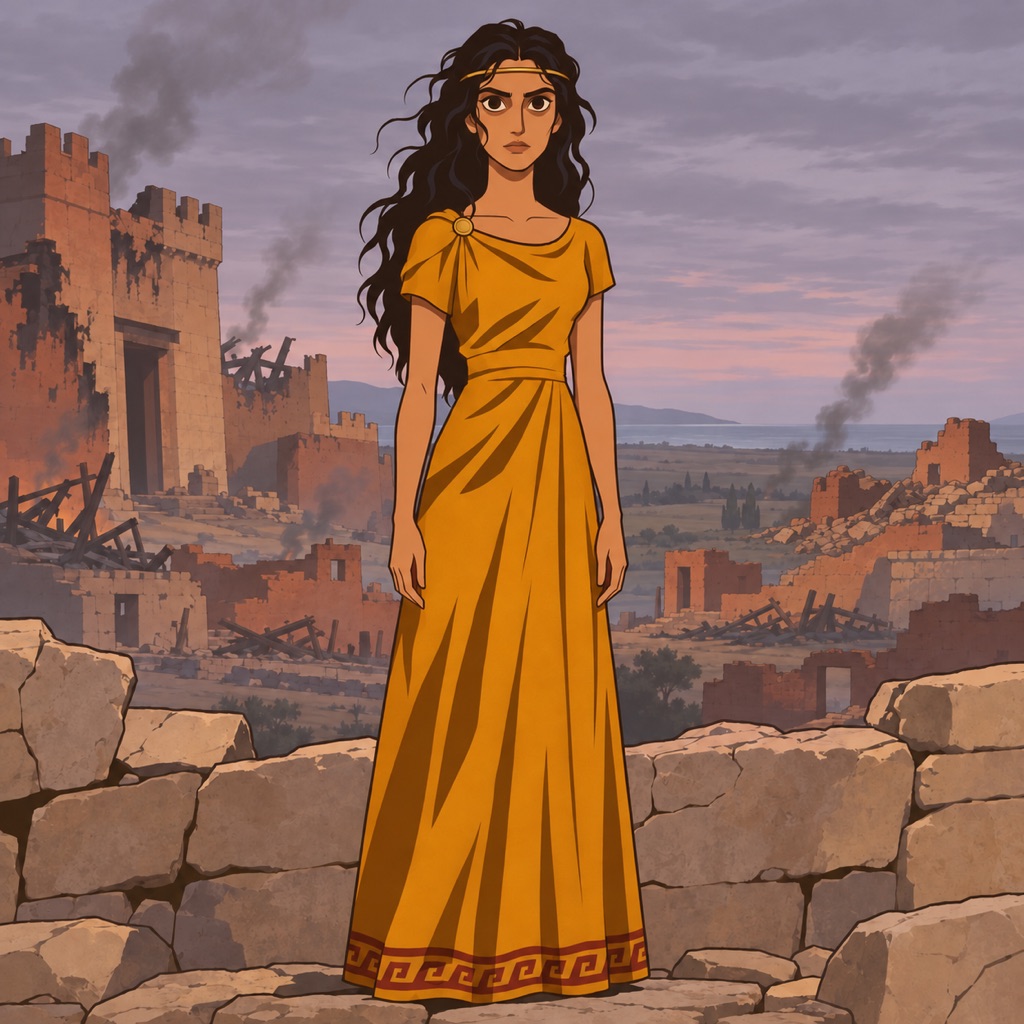
Aeschylus' Agamemnon gives Cassandra her greatest scene. Agamemnon returns to Mycenae in triumph with Cassandra in his chariot. His wife Clytemnestra has never forgiven him for sacrificing their daughter Iphigenia at the start of the war, and she has taken a lover, Aegisthus. She rolls out purple cloth for her husband to walk on into the palace. He goes in. Cassandra stays in the chariot and says nothing.
Then she breaks out into cries to Apollo, the god who ruined her. In a long scene with the chorus (lines 1072–1330) she sees the history of the house: the children of Thyestes murdered and served to their father by Agamemnon's father, generations earlier. Then she sees the future. The king will be killed in his bath, caught in a net of cloth, and she will die beside him. She tells the chorus all of this clearly. They are frightened, they are moved, and they do not understand.
Knowing what is waiting inside, she takes off the prophet's garlands, throws them to the ground and walks into the palace. Soon Agamemnon's death cries are heard from inside. Clytemnestra then appears over the two bodies and boasts that she has killed Apollo's prophet too (1440–1447). The poet Pindar (Pythian 11.19–22) also tells of Clytemnestra killing Cassandra with Agamemnon.
Greeks later disagreed about where Cassandra was buried. Pausanias says Mycenae showed a tomb of Cassandra, and that the people of Amyclae near Sparta claimed hers was there, with a statue and a sanctuary in which she was called Alexandra (2.16.6; 3.19.6). He also records a tradition that she had twin sons by Agamemnon, killed with her.
The "Cassandra" Term in Modern Use
Cassandra's story never stopped being retold. The Hellenistic poet Lycophron wrote a whole dark, riddling poem, the Alexandra, in the form of a guard's report of her prophecies. Shakespeare gives her a scene in Troilus and Cressida, where she cries out against the war and is dismissed as mad. In 1852 Florence Nightingale wrote an essay called Cassandra about the frustration of women whose intelligence society refused to use. The German novelist Christa Wolf retold the fall of Troy from Cassandra's point of view in Kassandra (1983).
The name also became a term. The French philosopher Gaston Bachelard wrote of a "Cassandra complex" in 1949, and the psychoanalyst Melanie Klein used Cassandra in a 1963 essay on the Oresteia. Today "a Cassandra" means anyone whose true warnings are ignored: an economist who sees a crash coming, a scientist warning about a risk the public is not ready to hear, an engineer who flags a fault before the disaster. Sometimes the word is used unfairly, for people who are simply gloomy. In the myth, the point is that she was right every time.
Few figures in Greek myth have had less control over their own lives. A god gave her a gift and ruined it. Her family loved her and ignored her. A Greek soldier dragged her from a goddess's statue, a king took her as a prize, and a queen killed her. Through all of it, the Greek writers who told her story agreed on one thing: everything she said was true.
For the whole war in which her warnings went unheard, see the Trojan War and the Iliad summary. For the poet who first named her, see Homer, and for the woman whose arrival started it all, Helen of Troy. The wider world of these stories is at Ancient Greece.
Frequently Asked Questions
1Who was Cassandra in Greek mythology?
Cassandra was a princess of Troy, a daughter of King Priam and Queen Hecuba. In the legend Apollo gave her the gift of prophecy and then cursed her so that no one would believe what she foretold. She warned the Trojans about the wooden horse, was taken by Agamemnon after Troy fell, and was killed with him at Mycenae.
2What was Cassandra's curse?
In Aeschylus' Agamemnon and in Apollodorus, Apollo gave Cassandra the power of prophecy because he desired her. When she refused him, he could not take the gift back, so he made sure no one would ever believe her prophecies.
3Did Cassandra warn Troy about the Trojan horse?
Yes. According to Apollodorus, she told the Trojans that an armed force was hidden inside the horse, and the seer Laocoön agreed. The Trojans kept it anyway. The Roman poet Virgil also includes her warning in the Aeneid.
4What happened to Cassandra after the fall of Troy?
The lost epic Sack of Troy says Ajax son of Oileus dragged her from the statue of Athena, an act of sacrilege that brought Athena's anger on the Greek fleet. She was then given to Agamemnon as his prize. In Aeschylus' Agamemnon she goes with him to Mycenae, foresees their deaths, and is killed alongside him by his wife Clytemnestra.
5Does Cassandra appear in the Iliad?
Yes, briefly, but not as a prophet. Homer calls her the loveliest of Priam's daughters and has her be the first to see Priam bringing Hector's body home. In the Odyssey, Agamemnon's ghost remembers hearing her cry as Clytemnestra killed her.
6What does it mean to call someone a Cassandra?
It means someone who gives accurate warnings that nobody believes or acts on. The term comes from the Trojan princess of the myth, and psychologists and writers have spoken of a 'Cassandra complex' since the mid-20th century.
Hear Cassandra's Warning
The horse on the beach, the argument on the citadel and the voice nobody believed: hear the last night of Troy in the Walls of Troy chapter of Histolumo.


Hear Their Story
Voices in the Horse
5 minCassandra screams that the horse is full of soldiers. The Trojans laugh, and drag it inside.

Related Articles
The Trojan Horse: The Real Story
The Trojan Horse real story, from Homer and the lost epics: who built it, who hid inside, Cassandra's warning, Helen's trick, and whether a horse ever existed.
Trojan War Summary: The Whole Story
Trojan War summary in order: the golden apple, Helen and Paris, Achilles and Hector, the wooden horse and the fall of Troy, with a timeline and the archaeology.
Was Troy Real? What Archaeologists Found
Was Troy real? Yes: a Bronze Age city at Hisarlik in Turkey burned around 1180 BCE. Whether a Greek army burned it is still one of archaeology's big debates.
Experience Cassandra of Troy's Story
Go beyond the biography. Hear Cassandra of Troy's story told by Lumo, your immortal wolf guide who witnessed these events firsthand.